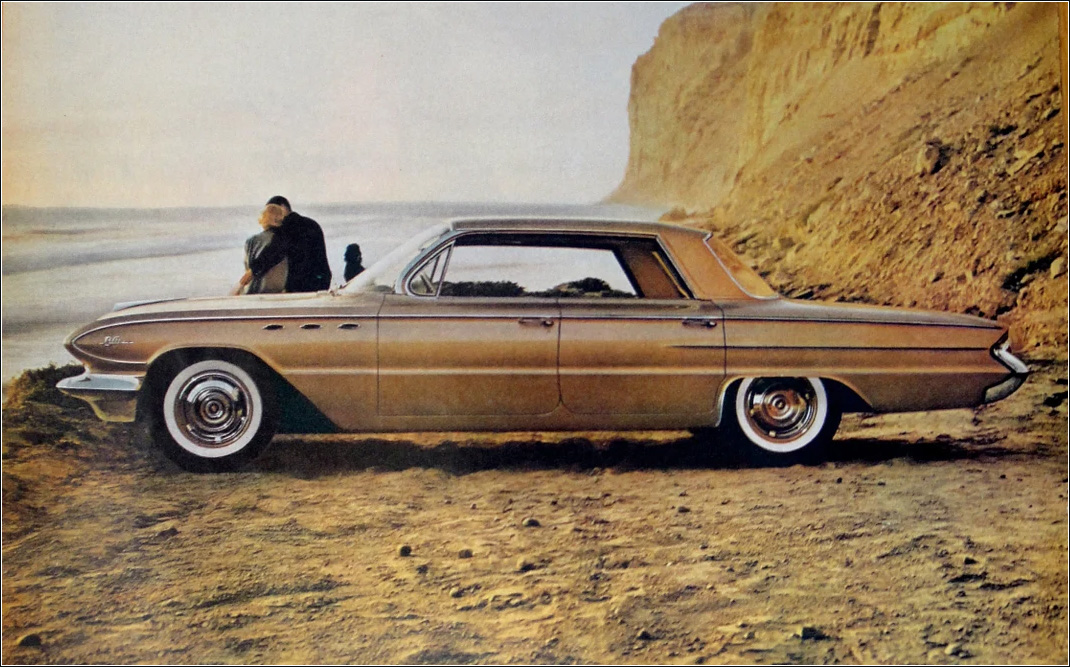
My dear Mom makes sure I get a car calendar at the new year and this February the model is a 1961 Buick LeSabre. This car ushered in a new style for GM and changed how we thought about cars in the ’60’s.
LeSabre and all other full-sized Buicks were completely restyled for 1961 featuring finless rear ends, more restrained use of chrome, and boxier sheetmetal. Wheelbases remained at 123 inches (3,100 mm) but the new cars were slightly downsized in both length and width, and rode on a new X-frame chassis which included a conventional rear axle and driveshaft replacing the decades-old torque tube design. Inside were revised instrument panels retaining the “Mirrormatic” speedometer and new upholstery trims.
The 401ci Nailhead V8 engine in a 1964 Buick Wildcat. “Wildcat 445” is the name of this engine, with “445” referring to the engine’s torque (in foot-pounds).
Wildcat 445
1961 Buick LeSabre gallery
LeSabres were rear-drive six-passenger vehicles from 1959 to 1985 (station wagons through 1990) featuring separate body-on-frame construction along with a longitudinally mounted front engine. The first downsized generation of LeSabres introduced in 1977 retained the rear-drive and body-on-frame construction, while the later-generation models introduced in 1986 switched to front-wheel-drive, unit-body construction and transversely mounted engine. Convertibles were offered each year through 1975 while two- and four-door hardtops were dropped after 1976 and only pillared body styles were offered from 1977 to 2005. Station wagons were offered through 1964 and then dropped for several years until being reintroduced in 1970 and continued until 1990 after which year they were moved to the revived Roadmaster series. LeSabres come in two versions: Custom and Limited.
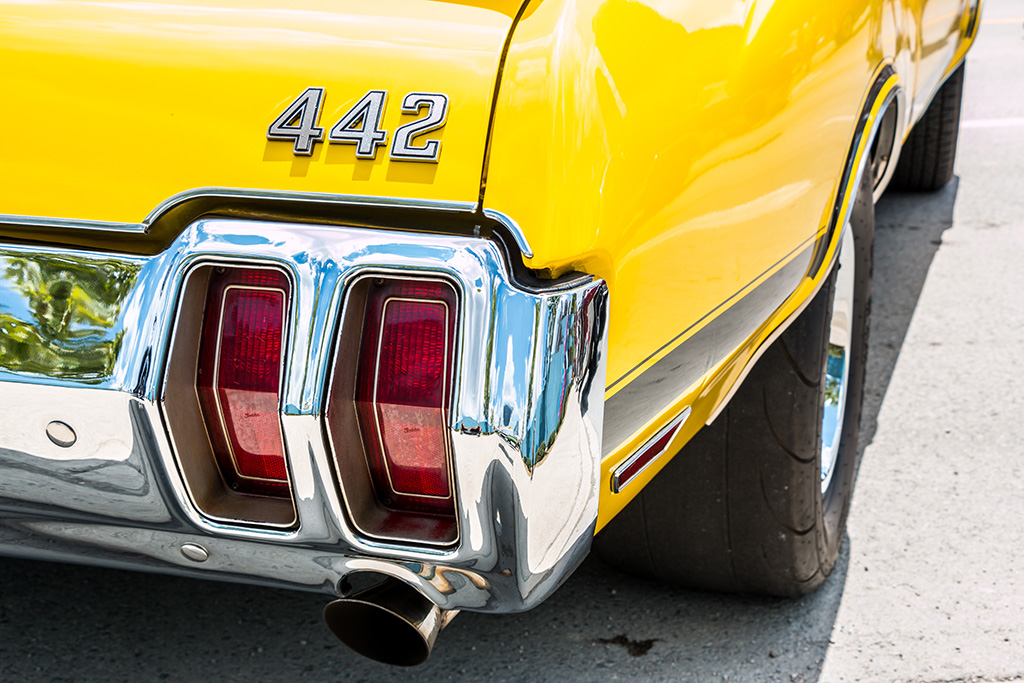
Whenever I see the time on a digital clock of 4:42 I think of my good friend Kim. He was a couple years older than me and in high-school he was the guy we looked up to. Kim had the hottest girlfriends, lived in the best neighbourhood, in the best house, with the best pool. On top of everything else, Kim was cool and he also owned the coolest muscle car; a 442.
Oldsmobile 442
Oldsmobile 442 – began as a 1964 muscle car option package (4-barrel carburetor, 4-speed manual transmission, and 2 exhausts) on the F-85/Cutlass. In 1965, to better compete with the Pontiac GTO, the original 330 CID V8 rated at 310 hp (231 kW) was replaced by a new 400 CID V8 rated at 345 hp (257 kW).
The 442 definition was changed to “4” hundred CID V8 engine, “4”-barrel carburetor, and “2” exhaust pipes, and was named by “Car Craft Nationals” as the “top car of 1965”. In 1968 the 442 became its own model and got a larger, 455 CID (7.5 L), V8 engine in 1970.
The Oldsmobile 4-4-2 (also known as the 442) is a muscle car produced by Oldsmobile between the 1964 and 1987 model years. Introduced as an option package for US-sold F-85 and Cutlass models, it became a model in its own right from 1968 to 1971, spawned the Hurst/Olds in 1968, then reverted to an option through the mid-1970s. The name was revived in the 1980s on the rear-wheel driveCutlass Supreme and early 1990s as an option package for the new front-wheel driveCutlass Calais.
The “4-4-2” name (pronounced “Four-four-two”) derives from the original car’s four-barrel carburetor, four-speed manual transmission, and dual exhausts (Some maintain that the ‘2’ indicated a limited-slip differential). It was originally written “4-4-2” (with badging showing hyphens between the numerals), and remained hyphenated throughout Oldsmobile’s use of the designation.
Beginning in 1965, the 4-4-2s standard transmission was a three-speed manual along with an optional two-speed automatic and four-speed manual, but were still badged as “4-4-2″s. Because of this change, from 1965 on, according to Oldsmobile brochures and advertisements, the 4-4-2 designation referred to the 400 cubic inch engine, four-barrel carburetor, and dual exhausts.
By 1968 badging was shortened to simply “442”, but Oldsmobile brochures and internal documents continued to use the “4-4-2” model designation.
The year was 1969, my Dad’s friend was the proud owner of a new Mustang GT Fastback. We had the most amazing ride along Skaha Lake and the memory has never left me. At 8 years old the love of cars is already ingrained, we had Hot-Wheels miniature model cars of race cars.
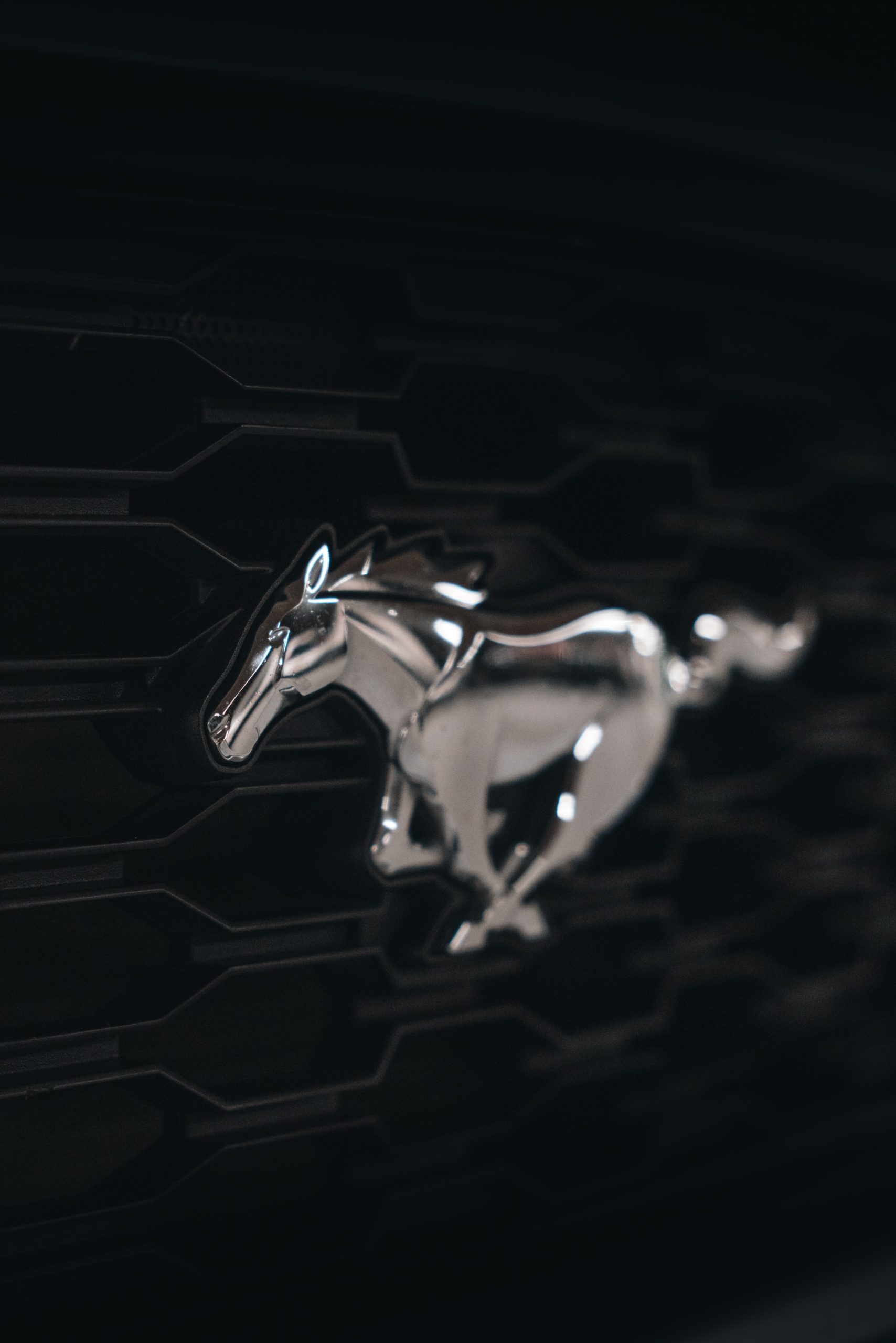
Ford Mustang is pure America, iconic and romantic. The muscle car made by Ford was then the GT and 1969 was the last year for the fastback. It was a hot summer day and we had the windows open and cruised the back road of Skaha Lake like we were on a secret mission. That Mustang could accelerate like nothing we had ever experienced before, we were gleeful.
Mustang Sally is a great old rock song, made famous by the movie called the “The Commitments”. Every time I here that song it reminds me of the hot summer day in the summer of 1969 going over 100 miles per hour in the blink of an eye, being sucked back into the leather seats of the hottest car I had ever seen.
Decades later I rented a Mustang GT at Miami International Airport, it was all mine for 7 days.
Alligator Alley crosses the Everglades of Florida at the southernmost point, it’s the longest straightest road I know and late one night I put the pony to the test. After about 120 miles per hour it would feel like the car was floating through the air, what’s most amazing though is that my foot was holding the peddle to metal and the car was still accelerating. I had to let off, also it’s legend that alligators do come out and cross the road at night and at that speed it’s certain death.
Ford Mustang Mach-E Deliveries Now Underway In China
As Ford Authority reported earlier this year, the Ford Mustang Mach-E is manufactured by Changan Ford – a 50:50 joint venture between Changan Automobile and Ford Motor Company – in China for local customers, as opposed to the Ford Cuautitlan Assembly Plant in Mexico, which produces the Mach-E for North America and Europe. Order banks opened up back in April, after which the first Chinese Mach-E rolled off the assembly line back in October, and now, deliveries of the Ford Mustang Mach-E have begun in China, according to the automaker.
The very first Mach-E deliveries took place in China just yesterday. One of the very first to take possession of the EV crossover was ad executive and Mustang fan Jin Zhang, who was handed the keys to his new Mach-E by Mark Kaufman, general manager, Ford China BEV Division. Zhang reportedly plans on using his Mach-E to haul his family around town.
As Ford Authorityreported back in July, Ford created a total of 25 dedicated Mach-E stores in Chinese metropolitan markets as it establishes its direct-sales model in the country. The first Mach-E store opened in Shanghai back in May, which was followed by locations in Shanghai, Suzhou, Chongqing, Beijing, Qingdao, Shenzhen, Chengdu, and Dongguan, to name a few.
There was a lot of reasons why the “Car” category was added to this blog. One reason is my love of design and style, everyone has their own taste but all have a “Dream Car”. For some it’s because of where it can take them, for some it’s how fast, and others how cool. Cars are part of our world and reflect our style. Everyone has a dream car.
In my experience, to own a car is not actually fun, after the first drive the thrill can start to fade. Only your dream car can be as exhilarating every time you turn the key. Here’s the thing though, keys are a thing of the past and soon combustion engines will be obsolete too. Blogging about collector cars was also one of the reasons for adding “Cars” as a category here.
The Dream Car Challenge is to consider what car you would own today, if you could choose any fossil fuel car in the world BUT that had to be the last car you would ever own?
Electric cars are the future, I get it. Currently I prefer gas engines, or diesel engine trucks. Most likely in the real world, I would choose a GMC Sierra HD pick-up truck. Also, I don’t believe clean energy is clean, e-cars are more damaging to the environment than fossil fuel and Canada has infinite amounts of fuel. This is a challenge in a dream, so it’s about “which car” that burns gas.
Before I tell you my “Dream Car” it’s important to mention, I’ve not owned a car (by choice) for 5 years. Living in a city there’s no need and for the first time in 42 years, there’s no parking or maintenance. Life is much better by bicycle and I prefer not owning a car. Plus, I believe anti-gravity flying cars are just 2 years away.YES! I do want a flying car, especially with Zero-point energy but that’s another story for another day.
My Dream Car Challenge Choice
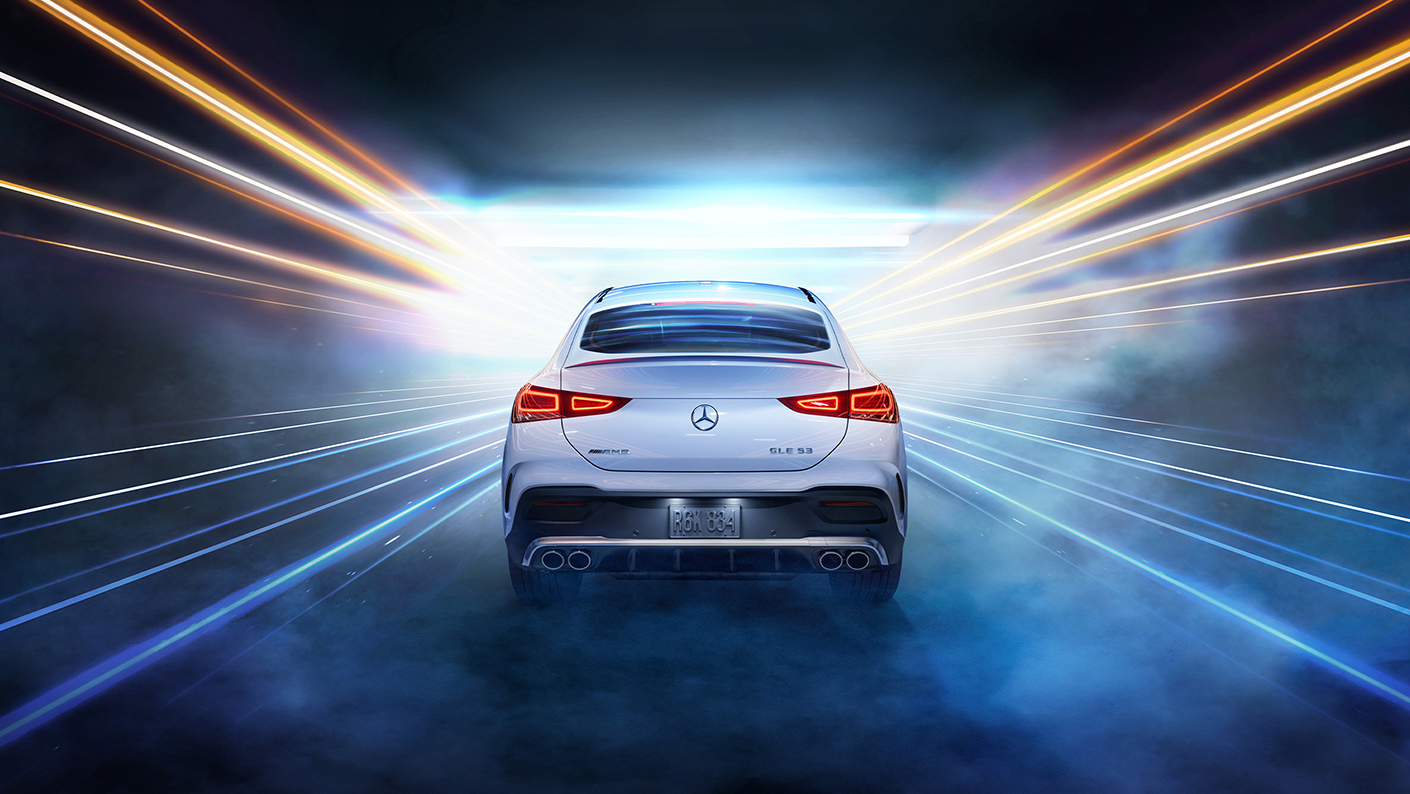
The reason I would choose Mercedes Benz AMG GLE 53 Coupe is mainly because of how well they age and how dependable they are. The choices narrow for me because British Columbia has long hard winters and I like to drive in the mountains when I travel, so all-wheel drive is important. Now’s the time when Janis Jopplin should be singing “oh Lord won’t you buy me, a Mercedes Benz, all my friends drive Porshes, I must make amends”.
Ironic that we often remark about how quiet it is riding in great cars, yet electric cars are bizarre quiet and not as much fun without the sound of the 429 hp turbo inline 6 cylinder engine, when you rev the gas. Electric cars are not as fun, although they accelerate just as fast.
The soul of a sports car, the skills of an SUV, and the elegance of a coupe unite to accelerate the pulse rate of Mercedes passion. If it were the last fossil fuel car I ever own, it would be the classic silver with black interior; Mercedes Benz AMG GLE 53 Coupe.
The Last Dream Car
The reason this is relevant; if you buy a gas guzzler now, it may be the last you ever own. My only other Mercedes was already old when I bought it in Miami, perhaps it was cruising to Key West that made me love the feel of the German land yacht. That car was like a dream to drive on the A1A, one more would be a charm. Dream on!
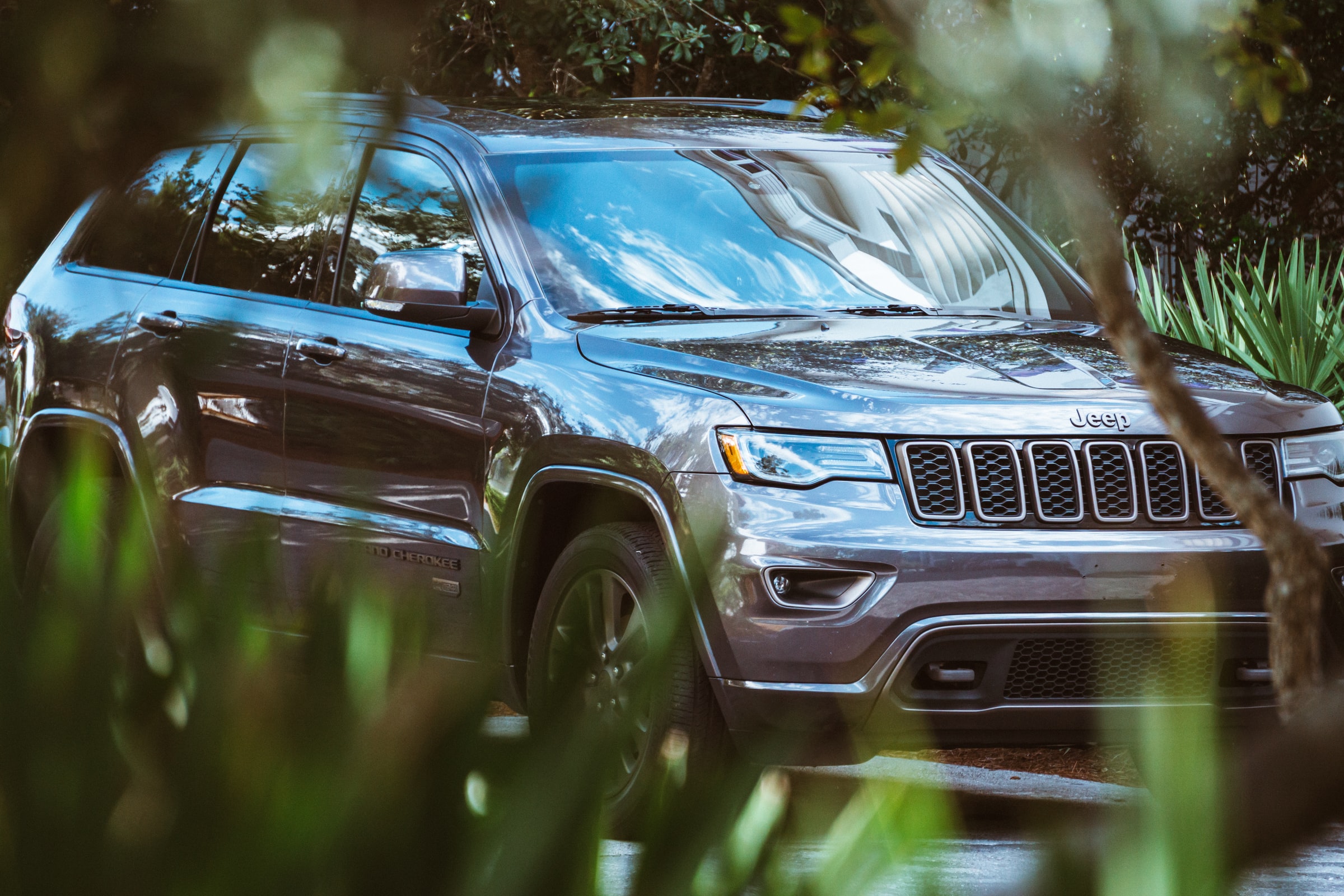
Jeep respectfully declined dropping the Cherokee name for it’s famous U.S. Auto brand. For this corporate courage we salute the automaker of this legendary driving experience, enjoyed by car enthusiasts all over the world. Jeep Grand Cherokee set the first standard for luxury sport utility and may have even been the inventor of the modern day SUV.
American Indians, or whatever the politically correct term for the indigenous people of America, are proud of these brands like the Cleveland Indians or Chicago Blackhawks and all people of the world are sadden by the woke culture of political correctness. We wish to remember and honor the American Indians, like the famous Indian motorcycle, as the symbol of superior toughness and endurance. It is wrong to diminish heritage.
The Grand Cherokee’s origins date back to 1983 when American Motors Corporation (AMC) was designing a successor to the smaller Jeep Cherokee (XJ). Three outside (non-AMC) designers—Larry Shinoda, Alain Clenet, and Giorgetto Giugiaro—were also under contract with AMC to create and build a clay model of the Cherokee XJ replacement, then known as the “XJC” project. However, the basic design for the Cherokee’s replacement was well under way by AMC’s in-house designers and the 1989 Jeep Concept 1show car foretold the basic design.
As AMC began development of the next Jeep in 1985, management created a business process that is now known as product lifecycle management (PLM). According to François Castaing, Vice President for Product Engineering and Development, the smallest U.S. automaker was looking for a way to speed up its product development process to compete better against its larger competitors. The XJC’s development was aided by computer-aided design (CAD) software systems making the engineers more productive. Meanwhile, new communication systems allowed potential conflicts to be resolved faster, thus reducing costly engineering changes, because all drawings and documents were in a central database. The system was so effective that after Chrysler purchased AMC in 1987, it expanded the system throughout its enterprise, thus connecting everyone involved in designing and building products.
The Grand Cherokee thus became the first Chrysler-badged Jeep product. Development work for the new Jeep model continued and Chrysler’s employees (after the 1987 buyout of AMC) were eager for a late-1980s release date; however, CEO Lee Iacocca was pushing for redesigned Chrysler minivans, thus delaying the Grand Cherokee’s release until late 1992 as an Explorer competitor. Unlike the Explorer, the Grand Cherokee utilized monocoque (unibody) construction, whereas the Explorer was a derivative of the Ranger pickup with a separate body-on-frame.
Production of the Grand Cherokee started shortly afterward in the purpose-built Jefferson North Assembly in Detroit, Michigan. European Grand Cherokees are manufactured in Austria by Magna Steyr. The Grand Cherokee “played a significant part in reviving Chrysler’s fortunes by moving it into the then nascent market for high-margin sports utility vehicles.”
Upon its introduction, it was the first full-scale manufacture of an automobile in the US using HFC-134a refrigerant in place of HCFC-12 for the HVAC system.
European design has always captured our collective imaginations and there was a time when “sports” car referred to European brands like Audi, Austin Martin, Bavarian Motor Works (BMW), Bugatti, Ferrari, Lamborghini, Mercedes Benz, MGB and the iconic Porshe.
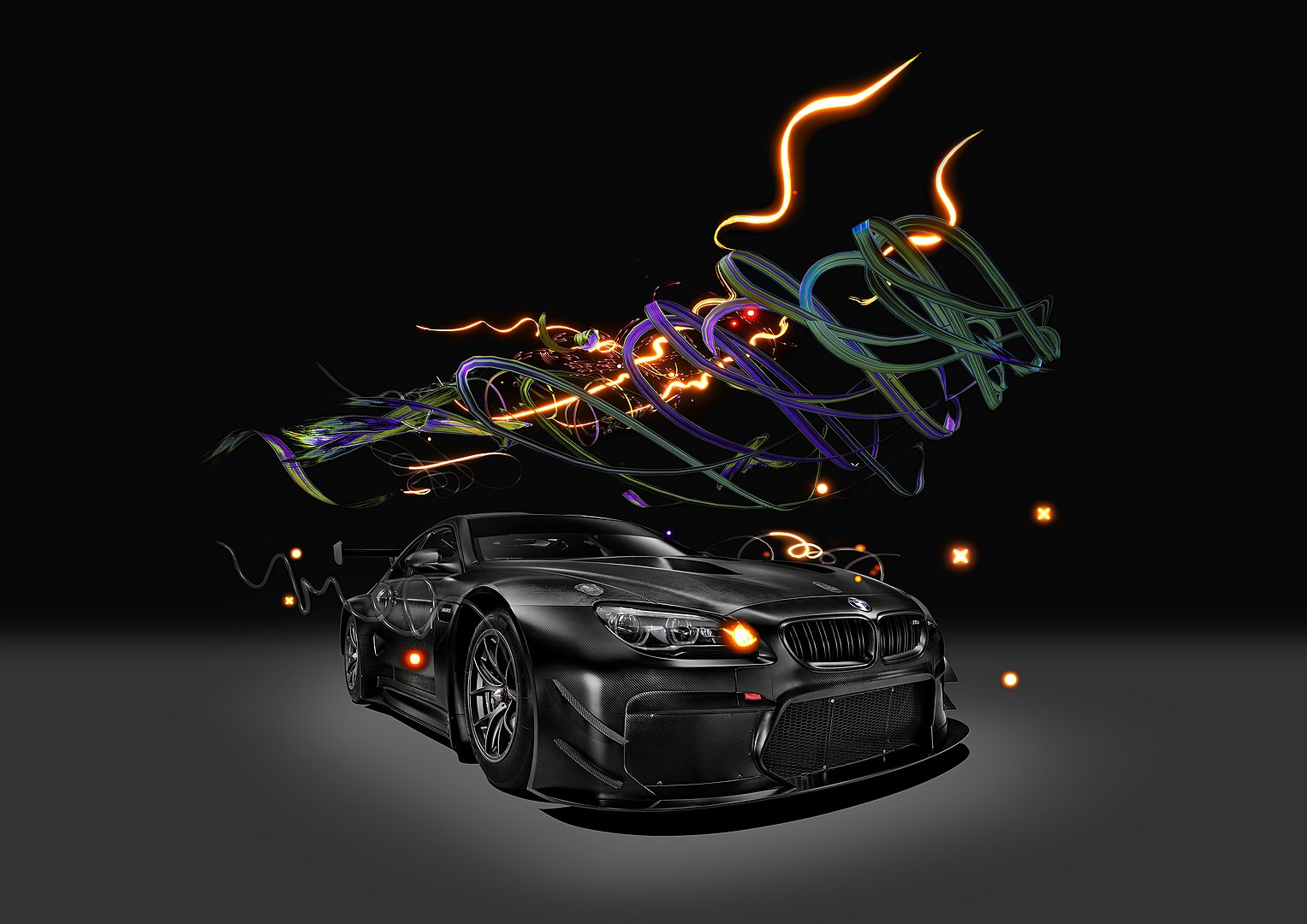
Cars was added recently to this blog and since then only American models have been posted to date, so I decided to feature arguably the finest automaker and one of the worlds greatest car maker – BMW –
Bavarian Motor Works
BMW dates back to 1913, when the original company to use the name was founded by Karl Rapp (initially as Rapp Motorenwerke GmbH). BMW’s first product was a straight-six aircraft engine called the BMW IIIa. Following the end of World War I, BMW remained in business by producing motorcycle engines, farm equipment, household items and railway brakes. The company produced its first motorcycle, the BMW R 32 in 1923.
BMW became an automobile manufacturer in 1928 when it purchased Fahrzeugfabrik Eisenach, which, at the time, built Austin Sevens under licence under the Dixi marque. The first car sold as a BMW was a rebadged Dixi called the BMW 3/15, following BMW’s acquisition of the car manufacturer Automobilwerk Eisenach. Throughout the 1930s, BMW expanded its range into sports cars and larger luxury cars.
Aircraft engines, motorcycles, and automobiles would be BMW’s main products until World War II. During the war, against the wishes of its director Franz Josef Popp, BMW concentrated on aircraft engine production using forced labor consisting primarily of prisoners from concentration camps, with motorcycles as a side line and automobile manufacture ceased altogether.
BMW’s factories were heavily bombed during the war and its remaining West German facilities were banned from producing motor vehicles or aircraft after the war. Again, the company survived by making pots, pans, and bicycles. In 1948, BMW restarted motorcycle production. BMW resumed car production in Bavaria in 1952 with the BMW 501 luxury saloon.
The range of cars was expanded in 1955, through the production of the cheaper Isetta microcar under licence. Slow sales of luxury cars and small profit margins from microcars meant BMW was in serious financial trouble and in 1959 the company was nearly taken over by rival Daimler-Benz. A large investment in BMW by Herbert Quandt and Harald Quandt resulted in the company surviving as a separate entity. The BMW 700 was successful and assisted in the company’s recovery.
The 1962 introduction of the BMW New Class compact sedans was the beginning of BMW’s reputation as a leading manufacturer of sport-oriented cars. Throughout the 1960s, BMW expanded its range by adding coupe and luxury sedan models. The BMW 5 Series mid-size sedan range was introduced in 1972, followed by the BMW 3 Series compact sedans in 1975, the BMW 6 Series luxury coupes in 1976 and the BMW 7 Series large luxury sedans in 1978.
The BMW M division released its first road car, a mid-engine supercar, in 1978. This was followed by the BMW M5 in 1984 and the BMW M3 in 1986. Also in 1986, BMW introduced its first V12 engine in the 750i luxury sedan.
The company purchased the Rover Group in 1994, however the takeover was not successful and was causing BMW large financial losses. In 2000, BMW sold off most of the Rover brands, retaining only the Mini brand.
In 1998, BMW also acquired the rights to the Rolls Royce brand from Vickers Plc.
The 1995 BMW Z3 expanded the line-up to include a mass-production two-seat roadster and the 1999 BMW X5 was the company’s entry into the SUV market.
The first modern mass-produced turbocharged petrol engine was introduced in 2006, (from 1973 to 1975, BMW built 1672 units of a turbocharged M10 engine for the BMW 2002 turbo), with most engines switching over to turbocharging over the 2010s. The first hybrid BMW was the 2010 BMW ActiveHybrid 7, and BMW’s first mass-production electric car was the BMW i3 city car, which was released in 2013, (from 1968 to 1972, BMW built two battery-electric BMW 1602 Elektro saloons for the 1972 Olympic Games). After many years of establishing a reputation for sporting rear-wheel drive cars, BMW’s first front-wheel drive car was the 2014 BMW 2 Series Active Tourer multi-purpose vehicle (MPV).
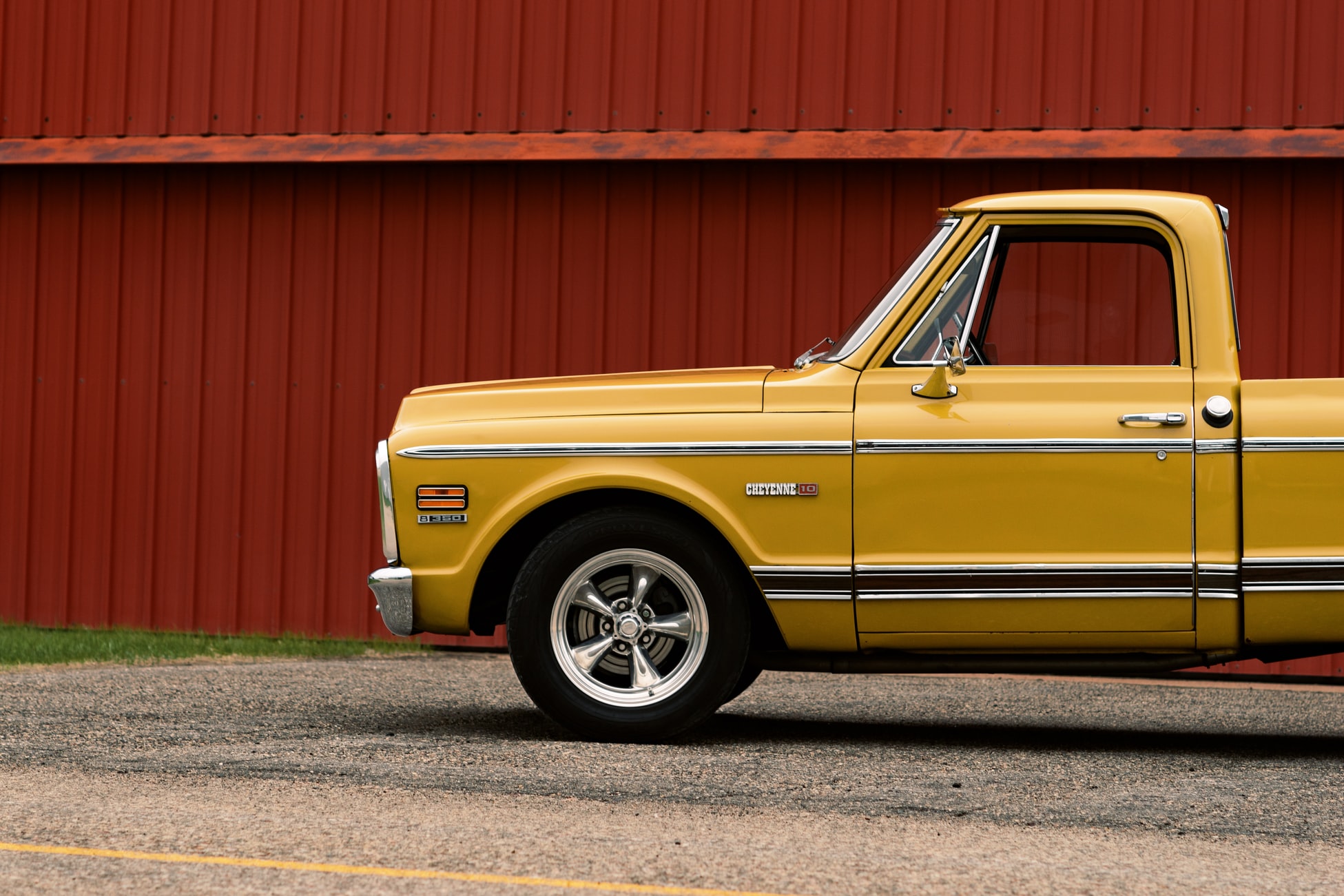
Chevy Trucks Rock in order to avoid spinning this blog into a new age spiritual platform direction, or too many scriptural type post, since I have a tendency of late to be in this armor of God sort of mindset. This armour of steel can act as an antidote.
My favourite thing for a couple of decades was a Chevy half ton with high performance small block 327 with four barrel carburettor, headers and dual exhaust, at good suspension and fat tires. All that’s missing is a killer stereo in the cab and a tank of gas.
Trucks are a real Dude thing, especially in the west of America. In Western Canada trucks are the most vehicle you’ll see, as soon as you leave the city. Every small town will have a truck parked in front of each house and the further north you go, the more percentage of trucks you see.
In the far north of Canada, the truck dealerships are gold mines and make more money than any other type of business, since people will walk in the door and have a pay check in one hand and a bank loan in the other. They sell trucks, during a boom time, like they were skateboards.
Chevy Colorado Z71
Most people are either Ford or Chevy but there still remains a hard-core Ram owners club and a growing Toyota crowd, plus many other good makes delivering that truck experience us Dude’s seek. It’s where they can take us, what we can take with us, and how good we feel getting there.
My first truck was a Ford but after that nothing but Chevy, a total of four, two of which were 4×4. That one had a sun roof too and was a real beauty, ran all those trucks for thousands of miles all over western Canada and drove one to Ontario, where I sold it for more than I paid.
The Car calendar on my wall in my office is showing a 1966 Chevelle convertible in blue, with a 396. The car in the photo (below) is a 1968 from Montreal, Quebec but I couldn’t find the blue beauty from my calendar.
As a teenager the first muscle car I went for rides in was this Chevy with a 396 four speed. I smile just thinking about it and can almost smell the burning rubber, as it’s owner liked to light up his tires for any reason.
Swing low, sweet chariot.
This carriage later became the famous Monte Carlo and Malibu, as the body style changed several times over the decades. The Chevelles of the 60’s were really nice cars, I enjoyed a cruise to Seattle once, following the Okanogan river and across the border at Orville, Washington, then on down the valley and then over the Cascade Range. It was August and we had the top down the entire way, in the convertible model, yellow with white leather seats.
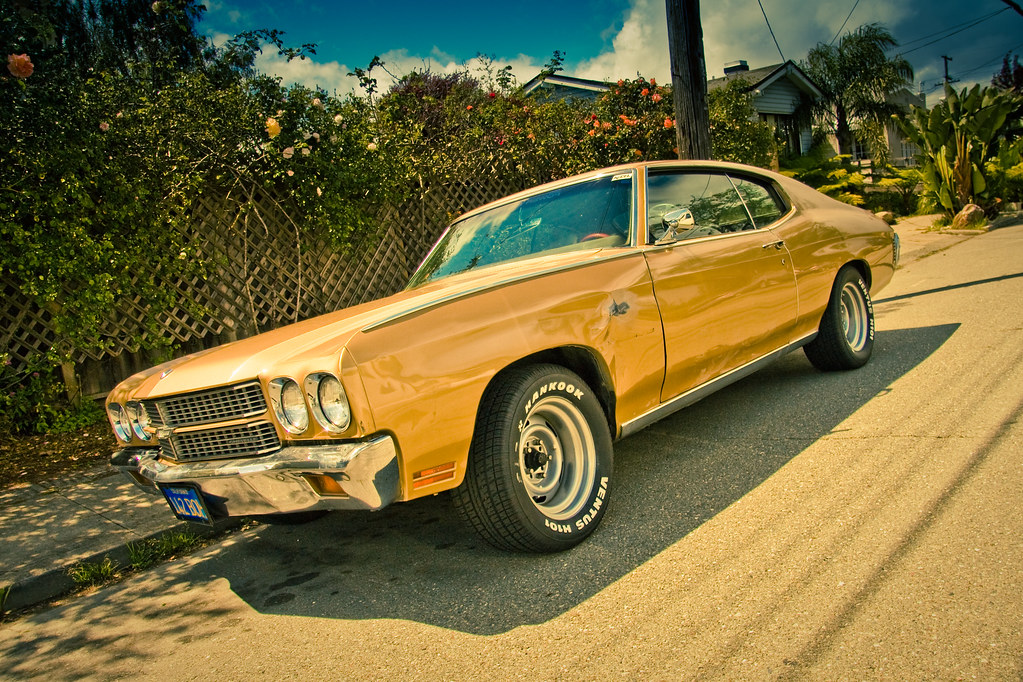
My friends muscle car was a 1970 coupe, as pictured
The Chevrolet Chevelle is a mid-sized automobile which was produced by Chevrolet in three generations for the 1964 through 1977 model years. Part of the General Motors (GM) A-Body platform, the Chevelle was one of Chevrolet’s most successful nameplates. Body styles include coupes, sedans, convertibles and station wagons. Super Sport versions were produced through the 1973 model year, and Lagunas from 1973 through 1976. After a four-year absence, the El Camino was reintroduced as part of the new Chevelle lineup in 1964. The Chevelle also provided the platform for the Monte Carlo introduced in 1970. The Malibu, the top of the line model through 1972, completely replaced the Chevelle nameplate for the redesigned, downsized 1978 model year.
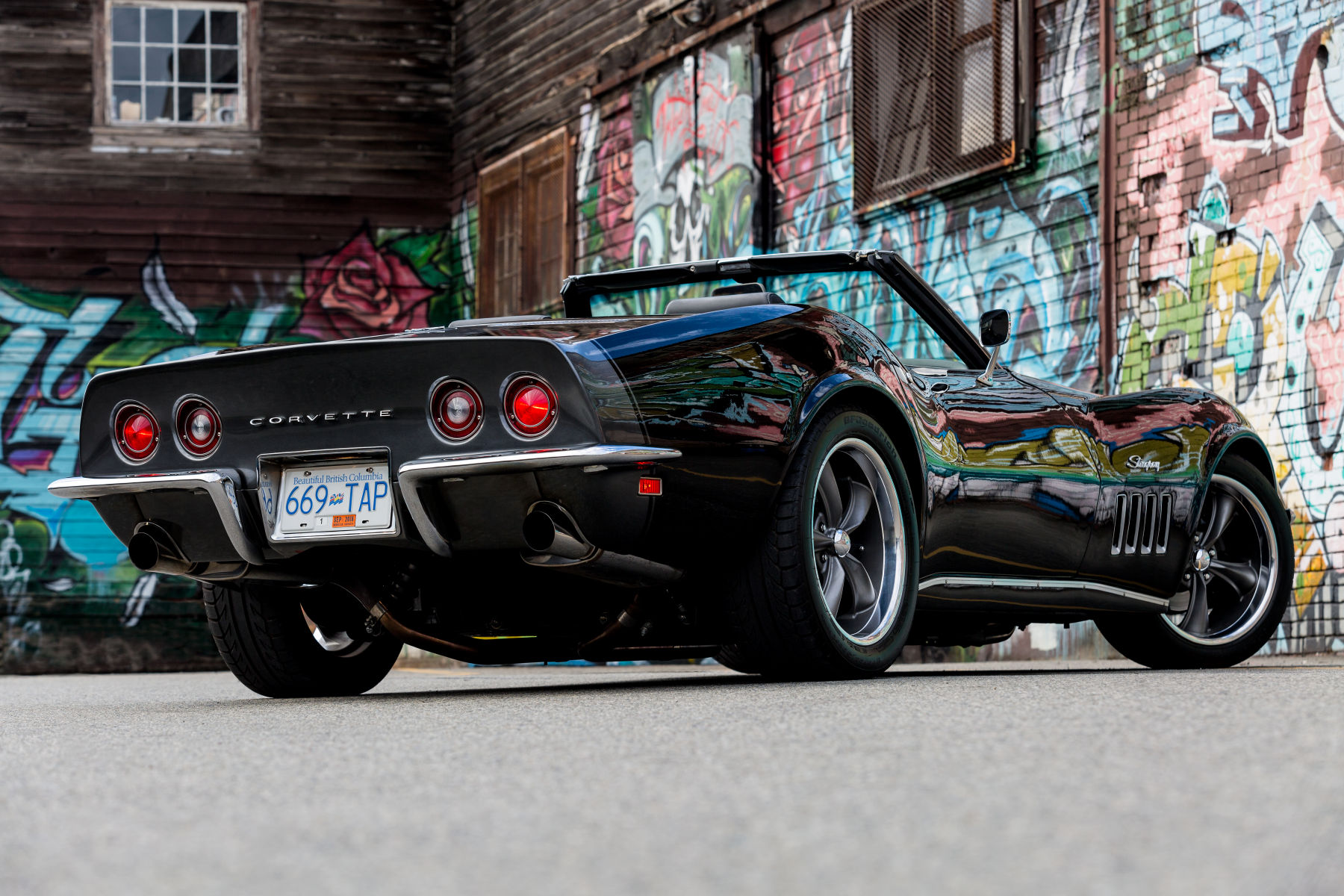
On the wall in my office is the above photo of a 1969 Chevrolet Corvette stingray, convertible. This outstanding photo, taken against graffiti in Vancouver, is poster child for the month of June in my 2019 calendar. The photo is by Gavin Mah for a custom car company called EFI and was included in the yearly calendar of an auto insurance company.
Today I add the category “Cars” to this blog, so that I could add these photos and admit to my love of autos. I’ve never owned a stingray and probably never will but I’ve driven a few, including a 1969 convertible, and rented a ZR1 Grand Sport for a week in California, and drove the “Pines to the Palms” hwy from Palm Springs to San Diego, then back to Malibu and LA.
EFISystemPro.Com is one of the Cyberspace Automotive Performance (CyberAuto) family of automotive performance websites. CyberAuto was the first auto parts store on the Internet back in 1993 and now includes a long legacy of world-class automotive performance websites, including Racing Seats USA and Fuel-Pumps.Net.
Looking at this photo every day and admiring that amazing muscle car all month (so far), today rather than add the story to “Design” category, which is where is really could belong. I was reluctant to add “Cars” as a category because it’s one of my temptations, along with women, that I try not to lust after.
These 60’s muscle car photos are meant to inspire people of a great car era. The Chevrolet Corvette is arguably the only American sports car, you would have had to drive one to understand what I mean, these are really fun cars to drive. Combustion engines created some really radical designs and very cool style for a carriage.
The 4 photos are borrowed from the gallery here: EFISystemPro.com
The Chevrolet Corvette, colloquially known as the Vette or Chevy Corvette, is a front engine, rear drive, two-door, two-passenger sports car manufactured and marketed by Chevrolet across more than sixty years of production and seven design generations — with GM confirming in early 2019 an eighth generation Corvette in a mid-engine configuration. With its generations noted sequentially from C1-C8, the Corvette serves as Chevrolet’s halo vehicle and is widely noted for its performance and distinctive plastic — either fiberglass or composite — bodywork.
In 1953, when GM executives were looking to name the new Chevrolet sports car, assistant director for the Public Relations department Myron Scott suggested Corvette after the small maneuverable warship — and the name was approved. The first model, a convertible, was introduced at the GM Motorama in 1953 as a concept and was followed ten years later, in the 1963 second generation, in coupe and convertible styles. Originally manufactured in Flint, Michigan as well as St. Louis, Missouri, the Corvette has been manufactured since 1981 in Bowling Green, Kentucky.
The Corvette has since become widely known as “America’s Sports Car.” Automotive News said that after ‘starring’ in the early 1960s television show Route 66, the Corvette became synonymous with freedom and adventure,” ultimately becoming both “the most successful concept car in history and the most popular sports car in history.


















You must be logged in to post a comment.