Tag: kelowna

  • The Syilx People of the Okanagan Nation

    The Syilx People of the Okanagan Nation

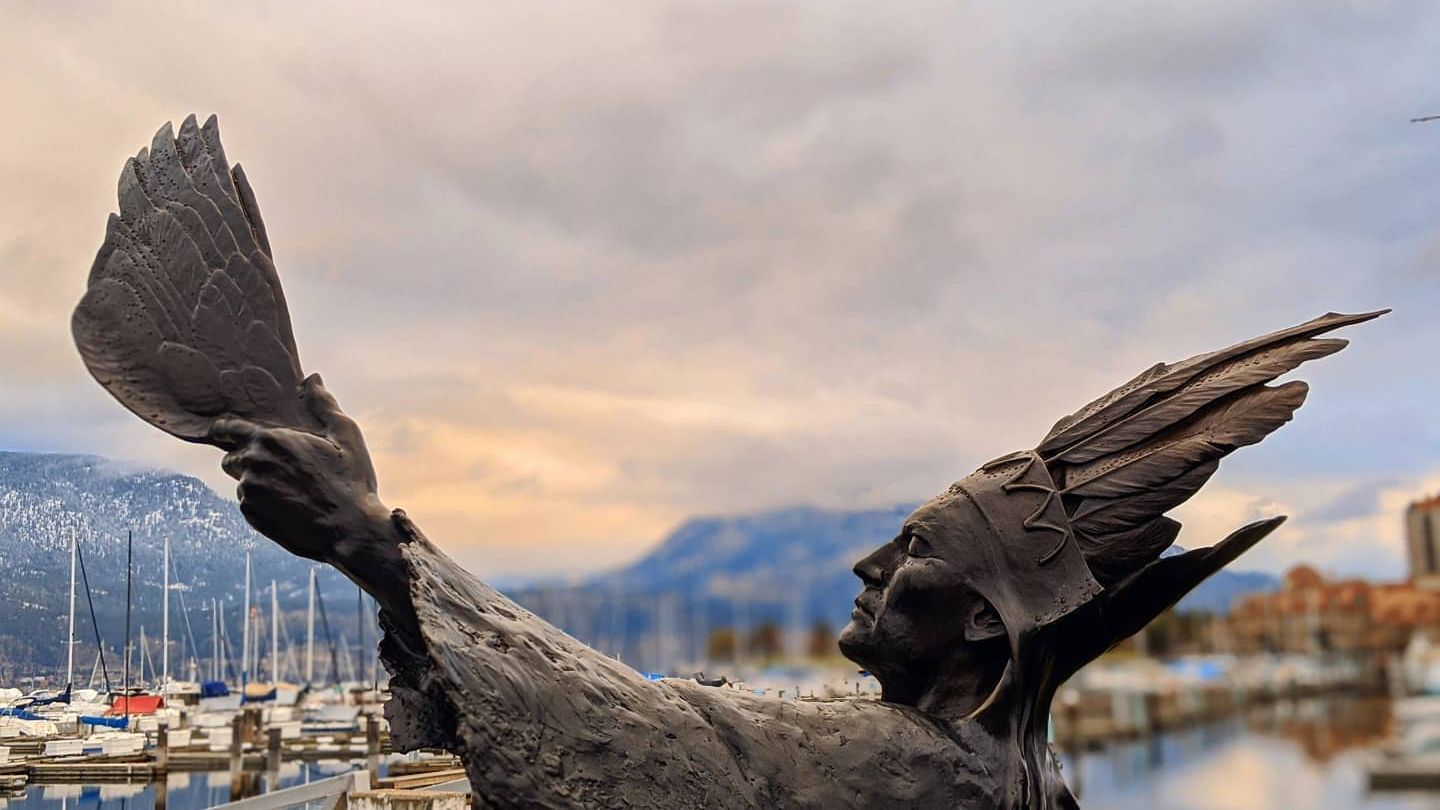
    Syilx Chief, Charlie Swkn̓cut

    Kelowna sits on the traditional, unceded territory of the Syilx/Okanagan people. This sculpture of historic Syilx Chief, Charlie Swkn̓cut, created by Crystal Przybille, features details signifying various aspects of Syilx culture.

    Kelowna, BC

    At the height of Syilx culture, about 3000 years ago, it is estimated that 12,000 people lived in this valley and surrounding areas. The Okanagan people employed an adaptive strategy, moving within traditional areas throughout the year to fish, hunt, or collect food, while in the winter months, they lived in semi-permanent villages of kekulis, a type of pithouse.

    When the Oregon Treaty partitioned the Pacific Northwest in 1846, the portion of the tribe remaining in what became Washington Territory reorganized under Chief Tonasket as a separate group from the majority of the Okanagan, whose communities remain in Canada. The Okanagan Tribal Alliance, however, incorporates the American branch of the Okanagan. The latter are part of the Confederated Tribes of the Colville, a multi-tribal government in Washington state.

    The bounds of Okanagan territory are roughly the basin of Okanagan Lake and the Okanagan River, plus the basin of the Similkameen River to the west of the Okanagan valley, and some of the uppermost valley of the Nicola River. The various Okanagan communities in British Columbia and Washington form the Okanagan Nation Alliance, a border-spanning organization which includes American-side Okanogans resident in the Colville Indian Reservation, where the Okanagan people are sometimes known as Colvilles.

    The today Upper Nicola Indian Band, an Okanagan group of the Nicola Valley, which was at the northwestern perimeter of Okanagan territory, are known in their dialect as the Spaxomin, and are joint members in a historic alliance with neighbouring communities of the Nlaka’pamux in the region known as the Nicola Country, which is named after the 19th-century chief who founded the alliance, Nicola. This alliance today is manifested in the Nicola Tribal Association.

    Sylix First Nation BC locator map

    The Syilx People of the Okanagan Nation

    Okanagan family, c. 1918

    The Syilx People of the Okanagan Nation are a trans-boundary tribe separated at the 49th parallel by the border between Canada and the United States. Our Nation is comprised of seven member communities in the Southern Interior of British Columbia: Okanagan Indian Band, Osoyoos Indian Band, Penticton Indian Band, Upper Nicola Band, Upper and Lower Similkameen Indian Bands, and Westbank First Nation; and in Northern Washington State, the Colville Confederated Tribes. Our members share the same land, nsyilxcən language, culture, and customs. We are a distinct and sovereign Nation.

    Today the Syilx/Okanagan People continue to assert their jurisdiction and responsibility over the stewarding of their land, resources and quality of life of their citizens. Our nsyilxcən language and our Syilx/Okanagan culture respectfully honour the natural laws of the tmixw that which gives us life.

    Source: About Syilx Nation
  • Sweet home Okanagan

    Sweet home Okanagan

    Aaron atop Knox Mountain, Kelowna, British Columbia, Canada

    Sweet home Okanagan title fits so well, borrowed from the famous rock anthem by Lynard Skynard, that it could very well have been written for the place where I grew up; the Okanagan Valley of British Columbia.

    Kelowna 1909

    My family legend is that my father’s grandfather left Salt Lake City in 1888 headed for Vancouver because of political upheaval in Utah and I suspect since he was a young man at that time (born in 1861) he migrated to Canada but on his way to the west coast boom town, he laid his eyes on Okanagan lake from the ridge pass and decided he’d found his new home.

    My father was born in Kelowna as was his father. I was born in Lions Gate Hospital in North Vancouver in 1961 and 100 years after Arthur Day, whose name is inscribed on the Mormon tabernacle in Salt Lake City. Although I live in Vancouver, my heart considers Kelowna my home.

    Kelowna 1920

    Now four generations later the once sleepy valley is home to three mature cities, Penticton, Kelowna and Vernon and the about a half million people that live in a four seasons playground that would be fit for a King.

    The Okanagan Lake is 97 miles long and 2 to 5 miles wide with a large provincial park covering a large swath of land, about in the middle of the lake to encompass the region that surrounds the lake, to preserve and protect that natural wilderness for generations to come.

    Most of the rest of Okanagan Lake has beautiful homes built upon it’s shore and thoughtful urban development has designed subdivisions spread along the mountainsides that gently slope to the waters edge. From a boat the spectacle is remarkable and wonderful to witness the integration of humanity in nature.

    Kelowna (/kəˈloʊnə/) is a city on Okanagan Lake in the Okanagan Valley in the southern interior of British Columbia, Canada. It serves as the head office of the Regional District of the Central Okanagan. The name Kelowna derives from an Okanagan language term for “grizzly bear“.

    The Kelowna metropolitan area has a population of 217,214; the third-largest metropolitan area in the province, behind only Vancouver and Victoria. Additionally, the City of Kelowna is the seventh-largest city in the province. It ranks as the 22nd-largest in Canada and is the largest inland city in British Columbia. Kelowna’s city proper contains 211.82 square kilometres (81.78 sq mi), and the census metropolitan area contains 2,904.86 square kilometres (1,121.57 sq mi). In 2019, it was estimated that Kelowna’s population had grown to 217,229 in the metropolitan area and 142,146 in the city proper.

    Nearby communities include the City of West Kelowna (also referred to as Westbank, Westside) to the west across Okanagan Lake, Lake Country and Vernon to the north, and Peachland to the southwest, and further to the south, Summerland and Penticton.

  • Super Natural British Columbia

    My family’s home in Canada is some 200 miles east of Vancouver, about half-way between the Rocky Mountains and the Pacific Ocean, on the shore of a magnificent lake in a magical valley, both sharing the Native Indian name “Okanagan”. Every summer I return to the place of my youth, both literally and figuratively, as I dedicate as much time as I’m able towards rest, relaxation, and recreation, prior to my annual pilgrimage to Las Vegas to attend the Casino Affiliate Conference.

    (more…)