Tag: South America

  • Pumalín Park and Patagonia Park in Chile

    Pumalín Park and Patagonia Park in Chile

    Pumalín Park

    If I were to have a bucket list, and I suppose I do, now that I mention Chile, it’s been on the top of the list for twenty years. Uruguay, Peru, Brazil and Venezuela but not Chile, Colombia, Bolivia and Argentina (yet). The love of Patagonia clothing company founders were the people who opened my mind to the idea of Chile and now learning about Pumalín Park in a new documentary, I’m enchanted with the wide-open and rugged spaces.

    Huinay, Pumalín National Park, Chile
    Huinay, Pumalín National Park, Chile

    History

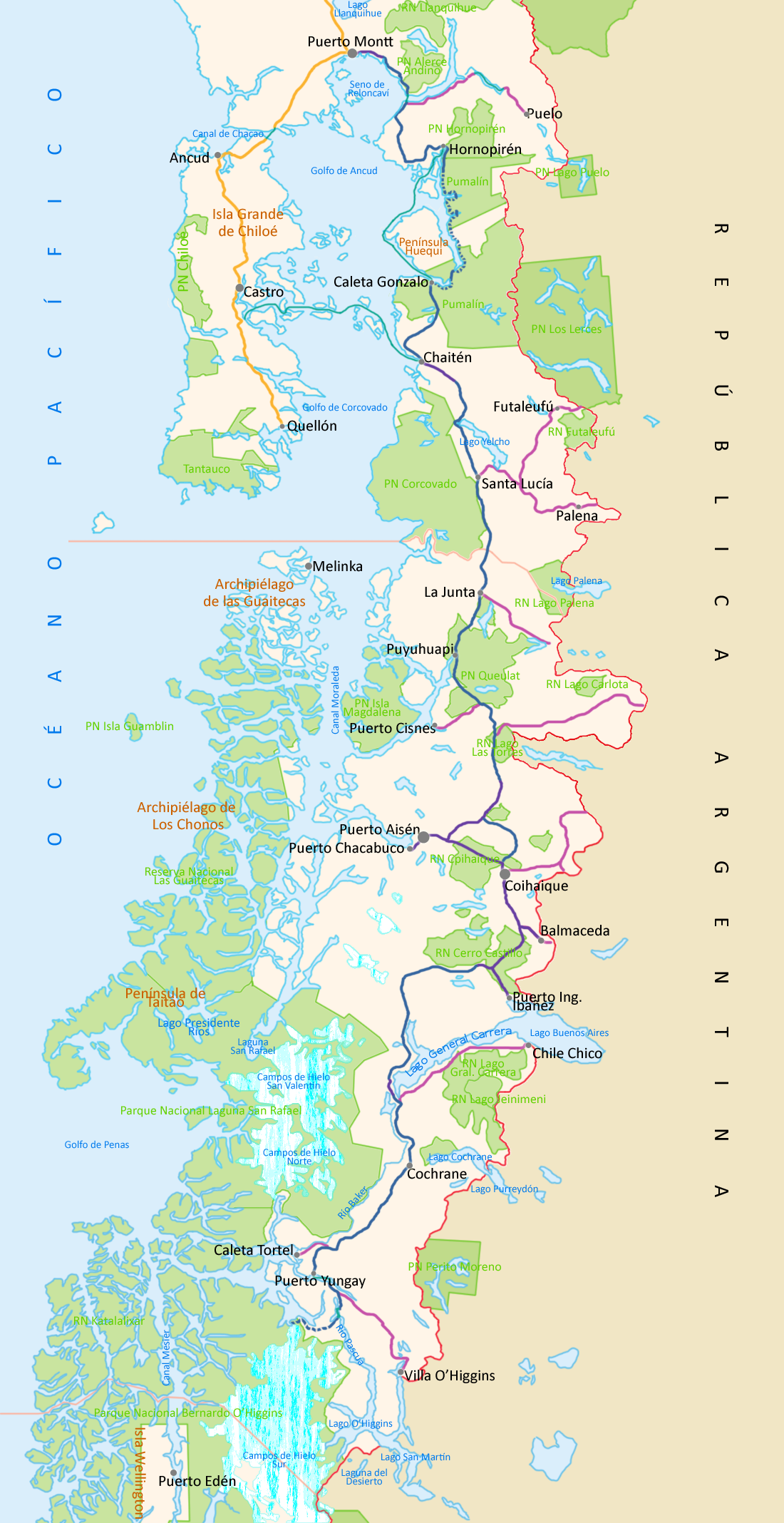
    Pumalín Park is situated on the upper right corner of the map
    Pumalín Park is situated on the upper right corner of the map

    In 1991, Douglas Tompkins bought a large, semi-abandoned plot of land in the Reñihue River Valley of the Chilean province of Palena. A mountaineer and conservationist who had been visiting Patagonia since the early 1960s, Tompkins sought to protect the 16,996.6 ha (42,000 acres) tract, most of which was primeval Valdivian temperate rainforest, from future exploitation. After moving to Reñihué to live full-time, Tompkins began developing plans for a larger park, gradually acquiring additional adjacent properties from willing sellers. Ultimately, roughly 98 percent of the park acreage was bought from absentee landowners.

    The Conservation Land Trust subsequently added approximately 283,280 ha (700,000 acres) in nearly contiguous parcels to form Pumalín Park, which was declared a Nature Sanctuary on August 19, 2005, by then-president Ricardo Lagos. This special designation by the Chilean government grants the land additional protections to secure its ecological values and prevent development. The Conservation Land Trust later donated the protected lands to Fundación Pumalín, a Chilean foundation, for their administration and ongoing preservation as a national park under private initiative.

    While nature-related philanthropy has a long tradition in the United States, large-scale private land acquisition for parks was unfamiliar in Chile, and initially generated skepticism and political opposition. Over the years of the project’s development, confidence has been built, both locally and nationally, as Pumalín Park’s public access infrastructure began serving thousands of visitors annually.

    Tourist Services of Pumalín and Patagonia parks in the process of concession

    Tompkins Conservation recently donated more than 407,000 hectares to the state of Chile to help create 5 new national parks, including Pumalín Douglas Tompkins and Patagonia parks. The restaurants, lodge, cabins and information centers in these parks will be closed until the selection of a new concessionaire, a process that is being carried out by the National Forest Service (Conaf) through concessions. Meanwhile, visitors can still enjoy the trails.

    For any questions about reservations in the cabins of Pumalín or the lodge at Valle Chacabuco of Parque Patagonia please write to the following emails: reservas@parquepumalin.cl or reservas@vallechacabuco.cl

    Pumalín Park Photo credit: draculina_ak on VisualHunt / CC BY-NC-ND Photo credit: fotospagoda. on Visualhunt / CC BY-NC-SA

  • Brazil for Offshore IT Outsource

    Brazil for Offshore IT Outsource

    I recently returned to Sao Paulo, Brazil after 6 months in North America, if there were an economic downturn in the rest of the world, they forgot to mention it to Brasileiro’s. This country is drunk with economic excess, even the street vendors are upgrading equipment and spending more money than ever to build-up their businesses. The signs of growth are everywhere in this city, especially in the Event Planning and management Corporate Event Planner, which is sprouting new high-rise condominiums, like springtime grass on a newly seeded soccer pitch. The economic growth Rio, for a change, is even more accelerated than Sao Paulo.

    FIFA World Cup 2014
    FIFA World Cup 2014

    Brazil’s commitment to sport can be seen in the further venue investment that is already under way in Rio. The world-famous Maracanã stadium will close next year for two years of refurbishment. The areas around it will be renovated, with access and transport links improved as the entire neighborhood is reborn ready for host the final of the 2014 FIFA World Cup. Work is already underway on the ongoing development of the Olympic Training Center (OTC), which includes many of the state-of-the-art venues built for the 2007 Pan and Parapan American Games. The OTC will be at the heart of the Rio Games – and international sport for years afterward. Athletes and coaches from all over the world will be offered scholarships to what will be a new regional hub for sport.

    2016 Olympic Games
    Olympic Games, Rio 2016

    With a strong economy and now guaranteed funding, Brazil’s economy is now the tenth largest in the world – and predicted to be fifth by the 2016 Olympics. Brazil is the world’s second biggest food exporter, one of the world’s largest oil and ore producers and the fifth largest advertising market. This diverse economy is the engine that drives South America and one of the world’s top 10 consumer markets. Brazil has the highest levels of Internet use in the world and according to the Brazilian Association of Information Technology and Communication Companies (commonly known as BRASSCOM), Brazil’s offshore IT outsourcing market hit $1.4 billion in 2008, rising 75 percent in a single year, making this one of the best places in the world for a web development company.

    Experts predict that an additional $500M will be spent just on IT and web development for the FIFA World Cup of soccer in 2014. The overall Latin America market for outsourced services, is expected to grow 12 percent in 2010 to $8 billion, according to Forrester Research. That’s on top of the $19 billion that local companies spend on IT consulting services. However, Brazil has approximately 250,000 IT professionals, 23,000 annual IT graduates, and infrastructure capable of supporting double-digit growth, this places Brazil firmly at the heart of the IT services supply chain in the Southern Hemisphere.

    In October 2009, a report from Gartner claimed that “Brazil’s economic footprint combined with having the largest domestic IT consumption in all of Latin America, as well as international recognition as one of the most promising and rapidly emerging economies, makes it a natural destination to evaluate for IT services.

    Enhanced by Zemanta