His name is Kwan Lok LEE (Leon) he’s a semi-retired Engineer from Vancouver, Canada. Leon is the founder and CEO of Vancouver Intercontinental Consulting Group (VICG), now specializing at Infrastructure Funding.
Leon Graduated B. Sc in Mechanical Engineering with Higher Honors in 1993 from North Carolina A&T State University.
Completed M.Sc in Engineering with Highest Honors in 1975 from North Carolina A&T State University.
Worked as an industrial engineer and production manager at
Jantzen, Ancient Mariner and various industries in Vancouver.
Worked as a consultant engineer in various industries.
From 1993-2002, had been working as an international
consultant on industrial projects in Hong Kong, China and Jamaica.
From 2002 -now, have been working as a international
consultant participating to finance construction infrastructure projects in
Caribbean and African countries which include the following:
Participating financing: housing development in Jamaica.
Completed the SHEP (Self Help Electrification Program) project in Ghana.
Completed building of a power plant in Samoa.
Surfacing the land and developing housing project in Senegal.
Currently participating to finance construction high way and housing
development in Cameroon.
Currently participating to build gypsum board and gypsum powder factories in Ethiopia.
From 2002 until now, we’ve been working as a international
consultant, participating to finance construction infrastructure
projects in the Caribbean, African countries and now the Americas.
We are in possession of the Guarantee (note) for $1.1B financing of PATH BC project from Sinosure of China to Canada
Leon Lee
…and in South America:
Brazil Drydock project has also recently received an Letter of Intent for $150M.
Leon Lee
We have simple EPC (engineering, procurement and construction)
criteria, before VICG begins working for your team, to obtain
construction financing, for the funding of infrastructure projects, as
follows:
Taschkent UZ – Barak-khan Medrese, on the old Silk Road
Vancouver Intercontinental Consulting Group (VICG) is a team of seasoned financial professionals that specialize in introducing infrastructure funding projects to engineering and constructions companies in Beijing. Contractors have excess capacity of equipment and manpower, to construct every imaginable type of infrastructure, and they are seeking large infrastructure projects.
VICG have direct access to China’s largest builders, we can have a response from China lenders, on a project of any size, within 72 hours.
Today I came across this excellent article that explain about the global need for infrastructure funding. Also, find below a description of Belt and Road Initiative from Wikipedia.
Belt and Road delivers crucial capital
Initiative’s infrastructure boost parallels 1930s New Deal
by Yaseen Anwar in Singapore – Tue 16 Apr 2019 – OMFIF
A grim outlook for corporate earnings in 2019, increased country debt, the US-China trade war, Britain’s exit from the European Union, and challenges to the independence of the Federal Reserve and other central banks are but a few of the dire issues weighing on policy-makers, and provide a compelling backdrop to a possible global economic recession. But several measures could be adopted to protect countries from these vulnerabilities and accumulate the necessary resources to stimulate sustainable growth.
US financier Michael Milken created the ‘junk bond’ market in the 1980s to enable smaller, non-rated companies to access capital. Besides triggering novel capital market opportunities for investors, this stimulated overall economic growth through new jobs and increased consumer purchasing power. The rise of the risk-reward ratio added another dimension to asset allocation strategies, as improved availability of data gave added comfort to investors when increasing their risk appetite in the search for higher returns.
Analogous to Milken’s strategy, China’s Belt and Road infrastructure initiative gives access to capital for those connected emerging markets that have not had the necessary investment grade ratings to tap international bond markets. These economies have never had the opportunity to attract offshore investors who require ratings dictated by their corporate policies. Nor do those investors have a high enough risk appetite to venture into uncharted emerging markets.
Infrastructure, the core of Belt and Road funding, is and has been the engine of growth for most economies. The 19th century industrial revolution transformed agrarian-based economies into technological and manufacturing-based ones. In the case of the US, this shift, accelerated again in the 1930s by President Franklin Roosevelt’s New Deal and the expansion of the domestic transportation network, made the country the leading global economy in the 20th century.
The lack of quality infrastructure has hampered the economic development that many Belt and Road-related countries sorely need. For example, the shortage of power in Pakistan has impaired GDP growth rates of up to 3%. The absence of a developed transportation network for refrigerated trucks for distribution of agricultural products results in a 50% loss of perishable products. The Belt and Road initiative can play at least a key role in filling these economies’ substantial financing gap. The collective resources of multilateral institutions can also be leveraged to fill financing gaps and alleviate the concerns of risk-averse private sector participants.
Certain countries have already felt the benefits of new employment opportunities and improved productivity thanks to Belt and Road projects. In 2017, the Greek port of Piraeus handled more than 4m containers for onward distribution to Europe, Germany’s Duisburg Inner Harbour has become the world’s largest inland port, and more than 10,000 companies are now operating across Africa through an expanding transportation network of rail and roads. More than $60bn of new business has been generated across a range of operations, including: increased investment and tourism into Africa; new housing in Indonesia; power projects in Bangladesh; roads in Pakistan and Kazakhstan; and rising global and intraregional trade in the Association of Southeast Asian Nations.
The Belt and Road makes available ample resources and opportunities to stimulate production and inclusive growth, as well as to preserve regional economic stability. Payments settlement risk can also be reduced by using the renminbi as an alternative currency. Exogenous shocks remain a risk, and regional economies must install policies and systems to mitigate such threats.
The Belt and Road offers the necessary ingredients to restore confidence and some stability in the international monetary system, while simultaneously generating new jobs and reducing poverty in many emerging markets.
Yaseen Anwar is Senior Adviser at ICBC Singapore and former Governor of the Central Bank of Pakistan.
Belt and Road Initiative
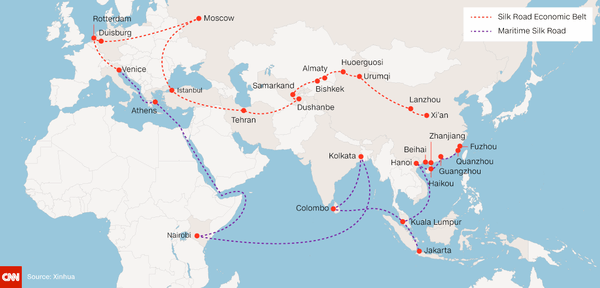
The Belt and Road Initiative (BRI), also known as the One Belt One Road (OBOR) (Chinese: 一带一路) or the Silk Road Economic Belt and the 21st-century Maritime Silk Road (Chinese: 丝绸之路经济带和21世纪海上丝绸之路), is a development strategy adopted by the Chinese government involving infrastructure development and investments in 152 countries and international organizations in Europe, Asia, Middle East, Latin America and Africa. The paramount leader of the People’s Republic of China, Xi Jinping, originally announced the strategy during official visits to Indonesia and Kazakhstan in 2013. “Belt” refers to theoverland routes for road and rail transportation, called “the Silk Road Economic Belt”; whereas “road” refers to the sea routes, or the 21st Century Maritime Silk Road. Until 2016 the initiative was officially known. in English as the One Belt and One Road initiative but the official name was changed as the Chinese government considered the emphasis on the word “one” as being prone to misinterpretation.
The Chinese government calls the initiative “a bid to enhance regional connectivity and embrace a brighter future”. Some observers see it as a push for Chinese dominance in global affairs with a China-centered trading network.





You must be logged in to post a comment.