We owe a huge debt of gratitude to Aaron Swartz for the whole “creative commons” movement. I feel that he was somewhat unsung for his part in Wikipedia, so we must strive to always remember him for Wikimedia Commons. Imagine how much music, art, content, media and photography has been licensed and protected for the public to use, all because of Aaron Swartz’s great idea – create a license and make it free!
Often times the media has a license calling for “Attribution” but who would care about that, if someone has created a great image or sound-track (for example) and they license it creative commons, then it’s “fair use” to add value to what your own creative efforts, for free, just attribute the licensor, many of whom are professionals and want to give-away their media and ideas. This platform promotes collaboration in the most subtle and yet obvious way, people working over great distances and yet with instant communication, is creating a new renaissance of sorts. New ground is being broken in every imaginable direction, just like Ray Kurzweil describes in his future trends forecast; we’re expanding exponentially because our minds are connected through devices that enable us tremendous access to ideas and knowledge.
Before Wikimedia Commons private image archives and news media would employ teams of IP (intellectual property) experts and copyright cops yo seek-out web publishers like me, that would often borrow maps, charts, content and images that clearly belonged to someone other than me, someone who had undoubtedly paid some other person to create such media. In others words, it had obvious value and I, in some cases, did not have the express written consent from the owner of said media. One day I learned better….
For years now it’s not been necessary to go anywhere but to huge royalty free archives, none though, came anywhere close to the home page for the Creative Commons, and the doorway into some of the best images and media anywhere. Several months ago I was tipped-off by Robin Good, he’s the guru of good ideas for content collaboration and web marketing, about VisualHunt.com which is the absolute most exciting thing for me, since Yahoo was launched because it’s a search engine of 354,191,553 Creative Commons Photos. Yep, that’s right… if you can’t find an image to express your vision, from amongst 350 million, then maybe it doesn’t exist and you need to create, so you can upload it and give a “creative commons” license. Let’s all put our best something good there.
On this 4th of July I spent several hours reading and reviewing what I knew about Aaron H. Swartz. I wish I could have met him, we would have lot’s in common to talk about. The first time I heard about him, was only a year or so before his sad demise. Now I’m very well aware of his genius and hold the highest regard for his efforts, on behalf of all people, everywhere, prior to his untimely end. This page and article, containing copy & paste text from Wikipedia is being published here, as a tribute to a great American hero.
It’s really important to understand what a threat Aaron posed to the establishment and to corrupt leaders everywhere. Aaron did not steal anything and was not a felon, or a criminal.
Upon his death the following statement was issued by the family and partner of Aaron Swartz
[box]Aaron’s death is not simply a personal tragedy, it is the product of a criminal justice system rife with intimidation and prosecutorial overreach. Decisions made by officials in the Massachusetts U.S. Attorney’s office and at MIT contributed to his death.[/box]
Highlight of a short career (Aaron Swartz passed at age 26)
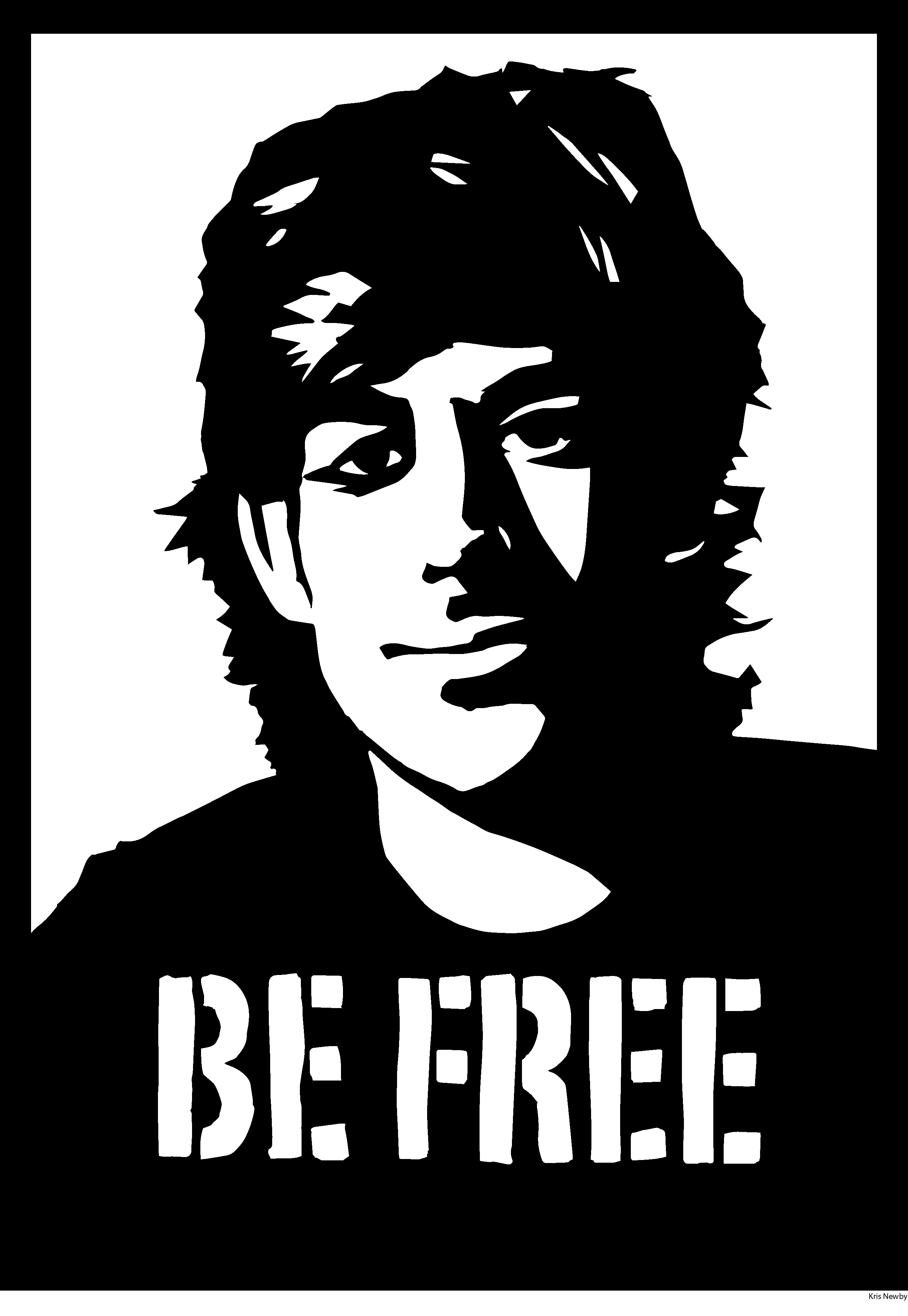
Aaron Swartz – Be Free
Swartz was instrumental in the campaign to prevent passage of the Stop Online Piracy Act (SOPA), which sought to combat Internet copyright violations but was criticized on the basis that it would have made it easier for the U.S. government to shut down web sites accused of violating copyright and would have placed intolerable burdens on Internet providers. Following the defeat of the bill, Swartz was the keynote speaker at the F2C:Freedom to Connect 2012 event in Washington, D.C., on May 21, 2012. His speech was titled “How We Stopped SOPA” and he informed the audience:
This bill … shut down whole websites. Essentially, it stopped Americans from communicating entirely with certain groups….
[quote]I called all my friends, and we stayed up all night setting up a website for this new group, Demand Progress, with an online petition opposing this noxious bill…. We [got] … 300,000 signers…. We met with the staff of members of Congress and pleaded with them…. And then it passed unanimously…. And then, suddenly, the process stopped. Senator Ron Wyden … put a hold on the bill.[/quote]
He added, “We won this fight because everyone made themselves the hero of their own story. Everyone took it as their job to save this crucial freedom.” He was referring to a series of protests against the bill by numerous websites that was described by the Electronic Frontier Foundation as the biggest in Internet history, with over 115,000 sites altering their webpages. Swartz also presented on this topic at an event organized by ThoughtWorks.
Swartz’s family and his partner created a memorial website on which they issued a statement, saying,
“He used his prodigious skills as a programmer and technologist not to enrich himself but to make the Internet and the world a fairer, better place.
Swartz’s funeral services were held on January 15, 2013, at Central Avenue Synagogue in Highland Park, Illinois.
Tim Berners-Lee, co-creator of the World Wide Web, delivered a eulogy.
The same day, the Wall Street Journal published a story based in part on an interview with Stinebrickner-Kauffman. She told the Journal that Swartz lacked the money to pay for a trial and “it was too hard for him to … make that part of his life go public” by asking for help. He was also distressed, she said, because two of his friends had just been subpoenaed and because he no longer believed that MIT would try to stop the prosecution.
On January 19, hundreds attended a memorial at Cooper Union. Speakers included Stinebrickner-Kauffman, Open Source advocate Doc Searls, Creative Commons’ Glenn Otis Brown, journalist Quinn Norton, Roy Singham of ThoughtWorks, and David Segal of Demand Progress.
On January 24, there was a memorial at the Internet Archive with speakers including Stinebrickner-Kauffman, Alex Stamos, and Carl Malamud.
On February 4, a memorial was held in the Cannon House Office Building on Capitol Hill. Speakers included Senator Ron Wyden and Representatives Darrell Issa, Alan Grayson and Jared Polis/ Other lawmakers in attendance included Senator Elizabeth Warren and Representatives Zoe Lofgren and Jan Schakowsky. “Stick it to the man,” said Issa. “Access to information is a human right.” A historic photo of Warren and Issa sitting together before an image of Swartz was posted on Twitter.
A memorial also took place on March 12, 2013 at the MIT Media Lab.
Reuters news agency called Swartz “an online icon” who “help[ed] to make a virtual mountain of information freely available to the public, including an estimated 19 million pages of federal court documents.” The Associated Press (AP) reported that Swartz’s case “highlights society’s uncertain, evolving view of how to treat people who break into computer systems and share data not to enrich themselves, but to make it available to others,” and that JSTOR’s lawyer, former U.S. Attorney for Manhattan Mary Jo White, had asked the lead prosecutor to drop the charges.
As discussed by editor Hrag Vartanian in Hyperactive, Brooklyn, NY muralist BAMN (“By Any Means Necessary”) created a mural of Swartz.
“Swartz was an amazing human being who fought tirelessly for our right to a free and open Internet,” the artist explained. “He was much more than just the ‘Reddit guy’.”
The Internet’s Own Boy: The Story of Aaron Swartz
Aaron Swartz profile
On January 11, 2014, marking the first anniversary of his death, a sneak preview was released from The Internet’s Own Boy: The Story of Aaron Swartz, a documentary about Swartz, the NSA and SOPA. The film was officially released at the January 2014 Sundance Film Festival. The documentary was to be released under a Creative Commons License; it debuted in theaters and on-demand in June 2014.
Mashable called the documentary “a powerful homage to Aaron Swartz”. Its debut at Sundance received a standing ovation. Mashable printed, “With the help of experts, The Internet’s Own Boy makes a clear argument: Swartz unjustly became a victim of the rights and freedoms for which he stood.” The Hollywood Reporter described it as a “heartbreaking” story of a “tech wunderkind persecuted by the US government”, and a must-see “for anyone who knows enough to care about the way laws govern information transfer in the digital age”.
Open AccessIn 2002, Swartz had stated that when he died he wanted all the contents of his hard drives made publicly available. A long-time supporter of Open Access, Swartz wrote in his Guerilla Open Access Manifesto:
The world’s entire scientific … heritage … is increasingly being digitized and locked up by a handful of private corporations….
The Open Access Movement has fought valiantly to ensure that scientists do not sign their copyrights away but instead ensure their work is published on the Internet, under terms that allow anyone to access it.
Supporters of Swartz responded to news of his death with an effort called #PDFTribute to promote Open Access. On January 12, Eva Vivalt, a development economist at the World Bank, began posting her academic articles online using the hashtag #pdftribute as a tribute to Swartz. Scholars posted links to their works.
Swartz’s death prompted calls for more open access to scholarly data.
The Think Computer Foundation and the Center for Information Technology Policy (CITP) at Princeton University announced scholarships awarded in memory of Aaron Swartz.
In 2013, Aaron Swartz was posthumously awarded the American Library Association’s James Madison Award for being an “outspoken advocate for public participation in government and unrestricted access to peer-reviewed scholarly articles.”
In March, the editor and editorial board of the Journal of Library Administration resigned en masse, citing a dispute with the journal’s publisher. One board member wrote of a “crisis of conscience about publishing in a journal that was not open access” after the death of Aaron Swartz.
Hacks
On January 13, 2013, members of Anonymous hacked two websites on the MIT domain, replacing them with tributes to Swartz that called on members of the Internet community to use his death as a rallying point for the open access movement. The banner included a list of demands for improvements in the U.S. copyright system, along with Swartz’s Guerilla Open Access Manifesto.
On the night of January 18, 2013, MIT’s e-mail system was taken out of action for ten hours. On January 22, e-mail sent to MIT was redirected by hackers Aush0k and TibitXimer to the Korea Advanced Institute of Science & Technology. All other traffic to MIT was redirected to a computer at Harvard University that was publishing a statement headed “R.I.P Aaron Swartz,” with text from a 2009 posting by Swartz, accompanied by a chiptunes version of The Star-Spangled Banner. MIT regained full control after about seven hours.
In the early hours of January 26, 2013, the U.S. Sentencing Commission website, USSC.gov, was hacked by Anonymous. The home page was replaced with an embedded YouTube video, Anonymous Operation Last Resort. The video statement said Swartz “faced an impossible choice”.
A hacker downloaded “hundreds of thousands” of scientific-journal articles from a Swiss publisher’s website and republished them on the open Web in Swartz’s honor a week before the first anniversary of his death.
Commemorations
On August 3, 2013, Swartz was posthumously inducted into the Internet Hall of Fame.
There was a hackathon held in Swartz’ memory around the date of his birthday in 2013.
Over the weekend of November 8–10, 2013, inspired by Swartz’s work and life, a second annual hackathon was held in at least 16 cities around the world.
Preliminary topics worked on at the 2013 Aaron Swartz Hackathon[205] were privacy and software tools, transparency, activism, access, legal fixes, a low-cost book scanner.
In January 2014, Larry Lessig led a walk across New Hampshire in honor of Swartz, rallying for campaign finance reform.
Aaron Swartz will never be forgotten, and every July 4th honored as an American hero, and an Internet Legend. We do not forgive. We do not forget. Expect us.



You must be logged in to post a comment.