Cosmic Consciousness is the best term to define something that can’t be defined in language but it sure sounds fun and like something we all want to experience. Perhaps you’ve noticed my obsession with ascendance? Ever since I solved the ringing in the ears and connected the Schumann resonances, I’ve not been able to stop studying metaphysics.
If it weren’t for the Internet, perhaps many of us would have gone insane? However, the breadcrumb trails leading to the ancient wisdom, were everywhere. The pieces of the puzzle were all online, all that was needed was the time, the desire to know, and the willingness to learn.
Yogapedia explains Cosmic Consciousness
When Cosmic Consciousness is reached, the individual moves from believing in the oneness of the universe to having a direct knowledge of that fact. This level of consciousness requires letting go of the superficial ego.
Some claim that reaching this awareness may cause a person to retreat from the noise of the outside world and seek solitude. They will develop a heightened awareness of their own mental state and that of those around them.
In 1901, Richard Maurice Bucke — a Canadian psychiatrist — wrote a book about Cosmic Consciousness, in which he defined it as the highest of three levels of consciousness found in living beings:
Simple consciousness, which both mankind and animals possess;
Self-consciousness, which includes thought, reason, and imagination and that mankind possesses; and
Cosmic Consciousness, which is a higher and more spiritual consciousness than most ordinary people possess.
For Bucke, Cosmic Consciousness included a spiritual understanding that there is eternal life and that God is the whole universe. He saw all things as being interconnected — a part of the cosmic consciousness. A popular meditation and spirituality figure in the West, Deepak Chopra has postulated that the concept of Cosmic Consciousness may be related to the hidden dimensions of quantum mechanics.
A spiritual yoga practice can help an individual move closer to attaining Cosmic Consciousness. Poses that open the third eye and crown chakras are particularly helpful in reaching this goal.
A variety of Turmeric Flower found in Maharashtra, India. Turmeric or “Indian Saffron” is one of the most commonly used spice in India – a key flavouring ingredient in any Indian cuisine.
Recently I saw a documentary on web workers who travel the world, called something like Cyber Nomads and there was one young man that had all the best spices in a nice kit, ready for making curry. He’d learned in India how to mix it, so as a special gift, wherever he stayed, he would prepare a nice curry dinner.
When not used fresh, the rhizomes are boiled in water for about 30–45 minutes and then dried in hot ovens, after which they are ground into a deep orange-yellow powder commonly used as a coloring and flavoring agent in many Asian cuisines, especially for curries, as well as for dyeing. Turmeric powder has a warm, bitter, black pepper-like flavor and earthy, mustard-like aroma. Although long used in Ayurvedic medicine, where it is also known as haridra, no high-quality clinical evidence exists for use of turmeric or its constituent, curcumin, as a therapy.
Indian curry dishes
Historically, the word “curry” was first used in British cuisine to denote dishes of meat (often leftover lamb) in a Western-style sauce flavoured with curry powder.
The first curry recipe in Britain appeared in The Art of Cookery made Plain and Easy by Hannah Glasse in 1747. The first edition of her book used only black pepper and coriander seeds for seasoning of “currey”. By the fourth edition of the book, other ingredients such as turmeric and ginger were called for. The use of hot spices was not mentioned, which reflected the limited use of chili in India — chili plants had only been introduced into India around the late 16th century and at that time were only popular in southern India.
Many curry recipes are contained in 19th century cookbooks such as those of Charles Elmé Francatelli and Mrs Beeton. In Mrs Beeton’s Book of Household Management, a recipe for curry powder is given that contains coriander, turmeric, cinnamon, cayenne, mustard, ginger, allspice and fenugreek; although she notes that it is more economical to purchase the powder at “any respectable shop”.
According to legend, one 19th century attempt at curry resulted in the invention of Worcestershire sauce.
Throughout the 19th and early 20th centuries, curry grew increasingly popular in Britain owing to the large number of British civil servants and military personnel associated with the British Raj. Following World War II, curry became even more popular in Britain owing to the large number of immigrants from South Asia.
Curry has become an integral part of British cuisine, so much so that, since the late 1990s, chicken tikka masala has been referred to as “a true British national dish”.
Other British curry derivatives include “Coronation chicken“, a cold dish, often used as a sandwich filling, invented to commemorate the coronation of Queen Elizabeth II in 1953 – and curry sauce (or curry gravy), usually served warm with traditional British fast food dishes such as chips. Curry sauce occasionally includes sultanas and/or other dried fruits.
Ever since the first time I saw Visual Hunt it’s been the most commonly visited website for me, next to Drudge Report and Zero Hedge. That one resource changed publishing for me because I always knew I would be able to find a suitable image that wouldn’t cause a copyright issue. Until Visual Hunt was known to me, I would use Google image search and basically steal IP from whomever and hope for the best, that method was not sustainable.
Then there was Visual Hunt
High quality free photos in one place. They hunt for best free images from many online sources and pull them all together in one spot. Most of their photos are CC0 license (do whatever you want). Additionally they offer all Creative Commons and Public Domain photos from sources like Flickr and make it possible to embed them directly from their website.
click to go huge size
Here’s some links to give you an idea how cool the site is
One good law deserves another, or why fly on one wing? Seriously, I intended to add some information about Moore’s Law here because it comes up in conversation often and did again today, so I took that as a cue to look it up and extract a blog post from the findings and yes there’s allot to be found when you go poking around Moore’s Law.
Murphy’s law is an adage or epigram that is typically stated as: “Anything that can go wrong will go wrong”. Just so that’s clear.
Moore’s Law is not and adage of epigram, it is a theoretic, scientific assumption.
Moore’s law is the observation that the number of transistors in a dense integrated circuit doubles about every two years. The observation is named after Gordon Moore, the co-founder of Fairchild Semiconductor and CEO of Intel, whose 1965 paper described a doubling every year in the number of components per integrated circuit and projected this rate of growth would continue for at least another decade. In 1975, looking forward to the next decade, he revised the forecast to doubling every two years. The period is often quoted as 18 months because of a prediction by Intel executive David House (being a combination of the effect of more transistors and the transistors being faster).
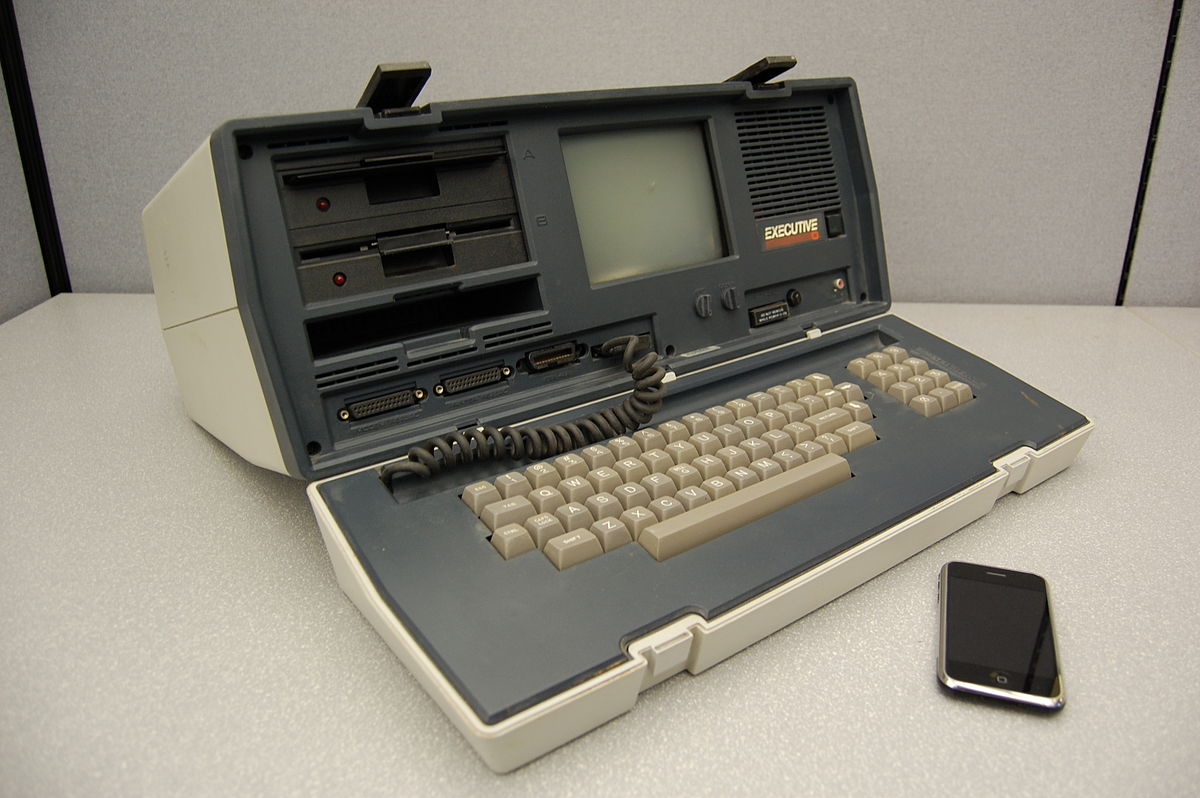
An Osborne Executive portable computer, from 1982, with a Zilog Z80 4 MHz CPU, and a 2007 Apple iPhone with a 412 MHz ARM11 CPU; the Executive weighs 100 times as much, has nearly 500 times the volume, costs approximately 10 times as much (adjusted for inflation), and has about 1/100th the clock frequency of the smartphone.
Consequences
The primary driving force of economic growth is the growth of productivity, and Moore’s law factors into productivity. Moore (1995) expected that “the rate of technological progress is going to be controlled from financial realities”. The reverse could and did occur around the late-1990s, however, with economists reporting that “Productivity growth is the key economic indicator of innovation.”
Technological change is a combination of more and of better technology. A 2011 study in the journal Science showed that the peak of the rate of change of the world’s capacity to compute information was in 1998, when the world’s technological capacity to compute information on general-purpose computers grew at 88% per year. Since then, technological change clearly has slowed. In recent times, every new year allowed humans to carry out roughly 60% more computation than possibly could have been executed by all existing general-purpose computers in the year before. This still is exponential, but shows that the rate of technological change varies over time.
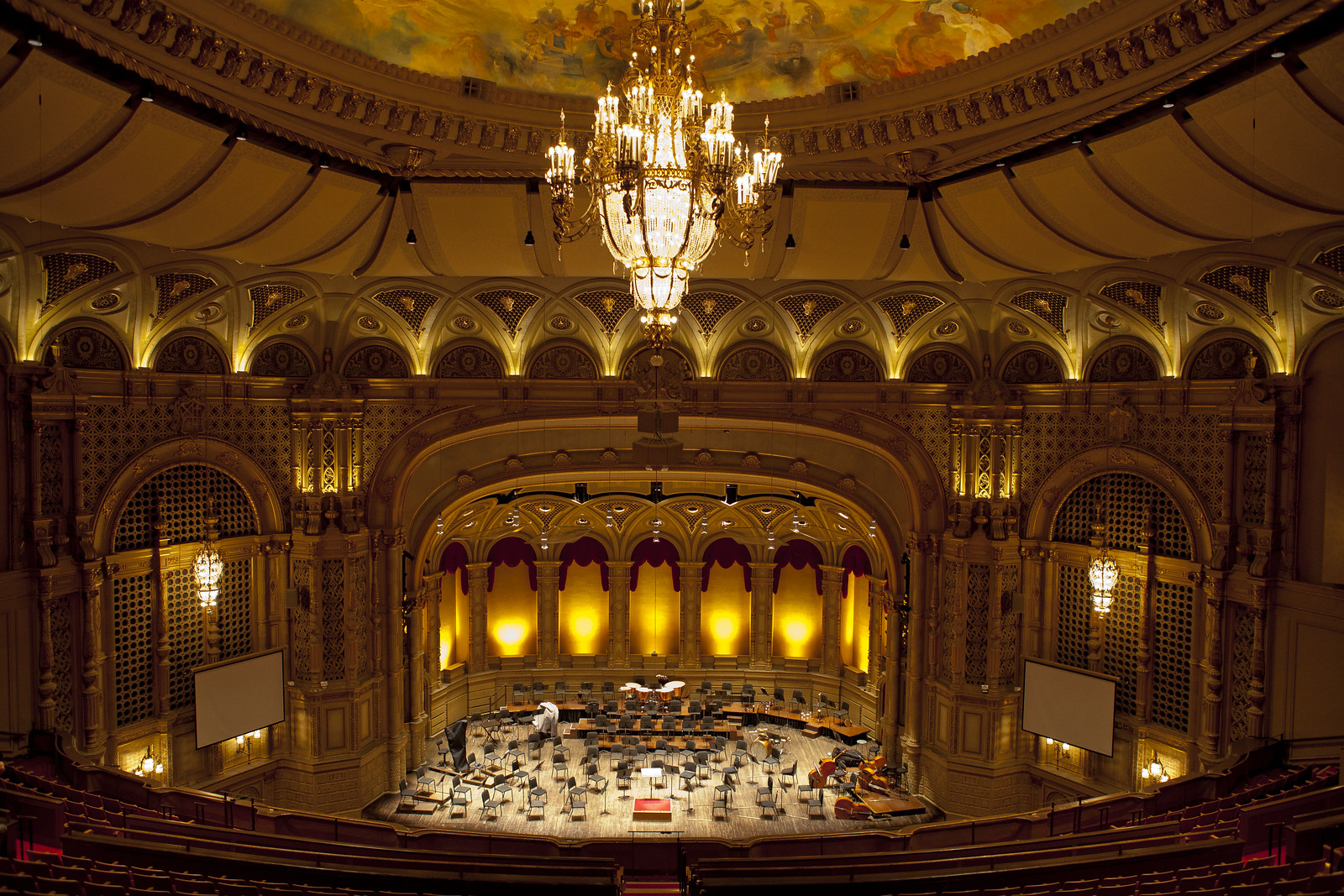
Thanks to Coastal Church of Vancouver for opening the doors of the Orpheum Theatre and entertaining us, and presenting such an awe inspiring Easter Sunday presentation.
During the service we celebrated the resurrection of our Saviour with dynamic worship music, stories of real life change, special media, musical elements, and a powerful message from Pastor, David Koop.
If you declare with your mouth, “Jesus is Lord,” and believe in your heart that God raised him from the dead, you will be saved.
Romans 10:9
The special musical presentation duet, of singer and violinist, backed by the orchestra was fabulous, especially from the best balcony seats in the house. Great show! I’m especially grateful for having seen the theatre in the daylight, to marvel at the ornate decor and purposeful design. This is truly a Vancouver Landmark building.
Orpheum Theatre Vancouver
The Orpheum Theatre with advertising for the movie Lady Luck, circa 1946.
Designed by Scottish architect Marcus Priteca, the theatre officially opened on November 8, 1927 as a vaudeville house, but it hosted its first shows the previous day. The old Orpheum, at 761 Granville Street, was renamed the Vancouver Theatre (later the Lyric, then the International Cinema, then the Lyric once more before it closed for demolition in 1969 to make way for the first phase of the Pacific Centre project). The New Orpheum, which was the biggest theatre in Canada when it opened in 1927, with three thousand seats, cost $1.25 million to construct. The first manager of the theatre was William A. Barnes.
Following the end of vaudeville’s heyday in the early 1930s, the Orpheum became primarily a movie house under Famous Players ownership, although it would continue to host live events on occasion. Ivan Ackery managed the Orpheum during most of this period, from 1935 up until his 1969 retirement.[
The Orpheum Theatre 2005, advertising the Vancouver Symphony Orchestra.
In 1973, for economic reasons, Famous Players decided to gut the inside of the Orpheum and change it into a multiplex. A “Save the Orpheum” public protest and fundraising campaign was launched, which even Jack Benny flew in to help with, and the Orpheum was saved. On March 19, 1974, the City of Vancouver bought the theatre for $7.1 million, with $3.1 million coming from the city itself, and $1.5 million from each of the provincial and federal governments.. The Orpheum closed on November 23, 1975 and a renovation and restoration was done by the architectural company Thomson, Berwick, Pratt and Partners. It re-opened on April 2, 1977 and has since been the permanent home of the Vancouver Symphony Orchestra. Tony Heinsbergen, a U.S. designer who originally chose the color scheme for the interior (ivory, moss green, gold and burgundy) was brought back, fifty years later, for the renovation. In 1983, an additional entrance was opened on Smithe Street.
In 2006, the Capitol Residences development was proposed for the old Capitol 6 cinema site adjacent to the Orpheum. The City of Vancouver gave the developer permission for extra height and density on their site in return for a major expansion to the Orpheum, including a long desired back stage area. This was the largest amenities trade in the history of the city, and will increase the usability of the facility.
The Orpheum’s neon sign was donated by Jim Pattison in the 1970s.
There’s no other day that deserves recognition and celebration like Earth Day, we don’t even know how old she is, or who lives inside her and on her sea floor but we managed to exploit every square inch of the place we call earth. Today I give thanks and declare my love of mother earth, the best planet that I’m able to remember living on.
Sure we have moments of discomfort and occasional tremors, belches and quakes but no matter what we humans do to slow her down, she just keeps spinning around like we weren’t even here. Meanwhile we’re busy drilling holes and scraping the surface, poisoning and plundering with the sense of urgency of a tick on a dog, and yet she just keeps on flying through space, while playing in a band with nine other planets (Nibiru = X), in an endless series of concerts, while many of the passengers are busy planning a mutiny, of the people who they think, control the spin.
In the great symphony of the planets, the little earth is just a singer in the chorus, as the tempo of the song accelerates and the beat quickens, the resonance raises as the climax approaches. Pulsating energy blasts out into space at a higher and higher frequency, as we all whirl through the universe together, towards the next dimension, on our way to infinity, faster and faster.
The audience is in awe of the fractals, and wonders if she will do a pole reversals for an encore. Do we end at the beginning? or do we begin at the end? Are we inside a computer simulation, or is this the mind of God?
EARTH DAY NETWORK’S 2019 CLEANUP SPANS THOUSANDS OF LOCATIONS DURING APRIL
Over 3,000 cleanups in communities across the U.S. for Earth Day 2019
April 15, 2019 (Washington D.C.) – Earth Day
Network is implementing a nationally coordinated environmental volunteer
cleanup to mark Earth Day 2019, in collaboration with partners across
the U.S., including National CleanUp Day and Keep America Beautiful. All
over the country people are encouraged to get up, get out, and help
clean their communities to celebrate Earth Day.
People have a right to expect a clean environment and can exercise
that right by helping to clean their own communities with over 3,000
cleanups of green spaces, urban landscapes and waterways with grassroots
organizations leading up to Earth Day on April 22 and taking place
throughout the remainder of the month of April.
Volunteers across the U.S. are coming together with grassroots
organizations for Earth Day 2019 to clean up over 3,000 green spaces,
urban landscapes, and waterways. Plastic pollution and waste challenge
every community, every day, and these cleanups offer a chance to make a
real difference.
Cleanups are planned in over 80 cities and town, including Chicago,
Dallas, Denver, Honolulu, Los Angeles, Miami, New York, Richmond, San
Diego, San Francisco, Seattle and Washington, D.C. More cities and sites
are being added every day.
Volunteer registration is open right now. Volunteers are invited to sign up at here.
The Earth Day 2019 Cleanup aims to inspire volunteerism and achieve
tangible impact on waste in our environment. The unified campaign
includes mobile registration, digital mapping, social media, photo
sharing, corporate volunteer engagement, and data collection on cleanup
results.
Building on best practices and verifiable metrics from 2019, this
event will then be scaled up for the 50th Anniversary of Earth Day in
2020, which will be known as the Great Global Cleanup, featuring more
than 100,000 events globally with goal of 1 billion pieces of trash
collected.
“The Great Global Cleanup will bring together millions of people
around the globe to create the largest coordinated volunteer event in
history,” Earth Day Network President Kathleen Rogers said. “We are
excited to kick off in cities across the U.S. in 2019, and to expand
globally in 2020 in honor of the 50th anniversary of Earth Day.” For
more information, go to earthday.org/greatglobalcleanup.
Earth Day 2019 Cleanup sponsors include Toyota, Kiehl’s Since 1851, Dos Gardenias, Burton Snowboards and Fetzer.
About Us
Earth Day Network’s mission is to diversify,
educate, and activate the environmental movement worldwide. Growing out
of the first Earth Day (1970), Earth Day Network works with more than
50,000 partners in 190 countries to build environmental democracy. More
than 1 billion people now participate in Earth Day activities each year,
making it the largest civic observance in the world. Learn more at earthday.org
National CleanUp Day is a call to action. National
CleanUp Day is a 501(c)3 nonprofit organization, dedicated to keeping
our nation’s urban, rural, and outdoor public spaces free of litter and
trash. For more information, please visit nationalcleanupday.org
Keep America Beautiful inspires and educates people
to take action every day to improve and beautify their community
environment. Established in 1953, Keep America Beautiful strives to End
Littering, Improve Recycling and Beautify America’s Communities. Learn
more at kab.org.
China has cast a magic spell on me, I’m enchanted with the middle kingdom, it’s wonderful people, past and present. My mind is attracted to all things related to the far east. Lately I’ve been admiring cheongsam worn by the stunning beautiful women of China. Men can dress to match, I once recall seeing a Mao suit on a mannequin in a Georgio Armani store. Cheongsam can be worn by men and women (see below).
Chinese singer and actress Zhou Xuan wearing a cheongsam in 1930s in Shanghai
The English loanwordcheongsam comes from chèuhngsāam (長衫; long shirt/dress), the Cantonese pronunciation of the Shanghainese term zansae,
by which the original tight-fitting form was first known. The
Shanghainese name was somewhat in contrast with usage in Mandarin and
other varieties of Chinese, where chángshān (Mandarin) refers to an exclusively male dress, and the female version is known as a qípáo.
In Hong Kong, where many Shanghai tailors fled after the communist revolution in China, the word chèuhngsāam may refer to either male or female garments. The word keipo (qípáo) is either a more formal term for the female chèuhngsāam, or is used for the two-piece cheongsam variant that is popular in mainland China. Traditionally, usage in Western countries mostly followed the original Shanghainese usage and applies the Cantonese-language name cheongsam to a garment worn by women.
Armani Mao suit
The story of the Last Emperor is tragic in many ways but an important stage in the evolution of modern day China. In the historic photo of Puyi, last emperor of China, with his consort Wan Rong, last empress of China. It’s a blaring contrast the western dress suite beside cheongsam or what came next; i.e. the Mao suit (see photo).
The Last Emperor, Puyi was a renaissance man and dressed like a modern day Puff Daddy (rap star). In his day, not only was he the last emperor but also the last fashion maven, for about half a century. Modern day Chinese are making up for the lost time and are now the largest consumer of luxury designer brands in the world. The Armani Mao suit is an iconic twist of elegance, Mao style.
Wanrong and Puyi in Tianjin
Emperor of China (1908–1912)
Chosen by Empress Dowager Cixi on her deathbed, Puyi became emperor at the age of 2 years and 10 months in December 1908 after the Guangxu Emperor died on 14 November. Titled the Xuantong Emperor (Wade-Giles: Hsuan-tung Emperor), Puyi’s introduction to the life of an emperor began when palace officials arrived at his family residence to take him. On the evening of 13 November 1908, without any advance notice, a procession of eunuchs and guardsmen led by the palace chamberlain left the Forbidden City for the Northern Mansion to inform Prince Chun that they were taking away his three-year-old son Puyi to be the new emperor.
Flag of the Chinese Empire under the Qing dynasty (1889-1912)
The toddler Puyi screamed and resisted as the officials ordered the eunuch attendants to pick him up. Puyi’s parents said nothing when they learned that they were losing their son. As Puyi cried, screaming that he did not want to leave his parents, he was forced into a palanquin that took him back to the Forbidden City. Puyi’s wet nurse Wang Wen-Chao was the only person from the Northern Mansion allowed to go with him, and she calmed the very distraught Puyi down by allowing him to suckle one of her breasts; this was the only reason she was taken along. Upon arriving at the Forbidden City, Puyi was taken to see Cixi Puyi later wrote:
I still have a dim recollection of this meeting, the
shock of which left a deep impression on my memory. I remember suddenly
finding myself surrounded by strangers, while before me was hung a drab
curtain through which I could see an emaciated and terrifying hideous
face. This was Cixi. It is said that I burst out into loud howls at the
sight and started to tremble uncontrollably. Cixi told someone to give
me some sweets, but I threw them on the floor and yelled “I want nanny, I
want nanny”, to her great displeasure. “What a naughty child” she said.
“Take him away to play.”
Taschkent UZ – Barak-khan Medrese, on the old Silk Road
Vancouver Intercontinental Consulting Group (VICG) is a team of seasoned financial professionals that specialize in introducing infrastructure funding projects to engineering and constructions companies in Beijing. Contractors have excess capacity of equipment and manpower, to construct every imaginable type of infrastructure, and they are seeking large infrastructure projects.
VICG have direct access to China’s largest builders, we can have a response from China lenders, on a project of any size, within 72 hours.
Today I came across this excellent article that explain about the global need for infrastructure funding. Also, find below a description of Belt and Road Initiative from Wikipedia.
Belt and Road delivers crucial capital
Initiative’s infrastructure boost parallels 1930s New Deal
by Yaseen Anwar in Singapore – Tue 16 Apr 2019 – OMFIF
A grim outlook for corporate earnings in 2019, increased country debt, the US-China trade war, Britain’s exit from the European Union, and challenges to the independence of the Federal Reserve and other central banks are but a few of the dire issues weighing on policy-makers, and provide a compelling backdrop to a possible global economic recession. But several measures could be adopted to protect countries from these vulnerabilities and accumulate the necessary resources to stimulate sustainable growth.
US financier Michael Milken created the ‘junk bond’ market in the 1980s to enable smaller, non-rated companies to access capital. Besides triggering novel capital market opportunities for investors, this stimulated overall economic growth through new jobs and increased consumer purchasing power. The rise of the risk-reward ratio added another dimension to asset allocation strategies, as improved availability of data gave added comfort to investors when increasing their risk appetite in the search for higher returns.
Analogous to Milken’s strategy, China’s Belt and Road infrastructure initiative gives access to capital for those connected emerging markets that have not had the necessary investment grade ratings to tap international bond markets. These economies have never had the opportunity to attract offshore investors who require ratings dictated by their corporate policies. Nor do those investors have a high enough risk appetite to venture into uncharted emerging markets.
Infrastructure, the core of Belt and Road funding, is and has been the engine of growth for most economies. The 19th century industrial revolution transformed agrarian-based economies into technological and manufacturing-based ones. In the case of the US, this shift, accelerated again in the 1930s by President Franklin Roosevelt’s New Deal and the expansion of the domestic transportation network, made the country the leading global economy in the 20th century.
The lack of quality infrastructure has hampered the economic development that many Belt and Road-related countries sorely need. For example, the shortage of power in Pakistan has impaired GDP growth rates of up to 3%. The absence of a developed transportation network for refrigerated trucks for distribution of agricultural products results in a 50% loss of perishable products. The Belt and Road initiative can play at least a key role in filling these economies’ substantial financing gap. The collective resources of multilateral institutions can also be leveraged to fill financing gaps and alleviate the concerns of risk-averse private sector participants.
Certain countries have already felt the benefits of new employment opportunities and improved productivity thanks to Belt and Road projects. In 2017, the Greek port of Piraeus handled more than 4m containers for onward distribution to Europe, Germany’s Duisburg Inner Harbour has become the world’s largest inland port, and more than 10,000 companies are now operating across Africa through an expanding transportation network of rail and roads. More than $60bn of new business has been generated across a range of operations, including: increased investment and tourism into Africa; new housing in Indonesia; power projects in Bangladesh; roads in Pakistan and Kazakhstan; and rising global and intraregional trade in the Association of Southeast Asian Nations.
The Belt and Road makes available ample resources and opportunities to stimulate production and inclusive growth, as well as to preserve regional economic stability. Payments settlement risk can also be reduced by using the renminbi as an alternative currency. Exogenous shocks remain a risk, and regional economies must install policies and systems to mitigate such threats.
The Belt and Road offers the necessary ingredients to restore confidence and some stability in the international monetary system, while simultaneously generating new jobs and reducing poverty in many emerging markets.
Yaseen Anwar is Senior Adviser at ICBC Singapore and former Governor of the Central Bank of Pakistan.
Belt and Road Initiative
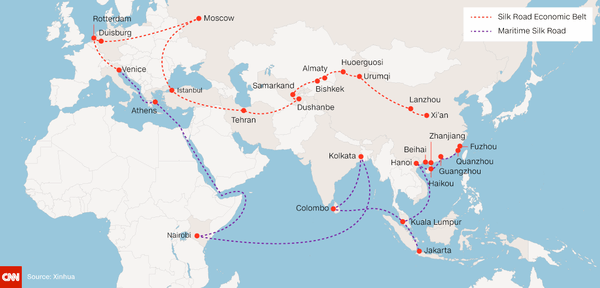
The Belt and Road Initiative (BRI), also known as the One Belt One Road (OBOR) (Chinese: 一带一路) or the Silk Road Economic Belt and the 21st-century Maritime Silk Road (Chinese: 丝绸之路经济带和21世纪海上丝绸之路), is a development strategy adopted by the Chinese government involving infrastructure development and investments in 152 countries and international organizations in Europe, Asia, Middle East, Latin America and Africa. The paramount leader of the People’s Republic of China, Xi Jinping, originally announced the strategy during official visits to Indonesia and Kazakhstan in 2013. “Belt” refers to theoverland routes for road and rail transportation, called “the Silk Road Economic Belt”; whereas “road” refers to the sea routes, or the 21st Century Maritime Silk Road. Until 2016 the initiative was officially known. in English as the One Belt and One Road initiative but the official name was changed as the Chinese government considered the emphasis on the word “one” as being prone to misinterpretation.
The Chinese government calls the initiative “a bid to enhance regional connectivity and embrace a brighter future”. Some observers see it as a push for Chinese dominance in global affairs with a China-centered trading network.
Starting on January 1, 2019 I began buying filtered water and storing in glass water storage bottles and looking at my future of water filtration and storage systems. This page and section is another of those sort of sticky notes to self, to aggregate more data about alternative water filtration technology and ideas for the best way to be water independent.
Reverse Osmosis is just one method, I want to put several here and begin to understand the advantages and disadvantages of each different type of filtration. Currently carrying water sucks but it tastes and tests great (I assume it’s tested – better make sure), the machine is in the grocery store and costs 79 cents for 4 litres to use a commercial reverse osmosis filter.
Water security and independence just to learn first hand, since I have enough food stored to last more than 30 days without having to leave my house, that is if I were to have enough water. Currently I could last a week on the water if I were to ration to austerity, so I wonder about filling more glass water bottles but then they’re good for one year, so there needs to be a system and contigency to filter using Brita and also using bladder storage of city water. Ultimately being able to filter and make good water is key.
My city, Vancouver, has excellent water and plenty of it, so realistically it’s highly likely that’ll I’ll ever need to be water secure and independent while living here but I want to become more aware of all things I consume and reduce everything because nothing makes us as happy as fresh air but second on the list we take for granted is fresh, clean drinking water.
Reverse osmosis (RO) is a water purification technology that uses a partially permeable membrane to remove ions, molecules and larger particles from drinking water. In reverse osmosis, an applied pressure is used to overcome osmotic pressure, a colligative property, that is driven by chemical potential differences of the solvent, a thermodynamic parameter. Reverse osmosis can remove many types of dissolved and suspended chemical species as well as biological ones (principally bacteria) from water, and is used in both industrial processes and the production of potable water. The result is that the solute is retained on the pressurized side of the membrane and the pure solvent is allowed to pass to the other side. To be “selective”, this membrane should not allow large molecules or ions through the pores (holes), but should allow smaller components of the solution (such as solvent molecules, i.e., water, H2O) to pass freely.
In the normal osmosis process, the solvent naturally moves from an area of low solute concentration (high water potential), through a membrane, to an area of high solute concentration (low water potential). The driving force for the movement of the solvent is the reduction in the free energy of the system when the difference in solvent concentration on either side of a membrane is reduced, generating osmotic pressure due to the solvent moving into the more concentrated solution. Applying an external pressure to reverse the natural flow of pure solvent, thus, is reverse osmosis. The process is similar to other membrane technology applications.
Reverse osmosis differs from filtration in that the mechanism of fluid flow is by osmosis across a membrane. The predominant removal mechanism in membrane filtration is straining, or size exclusion, where the pores are 0.01 micrometers or larger, so the process can theoretically achieve perfect efficiency regardless of parameters such as the solution’s pressure and concentration. Reverse osmosis instead involves solvent diffusion across a membrane that is either nonporous or uses nanofiltration with pores 0.001 micrometers in size. The predominant removal mechanism is from differences in solubility or diffusivity, and the process is dependent on pressure, solute concentration, and other conditions. Reverse osmosis is most commonly known for its use in drinking water purification from seawater, removing the salt and other effluent materials from the water molecules.
Ninurta Enterprises Incorporated (NEI) is a socially conscious and spiritually responsible sustainable engineering consulting firm that provides scientifically engineered solutions addressing the subjects of food, water, energy, housing, clothing, and waste recycling. We are capable of designing multi-tiered, scalable, and cross-platform systems with special focus on self-sustainable indoor vertical farming.
Vertical farm
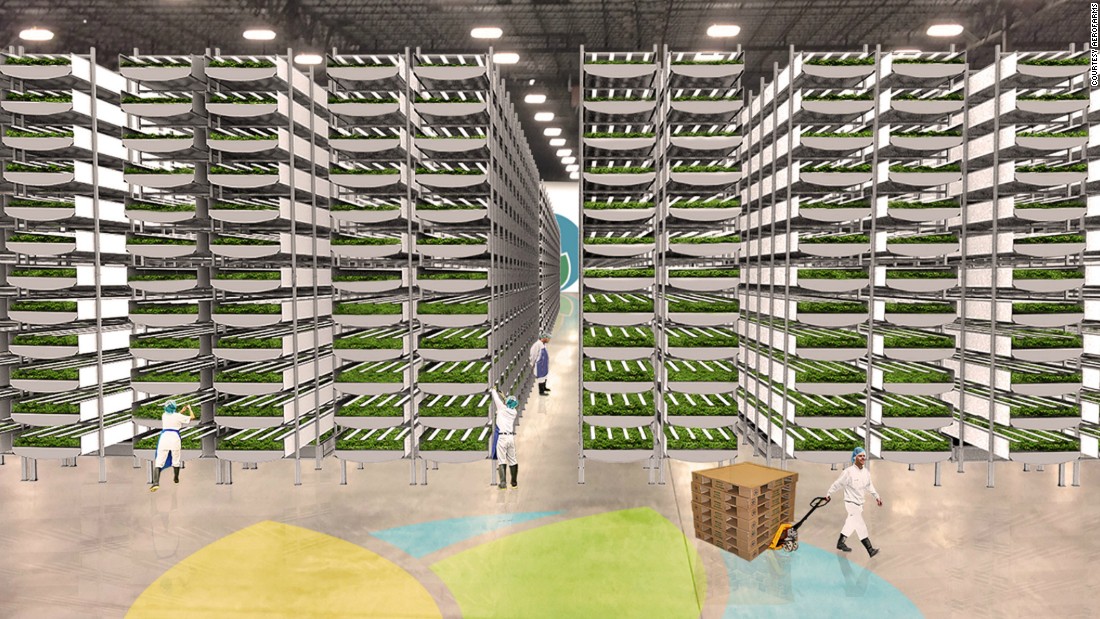
Lettuce grown in indoor vertical farming system
Dickson Despommier is a professor of environmental health sciences and microbiology.
He reopened the topic of VF in 1999 with graduate students in a medical
ecology class. He speculated that a 30-floor farm on one city block
could provide food for 50,000 people including vegetables, fruit, eggs
and meat, explaining that hydroponic crops could be grown on upper
floors; while the lower floors would be suited for chickens and fish
that eat plant waste.
Although many of Despommier’s suggestions have been challenged from an environmental science and engineering point of view, Despommier successfully popularized his assertion that food production can be transformed. Critics claimed that the additional energy needed for artificial lighting, heating and other operations would outweigh the benefit of the building’s close proximity to the areas of consumption.
Despommier originally challenged his class to feed the entire population of Manhattan (about 2,000,000 people) using only 5 hectares (13 acres) of rooftop gardens.
The class calculated that rooftop gardening methods could feed only two
percent of the population. Unsatisfied with the results, Despommier
made an off-the-cuff suggestion of growing plants indoors, vertically.
By 2001 the first outline of a vertical farm was introduced. In an
interview Despommier described how vertical farms would function:
Each floor will have its own watering and nutrient monitoring systems. There will be sensors for every single plant that tracks how much and what kinds of nutrients the plant has absorbed. You’ll even have systems to monitor plant diseases by employing DNA chip technologies that detect the presence of plant pathogens by simply sampling the air and using snippets from various viral and bacterial infections. It’s very easy to do.
Moreover, a gas chromatograph will tell us when to pick the plant by analyzing which flavenoids the produce contains. These flavonoids are what gives the food the flavors you’re so fond of, particularly for more aromatic produce like tomatoes and peppers. These are all right-off-the-shelf technologies. The ability to construct a vertical farm exists now. We don’t have to make anything new.
Architectural designs were independently produced by designers Chris Jacobs, Andrew Kranis and Gordon Graff.
Mass media attention began with an article written in New York magazine,[citation needed] followed by others,[ as well as radio and television features.
In 2011 the Plant in Chicago was building an anaerobic digester into the building. This will allow the farm to operate off the energy grid. Moreover, the anaerobic digester will be recycling waste from nearby businesses that would otherwise go into landfills.[
As of 2014, Vertical Fresh Farms was operating in Buffalo, New York, specializing in salad greens, herbs and sprouts. In March the world’s then largest vertical farm opened in Scranton, Pennsylvania, built by Green Spirit Farms (GSF). The firm is housed in a single story building covering 3.25 hectares, with racks stacked six high to house 17 million plants. The farm was to grow 14 lettuce crops per year, as well as spinach, kale, tomatoes, peppers, basil and strawberries. Water is scavenged from the farm’s atmosphere with a dehumidifier.
A 2015 study utilized inexpensive metalreflectors to supply sunlight to the plants, reducing energy costs.
Kyoto-based Nuvege (pronounced “new veggie”) operates a windowless farm. Its LED lighting is tuned to service two types of chlorophyll, one preferring red light and the other blue. Nuvege produces 6 million lettuce heads a year.























You must be logged in to post a comment.