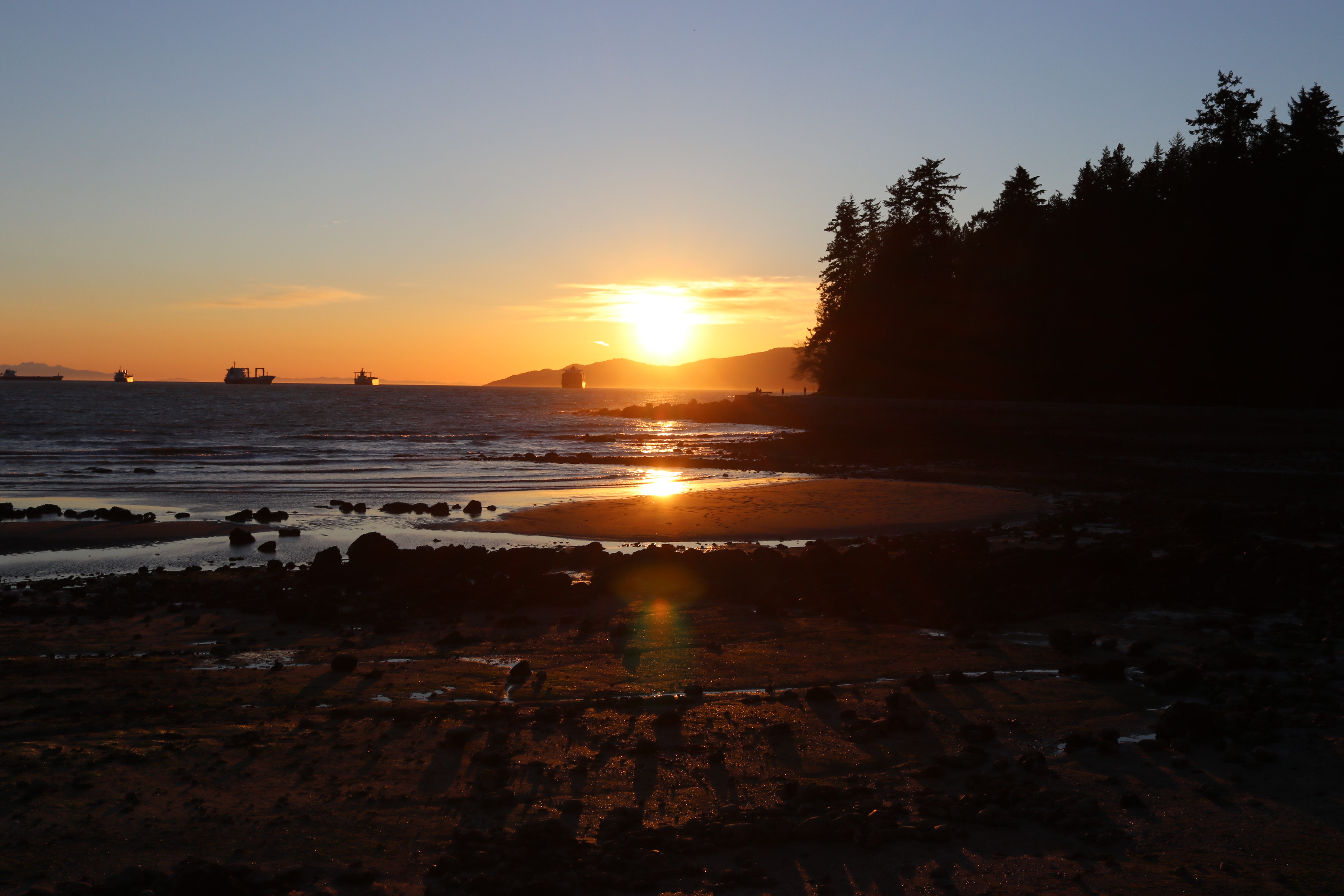
The orange color, always present in my life, even on rainy days ♥
My mind has been uplifted by something that Russel Brand said in a video called How To Let Go Of Sadness and that was the danger of self-pity was so toxic that we must do anything, to not feel too sad about stuff, like for example; the demise of our civilization. We’re not to be overly sad about the human condition but instead, we need to fight our inner debate with an obsession to become the change that we want to see in the world.
The greatest gift you can bestow on a person, is a good example.
Russel Brand
Disciple is the key theme to the great work that Russel Brand has been doing. Making a personal commitment, each and everyone of us, to do whatever it takes to self-improve. By this path, especially if the same amount of energy is invested into self-improvement that was used to self-destruct from drugs and alcohol, fight worthy causes, promote social change, or awaken other people, or even fighting against radical fundamentalism etc… It’s all a waste of time, there is no “us vs them“, no red team or blue team, good guys or bad guys, this illusion holds us back.
In order to transcend the misery we created on earth, we must each find the path towards peace. Give up fighting, forget the loss and move on towards the light.
Every word, every thought of anger and every moment of disgust at the desolation of abomination is a wasted chance to be self-inspired, to know that you know, that by dwelling on the past is not going to change anything and yet we must not do nothing. It’s commanded unto all of us, to do our best. I will never run a four minute mile, or make it to the moon but perhaps I can inspire someone else to raise-up their game and give it their very best. After all, if we don’t give it a shot, we’ll never know. Maybe I can inspire….
Remember in school, the things you learn on the playground; nobody likes and bully, a ta tel-tale or a cry-baby. So suck it up buttercup, the western world has fallen, the French don’t own France and you don’t belong to a blue team or a red team. The game is over, it’s now time to become the person you were meant to be, without a nanny state to hold your hand.
Pardon me for sounding callous but if news is fake, then what else is fake? And what would be the real news, if the masses are consuming fake news? Could there be something we’re not being told? Like who stole all the gold and money?
My truth is this; inner peace is the greatest truth you can ever find because it can be proven, only when experienced by you, to be known true and real. Once you know inner peace, you will want more, and once you know where to find it and how to get it, you’ll begin swapping the bad things for more of the good things, then experiencing more happiness.
Self inspiration is the key to see the silver lining in this time of tribulation.
Happiness leads towards joy, on it’s way to contentment. Therefore, having said all that airy-fairy, new age, mumbo jumbo I’ll just simply say that there’s still beauty everywhere in the world and tremendous, marvellous and even miraculous people among us, many who are having a much tougher time, against harder odds, or suffering worse than we are, so it is for them that we must keep a stiff upper lip and carry-on.
Self inspiration is my choice, and from here forward will strive to write only inspirational posts.
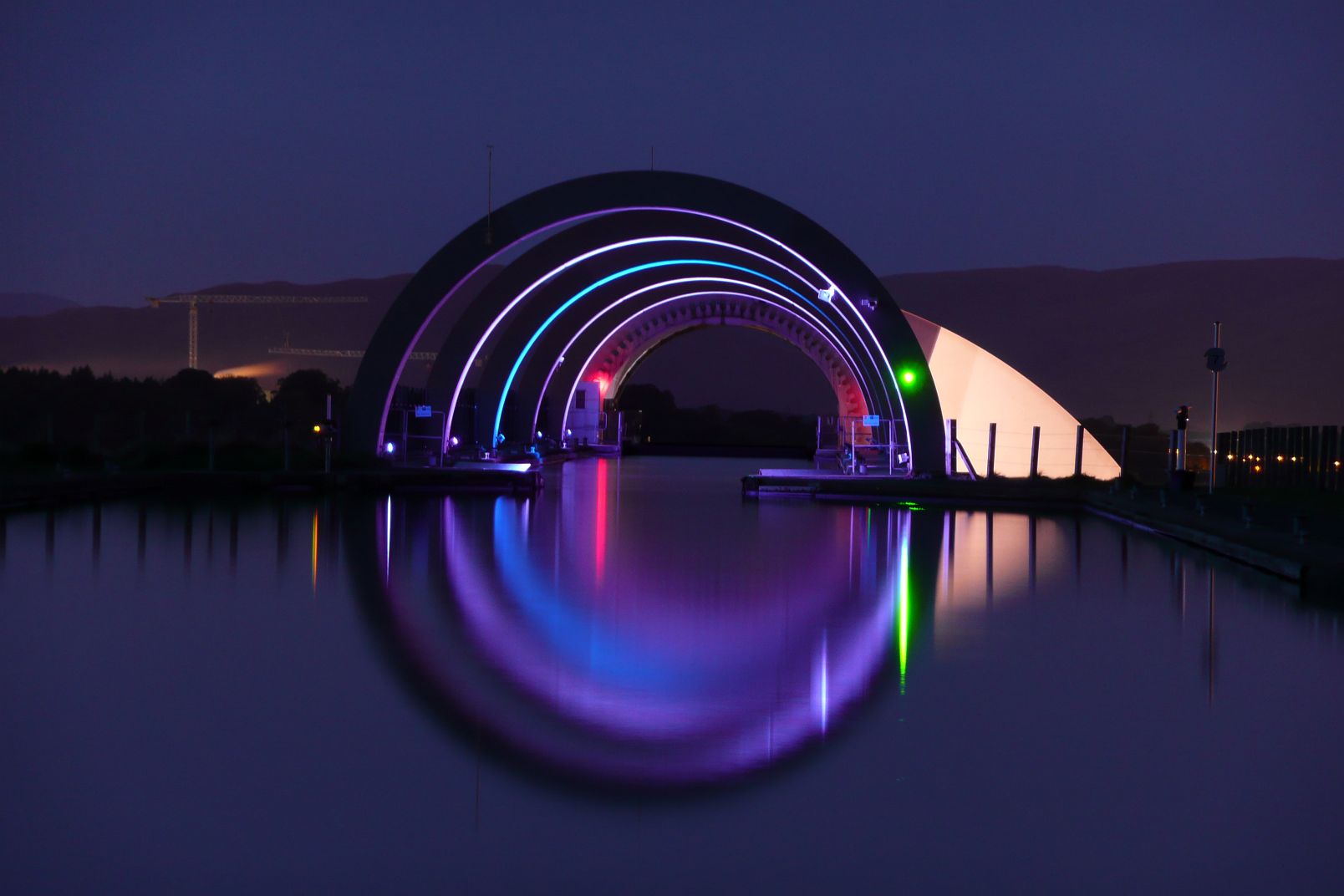
Windows Ten has a the feed of images that act as screen savers and provide new photographs that have been chosen for how engaging they are, a little pop-up asks if you like what you see? If you’re a Windows user you probably know it. This is how I first saw the Falkirk Wheel and beside the night time photo it asked; can you guess what this is?
Pardon my ignorance but I didn’t know about the canals of Scotland and never heard of a the Falkirk wheel, have you?
The Falkirk Wheel is a rotating boat lift in central Scotland, connecting the Forth and Clyde Canal with the Union Canal. The lift is named after Falkirk, the town in which it is located. It reconnects the two canals for the first time since the 1930s. It opened in 2002 as part of the Millennium Link project.
The wheel raises boats by 24 metres (79 ft), but the Union Canal is still 11 metres (36 ft) higher than the aqueduct which meets the wheel. Boats must also pass through a pair of locks between the top of the wheel and the Union Canal. The Falkirk Wheel is the only rotating boat lift of its kind in the world, and one of two working boat lifts in the United Kingdom, the other being the Anderton Boat Lift.
Ambition is challenged by the abomination on our planet but changes are happening faster and faster, the destruction of food supply from crop loss is particularly alarming but what’s more distructive to hope is the fact that leaders in every country know why climate change is accelerating and they’ve brainwashed the masses to believe it’s man made.
Man made carbon has exacerbated the problem without a doubt but deception of reality is far worse, as the masses of people will be blindsided by what is coming and this suffering could have been reduced. The abomination of desolation, is a term found in the Book of Daniel which means literally “an abomination that desolates” or “an abomination that appalls. To me this represents the leadership of our world.
Chemtrails was the term that first exposed Geoengineering and Atmospheric Aerosol Spraying or Solar Radiation Management (SRM), which has been going on for decades and was finally exposed into the light by the legal case in Rhode Island named the Geoengineering Act of 2017
Effects of Abomination
Consequences. Documented problems arising from geoengineering activities include, but are not limited to:
(1) Global dimming, causing reduced vitamin D absorption in humans and animals, and reduced photosynthesis;
(2) Changes in distribution patterns and chemical contents of local rainfall;
(3) Contamination of air, water, and soil, as particulates fall to earth’s surface;
(4) Degradation of human, animal and plant health, when people and other living organisms are exposed to falling particulates and other atmospheric contaminants;
(5) The acceleration of biodiversity and species losses, especially the loss of endangered and threatened species as identified under the U.S. Endangered Species Act of 1973 (ESA), each one of which species has intrinsic value as well as human resource value;
(6) Less direct sunlight reaching the earth, fewer winter freezes, and higher humidity, resulting in increased molds, mildews, fungi, and pest problems;
Abomination of Desolation
And he shall make a strong covenant with many for one week; and for half of the week he shall cause sacrifice and offering to cease; and upon the wing of abominations shall come one who makes desolate, until the decreed end is poured out on the desolator.
Quite simply, the way to overcome this abomination is to become the change you wish to see, improve yourself by focusing on raising your own vibration and see the beauty in everything, rather than look for the ugliness of the abomination. Seek enlightenment and strive to control your thinking to focus on positive thoughts and ideas.
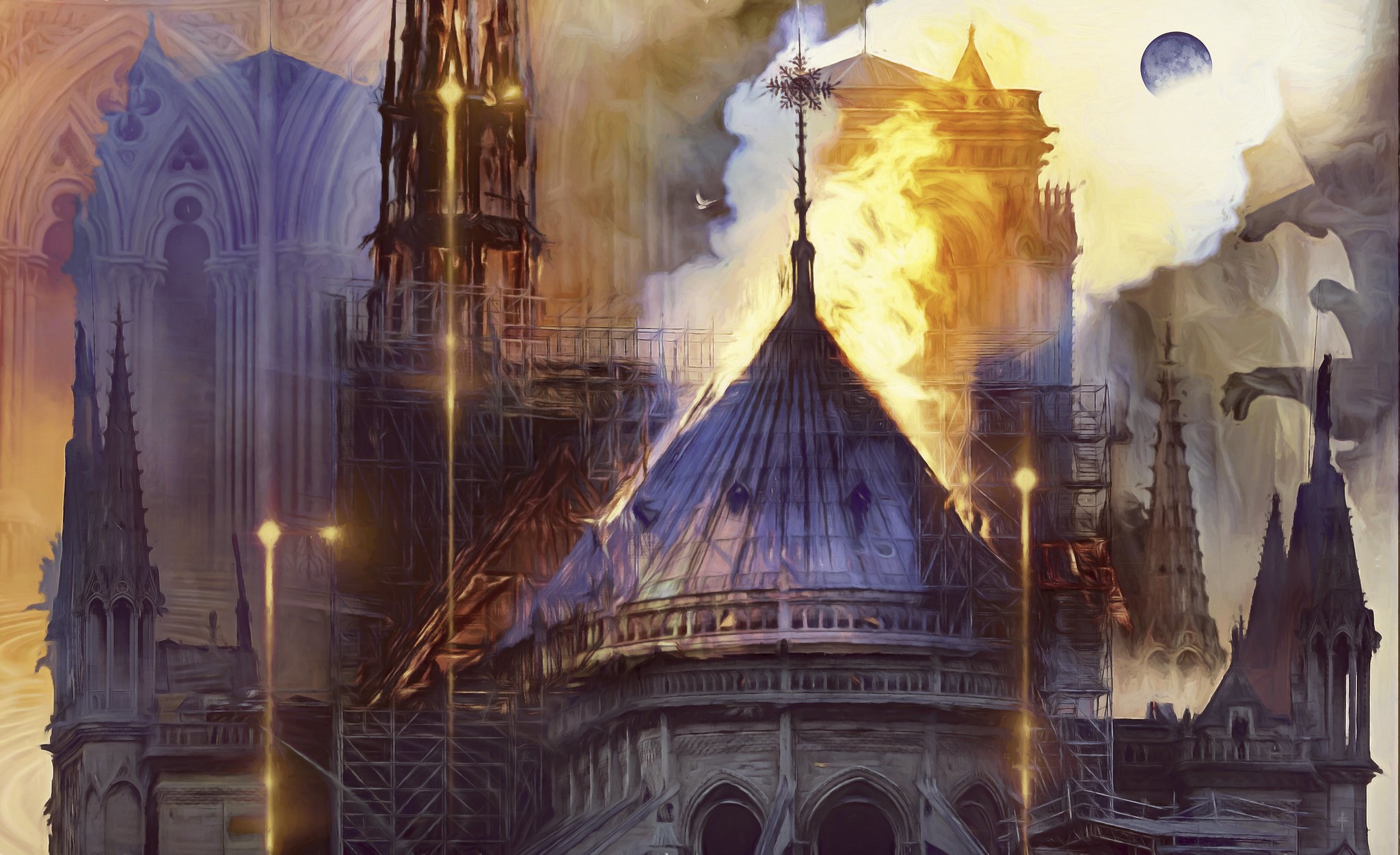
There’s so much to learn about the Notre Dame Cathedral, the history holds secrets that the recent fire, which many believe was arson by professionals, has only served to draw attention to the rich and illustrious past to understand some of the story of it’s construction and why it matters.
On April 15, 2019 a massive fire broke out at the 850-year-old Notre Dame Cathedral in Paris, a medieval Catholic sanctuary, ultimately leading to the collapse of its Gothic spire, as reported by The Guardian. The main structure of Notre Dame and its two towers have been saved by firefighters.
If there was ever a perfect example of Conspiracy theory it would be the fire of Notre Dame Cathedral. It’s obvious that the magnificent cathedral was an act of arson, without even knowing all the facts. It’s just simply the difficulty of making 850 year old oak catch on fire, it’s nearly impossible. This was not an accident.
The list of facts supporting arson is very long, including a string of church fires across France in the weeks leading up, and on the day of the Paris fire, at nearly the same time, a fire broke out at Jerusalem’s Al-Aqsa Mosque, the third holiest site in Islam. The flames engulfed the Marwani Prayer Room, also known as Solomon’s Stables. The fire at the mosque received minimal attention by international media.
Not sure the meaning or significance of the attacks on religious buildings but certainly the fire in both places at the same time, it is not a coincidence.
I decided to put this page here, so that I can place some information here about the magnificent Notre Dame Cathedral.
The cathedral’s construction was begun in 1160 under Bishop Maurice de Sully
and was largely complete by 1260, though it was modified frequently in
the following centuries. In the 1790s, Notre-Dame suffered desecration during the French Revolution; much of its religious imagery was damaged or destroyed. In the 19th century, the cathedral was the site of the coronation of Napoleon I, and the funerals of many French presidents.
Popular interest in the cathedral blossomed soon after the publication, in 1831, of Victor Hugo‘s novel Notre-Dame de Paris (better known in English as The Hunchback of Notre-Dame). This led to a major restoration project between 1844 and 1864, supervised by Eugène Viollet-le-Duc. The liberation of Paris was celebrated within Notre-Dame in 1944 with the singing of the Magnificat. Beginning in 1963, the cathedral’s façade was cleaned of centuries of soot and grime. Another cleaning and restoration project was carried out between 1991 and 2000.
The cathedral has been progressively stripped of its original
decoration and works of art. Several noteworthy examples of Gothic,
Baroque, and 19th-century sculptures and a group of 17th- and early
18th-century altarpieces remain in the cathedral’s collection.
The most important relics in Christendom, including the Crown of Thorns, a sliver of the true cross, and a nail from the true cross, are preserved at Nôtre Dame.
History
It is believed that before the arrival of Christianity in France, a Gallo-Roman temple dedicated to Jupiter stood on the site of Notre-Dame. Evidence for this is the Pillar of the Boatmen, discovered in 1710. This building was replaced with an Early Christianbasilica. It is unknown whether this church, dedicated to Saint Stephen, was constructed in the late 4th century and remodeled later, or if it was built in the 7th century from an older church, possibly the cathedral of Childebert I.[b] The basilica, later cathedral, of Saint-Étienne [fr] was situated about 40 meters (130 ft) west of Notre-Dame’s location and was wider and lower and roughly half its size. For its time, it was very large—70 meters (230 ft) long—and separated into nave and four aisles by marble columns, then decorated with mosaics.
Four churches succeeded the Roman temple before Notre-Dame. The first was the 4th century basilica of Saint-Étienne, then the Merovingian renovation of that church which was in turn remodeled in 857 under the Carolingians into a cathedral. The last church before the cathedral of Notre-Dame was a Romanesque remodeling of the prior structures that, although enlarged and remodeled, was found to be unfit for the growing population of Paris. A baptistery, the Church of John the Baptist [fr], built before 452, was located on the north side of the church of Saint-Étienne until the work of Jacques-Germain Soufflot in the 18th century.
In 1160, the Bishop of Paris, Maurice de Sully, decided to build a new and much larger church. He summarily demolished the Romanesque cathedral and chose to recycle its materials. Sully decided that the new church should be built in the Gothic style, which had been inaugurated at the royal abbey of Saint Denis in the late 1130s. The Gothic cathedrals of Sens, Senlis, Laon, Noyon and Angers were already under construction began at Nôtre Dame
The ZenDAO voting platform can replace the old corporate model of business organization with an inclusive, provably fair, and transparent economic system with incentives to participate.
Horizen is building a decentralized
autonomous organization (DAO) as a voting mechanism to allocate treasury
funds to continue the development of the Horizen platform.
The ZenDAO will be one of many sidechain applications for the Horizen platform, demonstrating the power of the dApps and their commitment to decentralized, community based governance.
The ZenDAO uses economic theory, game theory, liquid democracy, and the lastest privacy technology to allocated treasury fund resources. They are not just creating technological innovations, they are also pushing social innovations in how people interact with each other.
Delegative democracy, also known as liquid democracy, is a form of democracy whereby an electorate has the option of vesting voting power in delegates rather than voting directly themselves. The term is a generic description of either already-existing or proposed popular-control apparatuses. Voters can either vote directly or delegate their vote to other participants; voters may select a delegate for different issues. In other words, individual A of an X society can delegate its power to another individual B – and withdraw such power again at any time.
Illustration
of delegated voting. Voters to the left of the blue line voted by
delegation. Voters to the right voted directly. Numbers are the quantity
of voters represented by each delegate, with the delegate included in
the count.
Delegative Democracy, or liquid democracy, lies between direct and representative democracy. In direct democracy, participants must vote personally on all issues, while in representative democracy participants vote for representatives once in certain election cycles. Meanwhile, liquid democracy does not depend on representatives but rather on a weighted and transitory delegation of votes. Delegative democracy through elections should empower individuals to become sole interpreters of the interests of the nation. It allows for citizens to directly vote on policy issues, delegate their votes on one or multiple policy areas to delegates of their choosing, delegate votes to one or more people, delegated to them as a weighted voter, or get rid of their votes’ delegations whenever they please.
Most of the available academic literature on liquid democracy is
based on empirical research rather than on specific conceptualization or
theories. Experiments have mostly been conducted on a local level or
exclusively through online platforms, however polity examples are listed
below.
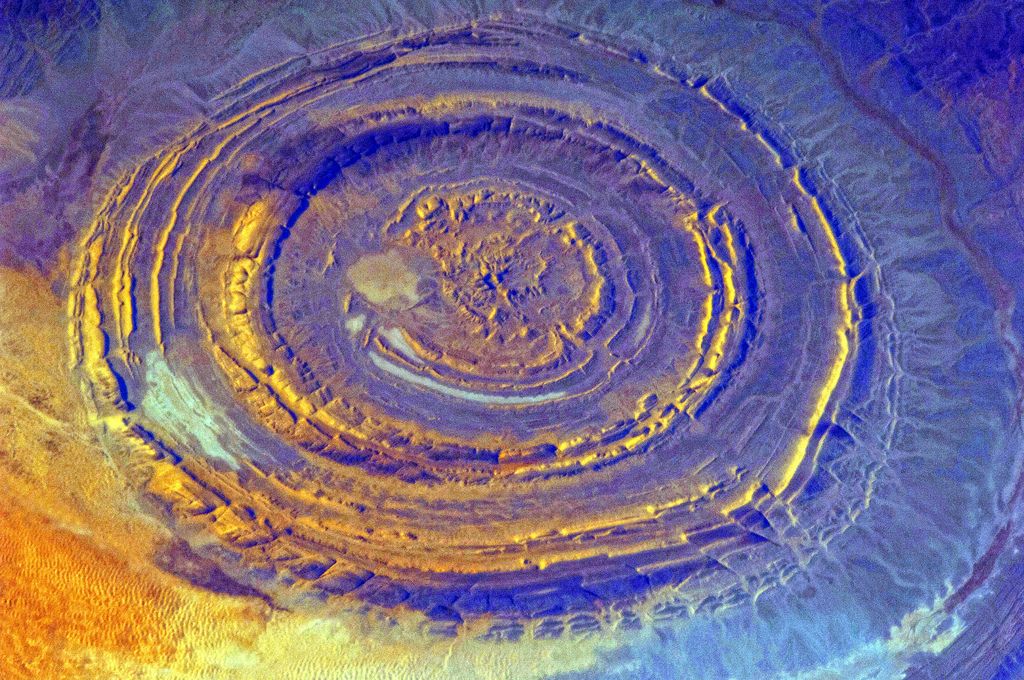
Perhaps the greatest unsolved natural mystery is what is the “eye of Sahara” and how did it get there? Such a gorgeous structure too, that it has it’s own Pinterest Boards and been blogged, researched, debunked, reported on and talked about for decades. To this day, there’s no explanation for who’s eye it is.
The Richat Structure, also called the “Eye of Africa”, or “Eye of the Sahara” is a prominent circular feature in the Sahara‘s Adrar Plateau, near Ouadane, west–central Mauritania.
A topographic reconstruction (scaled 6:1 on the vertical axis) from satellite photos. False coloring as follows: • Brown: bedrock • Yellow/white: sand • Green: vegetation • Blue: salty sediments
Naughty Beaver believes this to be a crashed UFO and if you look at the evidence, there’s no doubt that makes sense. Also, it would explain why civilization began from that point on the planet and who built the pyramids, and if they used the pyramids to generate enough energy to leave, then it would explain why we don’t know who put the pyramids there.
NASA tries to explain what happened on September 9, 2018 by issuing a statement that there were two lunar transits passing in front of the sun.
NASA’s Solar Dynamics Observatory, SDO photo from September 9, 2018
Lunar Transit or huge disk-shaped UFO?
“On Sept. 9, 2018, NASA’s Solar Dynamics Observatory, SDO, saw two
lunar transits as the Moon passed in front of the Sun. A transit happens
when a celestial body passes between a larger body and an observer.
The Moon does not, of course, actually change direction, but it
appears to do so from SDO’s perspective based on the fact that the
spacecraft’s orbit essentially catches up and passes the Moon during the
first transit.”
Here’s some of what we do know about The Eye of Sahara.
Satellite picture of the Richat Structure (false colour)
The Richat Structure is a deeply eroded, slightly elliptical dome with a diameter of 40 kilometres (25 mi). The sedimentary rock exposed in this dome ranges in age from Late Proterozoic within the center of the dome to Ordoviciansandstone around its edges. The sedimentary rocks composing this structure dip outward at 10–20°. Differential erosion of resistant layers of quartzite has created high-relief circular cuestas. Its center consists of a siliceousbreccia covering an area that is at least 30 kilometres (19 mi) in diameter.
Getting to this place is extremely challenging. Have a look at the terrain.
Exposed within the interior of the Richat Structure are a variety of intrusive and extrusiveigneous rocks. They include rhyolitic volcanic rocks, gabbros, carbonatites and kimberlites. The rhyolitic rocks consist of lava flows and hydrothermally altered tuffaceous rocks that are part of two distinct eruptive centers, which are interpreted to be the eroded remains of two maars. According to field mapping and aeromagnetic data, the gabbroic rocks form two concentric ring dikes. The inner ring dike is about 20 m in width and lies about 3 km from the center of the Richat Structure. The outer ring dike is about 50 m in width and lies about 7 to 8 km from the center of this structure. Thirty-two carbonatite dikes and sills have been mapped within the Richat Structure. The dikes are generally about 300 m long and typically 1 to 4 m wide. They consist of massive carbonatites that are mostly devoid of vesicles. The carbonatite rocks have been dated as having cooled between 94 and 104 million years ago. A kimberlitic plug and several sills have been found within the northern part of the Richat Structure. The kimberlite plug has been dated to around 99 million years old. These intrusive igneous rocks are interpreted as indicating the presence of a large alkaline igneous intrusion that currently underlies the Richat Structure and created it by uplifting the overlying rock.
Spectacular hydrothermal features are a part of the Richat Structure. They include the extensive hydrothermal alteration of rhyolites and gabbros and a central megabreccia created by hydrothermal dissolution and collapse. The siliceous megabreccia is at least 40 m thick in its center to only a few meters thick along its edges. The breccia consists of fragments of white to dark gray cherty material, quartz-rich sandstone, diagenetic cherty nodules, and stromatoliticlimestone and is intensively silicified. The hydrothermal alteration, which created this breccia, has been dated to have occurred about 98.2 ± 2.6 million years ago using the 40Ar/39Ar method.
Interpretation
The Richat structure is regarded by geologists as a highly symmetrical and deeply eroded geologic dome. It was first described in the 1930s to 1940s, as Richât Crater or Richât buttonhole (boutonnière du Richât). Richard-Molard (1948) considered it to be the result of a laccolithic thrust. A geological expedition to Mauritania led by Théodore Monod in 1952 recorded four “crateriform or circular irregularities” (accidents cratériformes ou circulaires) in the area, Er Richât, Aouelloul (south of Chinguetti), Temimichat-Ghallaman and Tenoumer. Origin of Er Richât as an impact structure (as is clearly the case with the other three) was briefly considered, but closer study in the 1950s to 1960s suggested that it was formed by terrestrial processes. After extensive field and laboratory studies in the 1960s, no credible evidence has been found for shock metamorphism or any type of deformation indicative of a hypervelocity extraterrestrial impact. While coesite, an indicator of shock metamorphism, had initially been reported as being present in rock samples collected from the Richat Structure, further analysis of rock samples concluded that barite had been misidentified as coesite.
Work on dating the structure was done in the 1990s. Renewed study of the formation of the structure by Matton et al. (2005) and Matton (2008) confirmed the conclusion that it is not an impact structure. The circular distribution of ridges and valleys is explained as the formation of cuestas by the differential erosion of alternating hard and soft rock layers uplifted as a dome by an underlying alkaline igneous complex of Cretaceous age.
A 2011 multianalytical study on the Richat megabreccias concluded that carbonates within the silica-rich megabreccias were created by low-temperature hydrothermal waters, and that the structure requires special protection and further investigation of its origin.
Archaeology
The Richat structure, also known as the Guelb er-Richât in the Mauritanian Adrar is the location of exceptional accumulations of Acheuleanartifact. These Acheulean archaeological sites are located along wadis that occupy outermost annular depression of this structure. Pre-Acheulean stone tools also have been found in the same areas. These sites are associated with rubbly, chaotic outcrops of quartzite that provided the raw material needed for the manufacture of these artifacts. The most important Acheulean sites and their associated outcrops are found along the north-west of the outer ring, from which Wadi Akerdil heads east and Wadi Bamouere to the west. Sparse and widely scattered Neolithic spear points and other artifacts have also been found. However, since these sites were first discovered by Theodore Monod in 1974, mapping of artifacts within the area of the Richat structure have found them to be generally absent in its innermost depressions. So far, neither recognizable midden deposits nor manmade structures have been recognized and reported from the Richat structure. This is interpreted as indicating that area of the Richat structure was used only for short-term hunting and stone tool manufacturing. The local, apparent wealth of surface artifacts is the result of the concentration and mixing by deflation over multiple glacial–interglacial cycles.
Artifacts are found, typically redeposited, deflated, or both, in Late Pleistocene to early Holocene gravelly mud, muddy gravel, clayeysand, and silty sand. These sediments are often cemented into either concretionary masses or beds by calcrete. Ridges typically consist of deeply weathered bedrock representing truncated Cenozoicpaleosols that formed under tropical environments. The Pleistocene to Middle Holocene sediments occur along wadis as thin, meter- to less than meter-thick accumulations in the interior annular depressions to 3–4 meters (9.8–13.1 ft) thick accumulations along the wadis in the outermost annular depression of the Richat structure. The gravelly deposits consist of mixture of slope scree, debris flow, and fluviatile or even torrential flow deposits. The finer grained, sandy deposits consist of eolian and playa lake deposits. The latter contain well-preserved, freshwaterfossils. Numerous, concordant radiocarbon dates, indicate that the bulk of these sediments accumulated between 15,000 and 8,000 BP during the African humid period. These deposits lie directly upon deeply eroded and weathered bedrock.
Eye of Sahara, the Richat Structure Source: Wikipedia
I’ve been using Ormus for 90 days and could tell the difference in my hair, skin and especially nails. This intelligent super-food seems to provide something my body wasn’t getting in my diet. Supplementing a shot of Ormus each day has made a difference I can testify to. Also, topical application of Ormus directly on the skin, I could feel it work.
These
materials are referred to as High Spin State Superconducting Materials.
The modern name is ORMUS, ORME’s and WhiteHGold. I feel that the proper
terminology that should be used to describe these elements is:
Inductively Separated Atomic Elements, or I.S.A.E.’s.
It has also
been known as Elixer, Manna, Shewbread, the snot, monatomic elements,
AuM, the polymers, mHstate, ShemHanHna, microclusters, superdeformed
high H spin elements, exoticatoms, Semen of the Gods,(I almost left that
one out…) SchefaFood, Bread of the Presence of God, MFKZT, Elixir of
Life, the lapis ,the Sophic Hydrolith of the Wise, Erinaes, Philothes,
Philolithes, Apaitu, Batu, Surgawi, Bubuk Putih, Mannadan Salwa,
chrysopoeia, dew, occult gold, aurum potable, water of gold, and also
The Philosophers’ Stone, among many other names.
However, whatever
the name, the compounds are the same. These compounds are the material
bridge between chemistry, biology, and the physics of matter, through
scalar vortices that bridge all material, space-time, and even thought.
These compounds are everywhere. They are in the water, the soil and even
in the air that we breathe. But what are they? What are Orbitally
rearranged monoatomic elements? And, why are they so abundant?
They
are a result of a combined inductive and acidic reaction, a reaction
that dis-attaches a single atom of an inductive element and attaches it
to a chlorine molecule in a hydride solution, and then, causal
reactions, like gravity, inertia, and electromagnetic oscillations,
decouples this bond in an alkaline state, inducing a hydrofugal torsion
reaction due to the polarization of this inductive particle, this atom.
This becomes a high spin-state particle, a material oscillating,
inductive, conductive, gyroscopic, atomic, reactive compound.
Mineral
salts are not only everywhere on this planet but also in our bodies.
Many of these mineral salts are created by a gradual breakdown of some
of these inductive, conductive metallic materials, such as gold and
platinum group elements. These elements, atom by atom, are being
slightly loosened to their own elemental attractive bonds due to this
inductive reaction on the skin of the element this reaction creates an
attraction to, and bonding with, a chlorine molecule, into a chloride
solution, or substrate. Sodium chloride, Auric chloride, copper chloride
and many other bonded metallic salts are attached to the hydrate, the
molecule that we call water.
AuCl is Auric Chloride, or Gold
Chloride. This compound is plentiful in the Oceans of this planet. The
ocean has many chlorine-based metallic compounds suspended in it, in a
solution, as a substrate. What is profoundly interesting, is that in
this chlorine bonded state, these metals are water soluble and flow
through most filters.
What is equally fascinating is that they can
also be decoupled from the chlorine atom using inductive frequencies.
When these atoms are induced with a magnetic wave form, through a
torsion wave or a spinor vortex, the inductive frequency of the
inductive material allows it to charge, inducing a polar reaction which
dis-attaches it magnetically from the chlorine molecule. The charge
produced by the magnetic wave is the inductive frequency necessary to
dis-attach the inductive particle from the non-quite-so-inductive
material of the chlorine atom. Think of this as a magnet flipping poles
and moving away from its former attraction, through the opposing
magnetic vortex.
When these inductive elements are dis-attached,
they become a highly active “spin particle”, a highly magnetic and
energized electro-inductive, conductive atom, spinning unattached and
unopposed. This is a reaction that is understandable simply by watching
figure skaters spin.A single rotating particle or entity can always
rotate faster than two or more combined. This is an oscillatory response
and a magnetic interaction. This is due to magnetic vortices that are
creating resistance, via magnetic inductive interactions, inertia, an
oscillatory response to spin particles.
These precious materials
are also very abundant in this state, estimated to be many thousands of
times more plentiful than the metallic counterparts that are being mined
on land and sea. This may be due to the solubility of these precious
metals and the fact that they have been drained out to sea by rainfall
for many billions of years. The interior of the crust is liquid and, as
it oscillates, it pressurizes due to a centripetal reaction caused by
cavitation, an inertial transfer of force occurs, which is an
exponential reaction of centrifugal forces caused by acceleration . As
this reaction occurs, an elementally rich magma, continually pools these
elements to the surface, allowing this process, this accumulation, to
continue unabated for millennium. Seawater weighs 2.4% more than
freshwater, 1.024 grams per milliliter, due to this process. This means
there is 24 grams of metal per liter of seawater.
Now, this
process happens naturally in all living organisms through these magnetic
interactions that interface with intracellular reactions. In our
bodies, our acidic digestive system removes these materials from the
food that we eat. These minerals are absorbed into our blood, from the
gastrointestinal tract as metallic chlorides. This is why blood tastes
salty. It is salty. These are metallic chlorides in a substrate. These
substrates are highly inductive and conductive and allow wave transfers
from the interferometer.
Our Interferometer: Our Brain.
Our
brain is an interferometric accumulator. What the heck is that, you
ask? An interferometer is a mechanism for the collection and
accumulation of opposing magnetic fields and which has the capacity of
coupling these fields into an electromagnetic reaction. Our brain has a
bi-toroidal reaction occurring inside of it, but also around it. This is
the mechanism, the motor, the generator that creates our bodies
electromagnetic reactions. The myth of using only 15 percent of our
brain is exactly that, a myth. We use all of our brain. All of it. Our
brain has a similar function to that of a crystal refraction or a piezo
reaction. It separates magnetic wave forms, and then combines opposing
magnetic waves into an electromagnetic reaction. This is
bio-electricity. The conduit for this reaction, the transfer mechanism
between the chemical and the mineral and the bio-organic transfer of
energy, is through this Orbital Reaction.
Our brain has two
hemispheres for this reason. It couples these wave forms at the same
frequency as the longitudinal waves on our planets surface, 7.83 Hertz.
This pulse induces the reaction necessary to de-couple the chloride
bonded inductive materials in our bloodstream, which provides the
transfer of inductive fields into the mitochondria, the power plant of
the cell, allowing the bi-toroidal reaction of the ATP conversion to
take place. The process involves stripping the magnetic bond off the ATP
and kicking it back out in two pieces.
Remember the endoplasmic
reticulum? Exactly! The ER doesn’t allow particle or enzymatic transfer,
does it? This reaction, inside the mitochondria is an inductive
reaction, as all chemical reactions are based on transfers of magnetic
fields of force, causing coupling and decoupling of “atoms” by changing
the polarity of its wave forms.
All matter is formed by these forces.
Monoatomic
atoms have been observed to exist in all the heavy elements in the
center of the periodic table. These are the elements which have
“half-filled” bands of valence electrons and include the following
elements. Their atomic numbers are given in parenthesis (the atomic
number represents the number of protons in the nucleus.) Ruthenium (44),
Rhodium (45), Palladium (46), Silver (47), Osmium (76), Iridium (77),
Platinum (78), and Gold (79). Other metallic elements in the same part
of the periodic table have also been observed in micro clusters. Because
the atoms of monoatomic elements are not held in a rigid lattice
network, their physical characteristics are quite different from atoms
which are locked in the lattice. Thus, it is the grouping of atoms which
defines the physical characteristics of the element; not just the
number of neutrons and protons in the nucleus as previously believed. If
you don’t have a lattice network, you don’t have a metal even though
the atoms of the two forms of matter are identical!
Creation of the Sun and Moon by Michelangelo, face detail of God.
Michelangelo is the GOAT of art, sculpture and Architecture. His life and career spanned almost 100 years of creative genius on the next level. He was 74 years old when he began the Saint Peter Basilica, to claim his place as an unsurpassed architect. Michelangelo remains the greatest of all time, in more categories than anyone else in human history.
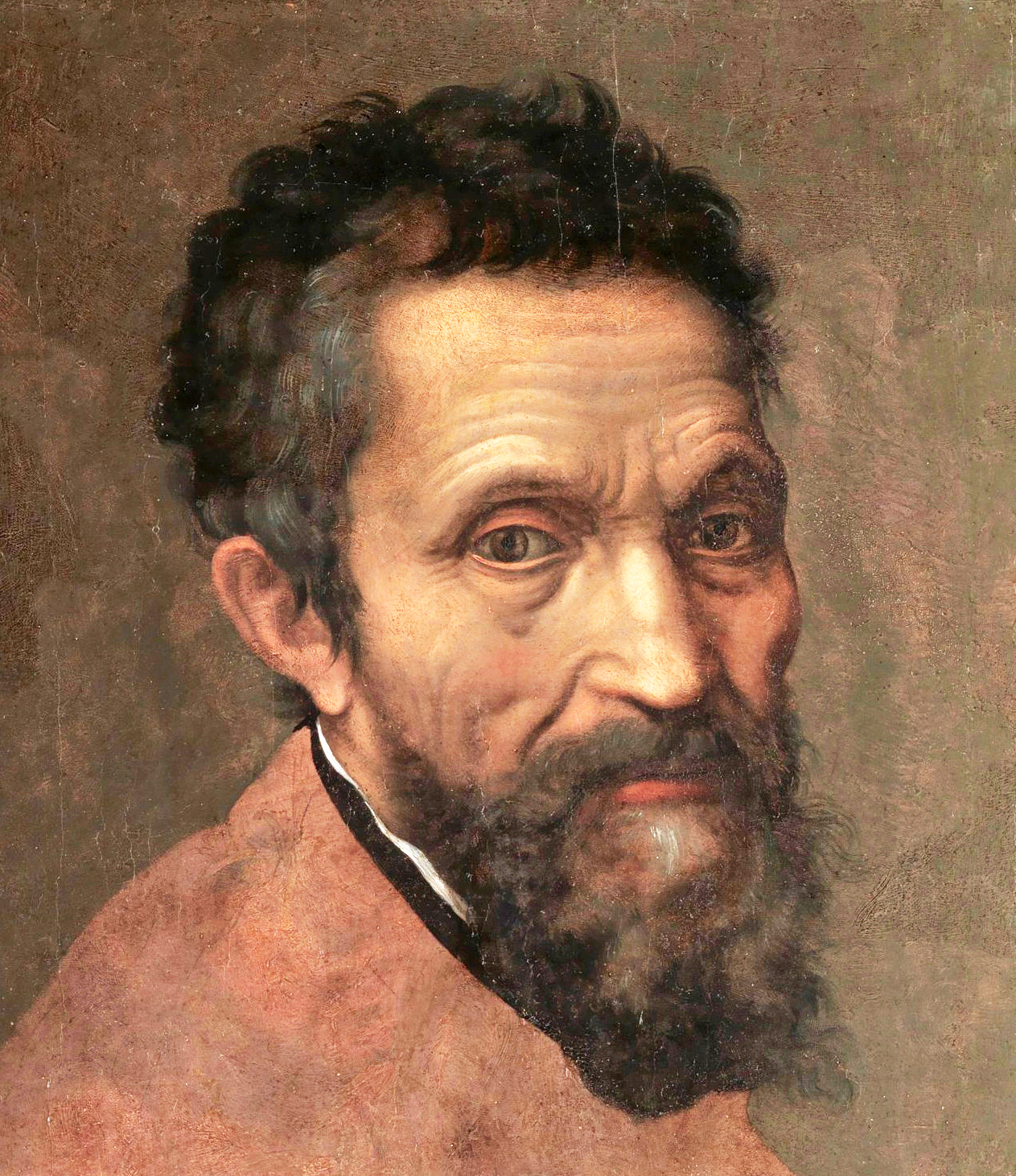
Daniele da Volterra of Michelangelo Buonarroti, probably ca. 1544
Oil on wood; 34 3/4 x 25 1/4 in. (88.3 x 64.1 cm)
The Metropolitan Museum of Art, New York, Gift of Clarence Dillon, 1977
Michelangelo di Lodovico Buonarroti Simoni or more commonly known by his first name Michelangelo (6 March 1475 – 18 February 1564) was an Italian sculptor, painter, architect and poet of the High Renaissance born in the Republic of Florence, who exerted an unparalleled influence on the development of Western art. Considered by many the greatest artist of his lifetime, and by some the greatest artist of all time, his artistic versatility was of such a high order that he is often considered a contender for the title of the archetypal Renaissance man, along with his rival, the fellow Florentine and client of the Medici, Leonardo da Vinci.
Michelangelo was the first Western artist whose biography was published while he was alive. In fact, two biographies were published during his lifetime. One of them, by Giorgio Vasari, proposed that Michelangelo’s work transcended that of any artist living or dead, and was “supreme in not one art alone but in all three”.
Detail from The Creation of Adam, portraying the creation of mankind by God
A number of Michelangelo’s works of painting, sculpture and architecture rank among the most famous in existence. His output in these fields was prodigious; given the sheer volume of surviving correspondence, sketches and reminiscences, he is the best-documented artist of the 16th century. He sculpted two of his best-known works, the Pietà and David, before the age of thirty. Despite holding a low opinion of painting, he also created two of the most influential frescoes in the history of Western art: the scenes from Genesis on the ceiling of the Sistine Chapel in Rome, and The Last Judgment on its altar wall. His design of the Laurentian Library pioneered Mannerist architecture. At the age of 74, he succeeded Antonio da Sangallo the Younger as the architect of St. Peter’s Basilica. He transformed the plan so that the western end was finished to his design, as was the dome, with some modification, after his death.
God dividing the waters, showing the illusionary architecture, and the positions of the Ignudi and shields
In his lifetime, Michelangelo was often called Il Divino (“the divine one”). His contemporaries often admired his terribilità—his ability to instil a sense of awe. Attempts by subsequent artists to imitate Michelangelo’s impassioned, highly personal style resulted in Mannerism, the next major movement in Western art after the High Renaissance.
See: The Renaissance – the Age of Michelangelo and Leonardo da Vinci
The Dead Sea Scrolls (also Qumran Caves Scrolls) are ancient Jewish religious manuscripts found in the Qumran Caves in the Judaean Desert, near Ein Feshkha on the northern shore of the Dead Sea. Scholarly consensus dates these scrolls from the last three centuries BCE and the first century CE. The texts have great historical, religious, and linguistic significance because they include the second-oldest known surviving manuscripts of works later included in the Hebrew Bible canon, along with deuterocanonical and extra-biblical manuscripts which preserve evidence of the diversity of religious thought in late Second Temple Judaism. Almost all of the Dead Sea Scrolls collection is currently under the ownership of the Government of the state of Israel, and housed in the Shrine of the Book on the grounds of the Israel Museum.
Two examples of the pottery that held some of the Dead Sea Scrolls documents found at Qumran.
Many thousands of written fragments have been discovered in the Dead Sea area. They represent the remnants of larger manuscripts damaged by natural causes or through human interference, with the vast majority holding only small scraps of text. However, a small number of well-preserved, almost intact manuscripts have survived – fewer than a dozen among those from the Qumran Caves. Researchers have assembled a collection of 981 different manuscripts – discovered in 1946/47 and in 1956 – from 11 caves. The 11 Qumran Caves lie in the immediate vicinity of the Hellenistic-period Jewish settlement at Khirbet Qumran in the eastern Judaean Desert, in the West Bank. The caves are located about one mile (1.6 kilometres) west of the northwest shore of the Dead Sea, whence they derive their name. Scholarly consensus dates the Qumran Caves Scrolls from the last three centuries BCE and the first century CE. Bronze coins found at the same sites form a series beginning with John Hyrcanus (in office 135–104 BCE) and continuing until the period of the First Jewish–Roman War (66–73 CE), supporting the radiocarbon and paleographic dating of the scrolls.
Scholars assembling and examining the Dead Sea Scrolls fragments in what became known as the “Scrollery” room of the Rockefeller Museum (formerly the Palestine Archaeological Museum).
Initial discovery (1946–1947)
The initial discovery by Bedouin shepherd Muhammed edh-Dhib, his cousin Jum’a Muhammed, and Khalil Musa, took place between November 1946 and February 1947. The shepherds discovered seven scrolls (See Scrolls and fragments) housed in jars in a cave near what is now known as the Qumran site. John C. Trever reconstructed the story of the scrolls from several interviews with the Bedouin. Edh-Dhib’s cousin noticed the caves, but edh-Dhib himself was the first to actually fall into one (the cave now called Cave 1). He retrieved a handful of scrolls, which Trever identifies as the Isaiah Scroll, Habakkuk Commentary, and the Community Rule, and took them back to the camp to show to his family. None of the scrolls were destroyed in this process. The Bedouin kept the scrolls hanging on a tent pole while they figured out what to do with them, periodically taking them out to show to their people. At some point during this time, the Community Rule was split in two. The Bedouin first took the scrolls to a dealer named Ibrahim ‘Ijha in Bethlehem. ‘Ijha returned them, saying they were worthless, after being warned that they might have been stolen from a synagogue. Undaunted, the Bedouin went to a nearby market, where a Syrian Christian offered to buy them. A sheikh joined their conversation and suggested they take the scrolls to Khalil Eskander Shahin, “Kando”, a cobbler and part-time antiques dealer. The Bedouin and the dealers returned to the site, leaving one scroll with Kando and selling three others to a dealer for 7 Jordanian pounds (approximately $28, or $314 in 2018 dollars). The original scrolls continued to change hands after the Bedouin left them in the possession of a third party until a sale could be arranged. (See Ownership.)
Qumran cave 4, where ninety percent of the scrolls were found
In 1947 the original seven scrolls caught the attention of Dr. John C. Trever, of the American Schools of Oriental Research (ASOR), who compared the script in the scrolls to that of The Nash Papyrus, the oldest biblical manuscript then known, and found similarities between them. In March the 1948 Arab–Israeli War prompted the move of some of the scrolls to Beirut, Lebanon, for safekeeping. On 11 April 1948, Millar Burrows, head of the ASOR, announced the discovery of the scrolls in a general press release.
In the larger sense, the Dead Sea Scrolls include manuscripts from additional Judaean Desert sites, dated as early as the 8th century BCE and as late as the 11th century CE.
Search for the Qumran caves (1948–1949)
A view of the Dead Sea from a cave at Qumran in which some of the Dead Sea Scrolls were discovered.
Early in September 1948, Metropolitan bishop Mar Samuel brought some additional scroll fragments that he had acquired to Professor Ovid R. Sellers, the new Director of ASOR. By the end of 1948, nearly two years after their discovery, scholars had yet to locate the original cave where the fragments had been found. With unrest in the country at that time, no large-scale search could be undertaken safely. Sellers tried to get the Syrians to assist in the search for the cave, but he was unable to pay their price. In early 1948, the government of Jordan gave permission to the Arab Legion to search the area where the original Qumran cave was thought to be. Consequently, Cave 1 was rediscovered on 28 January 1949, by Belgian United Nationsobserver Captain Phillipe Lippens and Arab Legion Captain Akkash el-Zebn.
Archaeologists have long associated the scrolls with the ancient Jewish sect called the Essenes, although some recent interpretations have challenged this connection and argue that priests in Jerusalem, or Zadokites, or other unknown Jewish groups wrote the scrolls. Robert Eisenman vigorously posits his theory that the later, non-biblical “sectarian” scrolls must be viewed in the context of a wider first-century CE “Opposition Movement,” including Essenes, Zealots, Sicarii, and/or Nazoreans, and particularly the early Judeo-Christian community of Jerusalem, the Ebionites, whose leader, James, the brother of Jesus, was acknowledged by the entire “Opposition Movement,” and who is no other than the Scrolls’ Teacher of Righteousness. He thus creates a strong link between the Scrolls and the pre-Pauline Jewish Christian community.
Emanuel Tov (1941–) who was Editor-in-Chief of the Dead Seas Scrolls Publication Project and, as a result, responsible for the publication of 32 volumes of the Discoveries in the Judaean Desert series. He also worked to publish a six-volume printed edition with a majority of the non-Biblical Dead Sea Scrolls and make the same volumes available electronically on CD in a collection titled “The Dead Sea Scrolls Reader”.
Owing to the poor condition of some of the scrolls, scholars have
not identified all of their texts. The identified texts fall into three
general groups:
About 40% are copies of texts from the Hebrew Scriptures.
Cosmic Consciousness is the best term to define something that can’t be defined in language but it sure sounds fun and like something we all want to experience. Perhaps you’ve noticed my obsession with ascendance? Ever since I solved the ringing in the ears and connected the Schumann resonances, I’ve not been able to stop studying metaphysics.
If it weren’t for the Internet, perhaps many of us would have gone insane? However, the breadcrumb trails leading to the ancient wisdom, were everywhere. The pieces of the puzzle were all online, all that was needed was the time, the desire to know, and the willingness to learn.
Yogapedia explains Cosmic Consciousness
When Cosmic Consciousness is reached, the individual moves from believing in the oneness of the universe to having a direct knowledge of that fact. This level of consciousness requires letting go of the superficial ego.
Some claim that reaching this awareness may cause a person to retreat from the noise of the outside world and seek solitude. They will develop a heightened awareness of their own mental state and that of those around them.
In 1901, Richard Maurice Bucke — a Canadian psychiatrist — wrote a book about Cosmic Consciousness, in which he defined it as the highest of three levels of consciousness found in living beings:
Simple consciousness, which both mankind and animals possess;
Self-consciousness, which includes thought, reason, and imagination and that mankind possesses; and
Cosmic Consciousness, which is a higher and more spiritual consciousness than most ordinary people possess.
For Bucke, Cosmic Consciousness included a spiritual understanding that there is eternal life and that God is the whole universe. He saw all things as being interconnected — a part of the cosmic consciousness. A popular meditation and spirituality figure in the West, Deepak Chopra has postulated that the concept of Cosmic Consciousness may be related to the hidden dimensions of quantum mechanics.
A spiritual yoga practice can help an individual move closer to attaining Cosmic Consciousness. Poses that open the third eye and crown chakras are particularly helpful in reaching this goal.


















You must be logged in to post a comment.