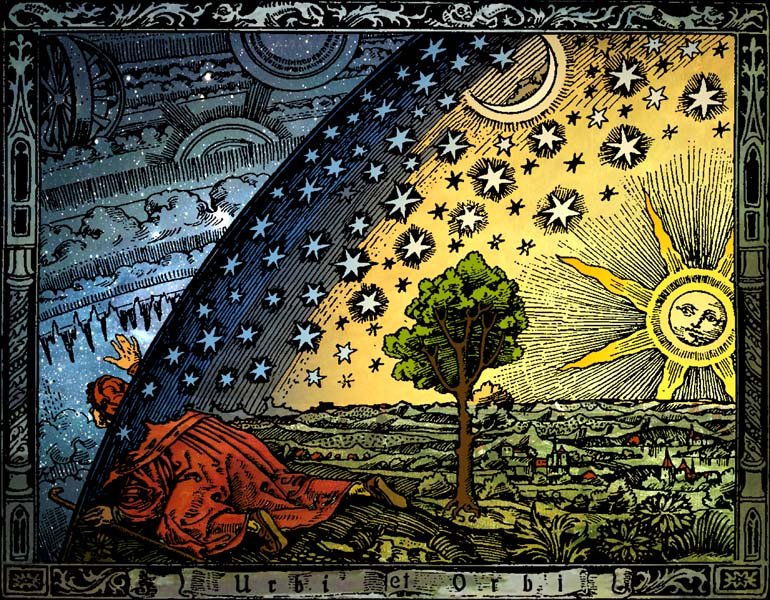
Colour adaptation of the original by Camille Flammarion (1842-1925).- L’atmosphère : météorologie populaire, Hachette, Paris, 1888
Today the magic of the Internet fed me some new food for thought, as I stumbled on a video I had been watching a video called “Enlightenment” on Youtube so several weeks ago, and just today got back to it and after only 5 minutes it expanded my mind with the terminology “Quantum Jumping”.
Random searching that keyword phrase and the word Gnosis when I noticed the thumbnail for this image from 1888 that completely captured my senses, perfect for an illustration of the impossible to explain, which when colour was added became a Quantum Jump poster (in my opinion). Hope this triggers you to jump.
The Flammarion engraving is a wood engraving by an unknown artist that first appeared in Camille Flammarion‘s L’atmosphère: météorologie populaire (1888). The image depicts a man crawling under the edge of the sky, depicted as if it were a solid hemisphere, to look at the mysterious Empyrean beyond. The caption translates to “A medieval missionary tells that he has found the point where heaven and Earth meet…”
What does quantum jumping mean? An abrupt transition of a system described by quantum mechanics from one of its discrete states to another, as the fall of an electron in an atom to an orbit of lower energy. any sudden and significant change, advance, or increase.
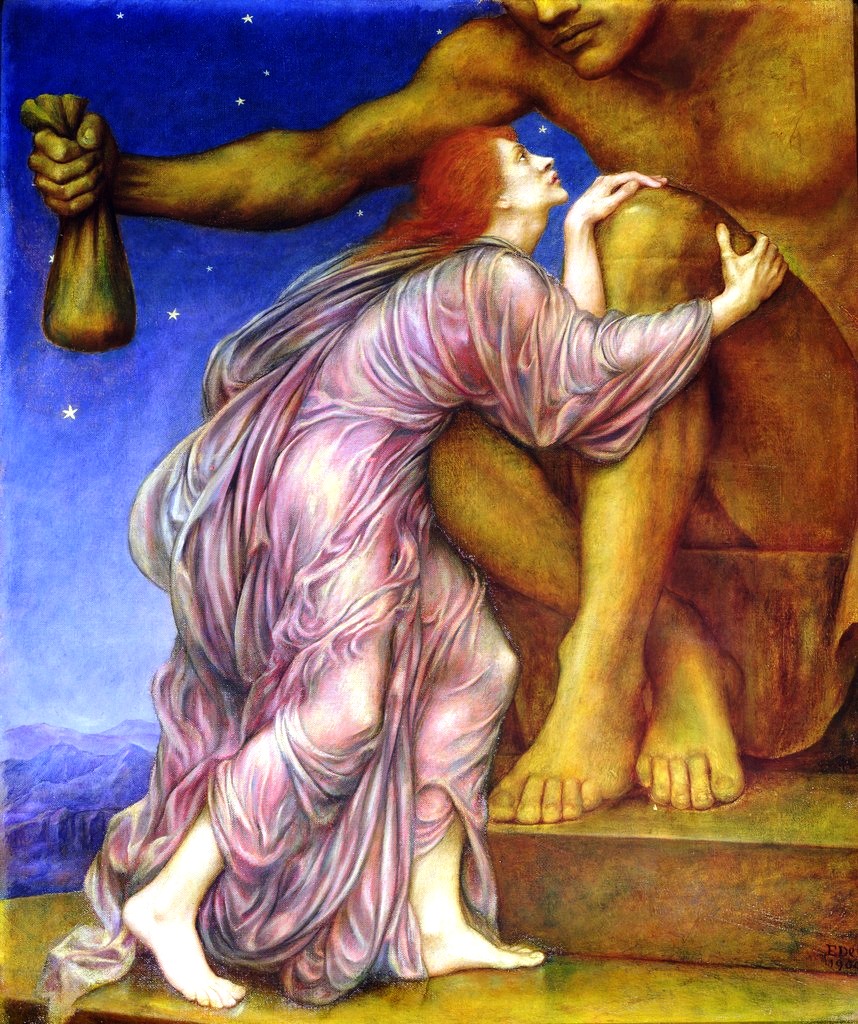
1909 painting The Worship of Mammon by Evelyn De Morgan.
The word Mammon really fell from our lexicon, wonder why too, as it’s such a descriptive word and has such a long history. It’s as though the the meaning is ugly or distasteful, so it’s been cast aside.
For the longest time I read and re-read Luke Chapter 16 and especially verse 8 , where Jesus say’s in the parable of the Unjust Steward;
for the children of this world are in their generation wiser than the children of the light.
Luke 16:8
Mammon Etymology
The word Mammon comes into English from post-classical Latinmammona ‘wealth’, used most importantly in the Vulgate Bible (along with Tertullian’smammonas and pseudo-Jerome’s mammon). This was in turn borrowed from Hellenistic Greek μαμωνᾶς, which appears in the New Testament, borrowed from Aramaic מָמוֹנָא māmōnā, an emphatic form of the word māmōn ‘wealth, profit’, perhaps specifically from the Syriac dialect. However, it is not clear what the earlier history of the Aramaic form is.
The word may have been present throughout the Canaanite languages: the word is unknown in Old Testament Hebrew, but has been found in the Qumran documents; post-biblical Hebrew attests to māmōn; and, according to St Augustine of Hippo, Punic included the word mammon ‘profit’. It has been suggested that the Aramaic word māmōn was a loanword from Mishnaic Hebrew ממון (mamôn) meaning money, wealth, or possessions; although it may also have meant “that in which one trusts”.
According to the Textus Receptus of the New Testament, the Greek word translated “Mammon” is spelled μαμμωνᾷ in the Sermon on the Mount at Matt. 6:24, and μαμωνᾶ (from μαμωνᾶς) in the parable of the Unjust Steward at Luke 16:9,11,13.
The 27th edition of the popular Critical Text of the New Testament has μαμωνᾶ in all four places with no indication of any textual variances, thereby ignoring the Textus Receptus reading at Matt. 6:24. The Liddell and Scott Lexicon has a listing for each spelling, indicating that each occurs only in the New Testament, nowhere else in ancient and Hellenistic Greek literature. The spelling μαμμωνᾷ refers to “a Syrian deity, god of riches; Hence riches, wealth”; μαμωνᾶς is transliterated from Aramaic [ממון] and also means “wealth.” The Authorised Version uses “Mammon” for both Greek spellings; John Wycliffe uses richessis.
The Revised Standard Version of the Bible explains it as “a Semitic word for money or riches”. The International Children’s Bible (ICB) uses the wording “You cannot serve God and money at the same time”.
Christians began to use mammon as a pejorative, a term that was used to describe gluttony, excessive materialism, greed, and unjust worldly gain.
I can attest to the this being a tough test, especially in an age when a billion dollars can be made in a single year, by a single soul, connected to the right people, at the right time, with the right ideas. Which is why tech incubators are located on university campuses. Silicon Valley is comprised of thousands of companies that were a bright idea just a few years ago.
Passion for web publishing and love of the Internet and this brave new information age world we live in, is what empowers me to keep chasing my own Mammon but for sure I am guilty of the sin of the worship of Mammon and recognize that my self-conditioning, cultural programming and total naivety, sadly; pursuit of Success has been the hallmark of my life.
I’m a Technocrat but at least not a snob about it. Forgive me, as I forgive myself and forgive you too but let’s try to get over it, worship of Mammon sucks, having it is sweet but what is best is a dough flow, thick and rich, started from a trickle and nurtured to a steady, consistent cash-flow.
The prayer to ask for, rather than a boatload of Mammon, is to find a useful niche that helps others benfit, from which to extract sustainable prosperity.
I had that feeling, upon entering the second hand store, that there was something in there I needed to find. It was a glorious Saturday in March and a little framed print caught my eye, on one of the lower shelves of a tightly packed array, when I went to the trouble to bend down, reach in and pull it out to look, the moment I saw eyes looking back at me I was thrilled and clutched it, then bought it, and came immediately home to hang it up.
Here’s the image from the Michelle Kuen Suet Fung website and her story of creating; Just Hanging Out…
Just Hanging Out 遊戲人間, 2008. Ink and Coloured Pencils on Paper 鋼筆、木顏色紙本 8×10″ Private Collection.
Michelle Kuen Suet Fung 馮捲雪!
“Just Hanging Out” is my most popular series to date.
Sometimes a great series was meticulously researched and carefully planned. Other times, it just happened.
This series just happened.
Late 2008, under the dark sky deep into the wee hours of the evening,
I buried myself in the studio, physically tired yet with blade-sharp
concentration. I was in that trance where I wanted to stay up all night
and create. (No, with no aid of drugs. See point 54.) I grabbed a piece of paper and started drawing.
There! it was done in one sitting.
To be honest, when I finished it, I treated it as one of my many drawings. I never paid much attention to it. I didn’t even like it that much. I didn’t do anything with it until in Jan 2009, I took this drawing (along with other works) to Doctor Vigari Gallery. The drawing was sold within a month and I had constant positive feedback from people.
The central tree is a symbolic tree of life and the various little people or animals/objects “just hanging out” with the tree parallel how we all just hanging out during the span of our lifetime. I use this context to ask some of my endless questions about life, death, love…I chose to take a playful approach rather than a didactic one. I prefer to be provided with a space to medidate rather than told how/what to think. This translate into how I want my viewers to approach my works. The light-hearted imageries reduces the emotional guard of adults. No matter how much one cannot identify with these big-eyed figures, it is rather difficult to be intimidated by them.
In this particular drawing (which was only meant to be a stand-alone
drawing in the beginning), I ask questions about life and death. A baby,
wrapped in a soft cocoon, is hung from a leaveless tree in a style not
unlike on a death rope. The tree is in its withering (or resting) stage,
whereas the baby in its cocoon suggests a glorious metamorphosis.
I love playing with contradiction within one image. My mother is in love with Charlotte Brontë’s Jane Eyre. (Alas I was into her sister’s Wuthering Heights more. Mom was not pleased that I was into the wild passion as a teen. See point 23) She always quoted “a bundle of contradictions” when I was a girl. I have always found the term befit me well. So there, as I say in my artist statement, none of my artworks is self portrait, but I acknowledge a lot of myself in them.
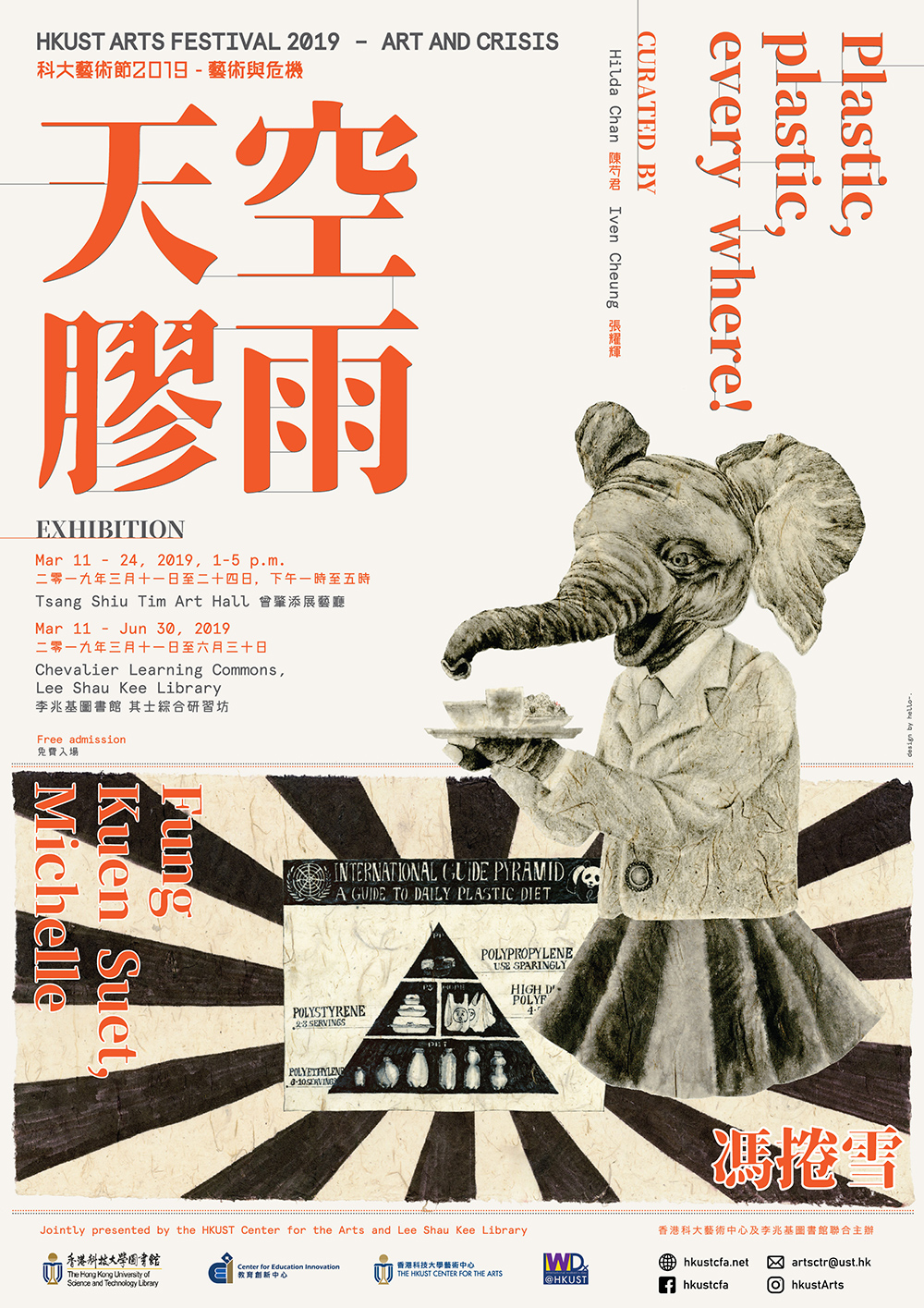
More promotion of Michelle Kuen Suet Fung, as she has an awesome exhibition to reduce plastic waste and help raise awareness of the danger to nature, with her exhibition called: Plastic, plastic, every where! 天空膠雨
Finding relations using statistics, machine learning, and artificial intelligence.
Not exactly sure how I found the website “I write like” but from the first moment I was mesmerized by the system. A simple idea in theory but very complicated in application. It’s a good example of where Artificial Intelligence (AI) has found a perfect application, to rapidly analyze language patterns, then make comparison of your writing style, to one of the more than 50 famous authors.
The other thing that’s very compelling about the “I write Like” website is the list of famous authors. Extra bonus is that you can learn about great new writers because the current list of 50 are very diverse, some of whom you likely will not have heard of, this will encourage more follow-up.
A great list of interesting writers, accompanied by thumb-nails of the Amazon linked books they’ve written. For example, my second and third random test of my writing (from this blog) returned the same result twice, that of a living legend, author, blog writer named Cory Doctorow.
I Write Like is a website created by Russian software programmer Dmitry Chestnykh, founder of software company Coding Robots. The site analyzes users’ writing samples and, by looking for certain keywords, vocabulary, and style via a naive Bayes classifier returns the name of a popular writer the sample most closely resembles. It was launched on July 9, 2010 and, according to reports, has gone viral, getting over 100,000 visitors on July 13, 2010 and spreading quickly across other blogs and popular social-networking websites such as Facebook and Twitter.
According to the Toronto Star, the website’s popularity soared as a result of a series of rants made by actor Mel Gibson; New York City-based blog Gawker submitted transcripts of Gibson’s rants to find that the site website compared them to writings by Canadian writer and feminist Margaret Atwood. Film critic Roger Ebert tried the site and said on a tweet that “I Write Like thinks I write like Margaret Atwood, she writes like H. P. Lovecraft, and he writes like James Joyce“. The Star also reported the result that Ontario premier Dalton McGuinty‘s Children’s hospital in Ottawa celebrates big expansion closely resembles Joyce’s A Portrait of the Artist as a Young Man. The Guardian reported that Atwood herself tried out the website, and it said that her writing resembles that of novelist Stephen King in one attempt and like Joyce on another try. William Gibson also tried the site, which said his writing resembles that of Vladimir Nabokov. A transcript of a speech made by U.S. President Barack Obama in June 2010 has been compared to author David Foster Wallace, while the lyrics to Lady Gaga‘s song “Alejandro” have been compared to William Shakespeare. Other bloggers, including author Teresa Nielsen Hayden, have expressed anger and frustration to find that the website has compared their writings to that by The Da Vinci Code author Dan Brown. Despite the website’s early success, Chestnykh was cautious to say that its accuracy still needs improvement, as he has only been able to upload “a few books by some 50 different authors” into its database. He says that he intends to include advanced features such as “probability percentages” that a user-submitted passage resembles a certain author.
Below are the words copied from the About-page at “I write Like” official website:
[hr]
I Write Like checks which famous writer you write like by analyzing your word choice and writing style and comparing them with those of the famous writers. Analyze your text
How does it work?
The algorithm pretty simple, and you can find it on every computer today. It’s a Bayesian classifier, which is widely used to fight spam on the Internet. Take for example the “Mark as spam” button in Gmail or Outlook. When you receive a message that you think is spam, you click this button, and the internal database gets trained to recognize future messages similar to this one as spam. This is basically how “I Write Like” works on my side: I feed it with “Frankenstein” and tell it, “This is Mary Shelley. Recognize works similar to this as Mary Shelley.” Of course, the algorithm is slightly different from the one used to detect spam, because it takes into account more stylistic features of the text, such as the number of words in sentences, the number of commas, semicolons, and whether the sentence is a direct speech or a quotation.
Mar is short for Mary Anne, or so my Mom tells me so. Mar was born in 1935 and became my mother in 1961. She’s the most amazing soul, always seeking things that others have overlooked. Recognizing value in art with an eye for style and a natural tendency to discover treasures. Mar finds art and second hand goods that improve or enhance the houses of her friends and family. A constant source of new used furniture, equipment and art, or the person to discover appliance or furniture for someone who needs something for home improvement. If there’s a “Restore or Value Village” she knows where but it’s her art collection that’s impressive containing a mix of original painting and sketches, plus several prints from Canadian artists including Emily Carr.
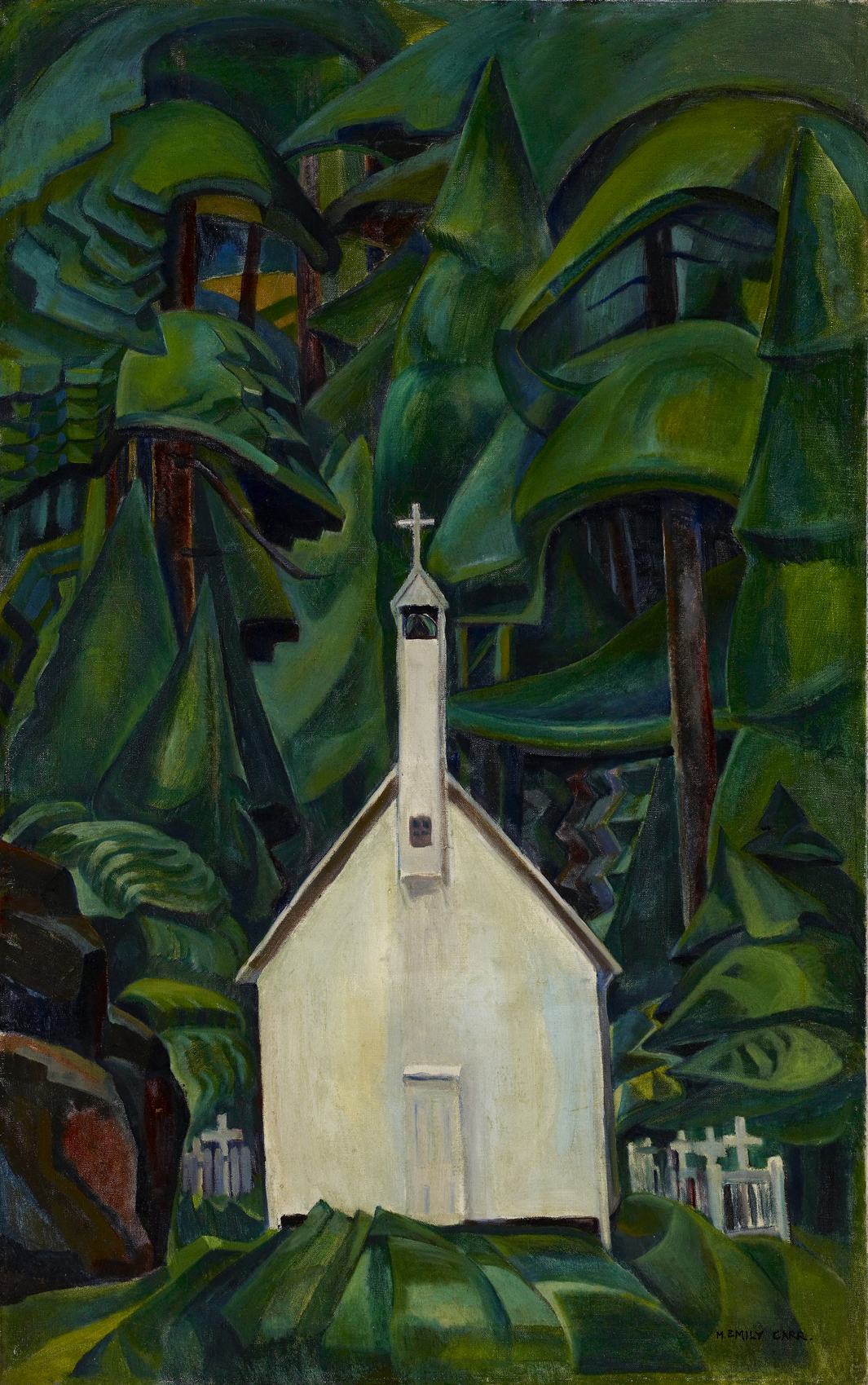
Mar keeps an entire collection of Emily Carr books and reviews of her large collection. Emily Carr has always been Mar’s favorite and reminds us of the story of Emily Carr’s life, before she became a famous artist. Recently Mar had to replace one of her favorite prints, of the painting that made Emily Carr famous; The Indian Church
Emily Carr – Wikipedia
The Indian Church is a 1929 painting by Canadian artist Emily Carr.Group of Seven artist Lawren Harris bought the painting to showcase it in his dining room, and called it Carr’s best work. In 1930, the work was shown in the Fifth Annual Exhibition of Canadian Art organised by the National Gallery of Canada. In 1938, the painting was chosen for an exhibition titled A Century of Canadian Art, at the Tate Gallery. The exhibition was described by Vincent Massey as “a most representative showing of Canadian painting and sculpture, including all schools and all periods.” It is considered a “transitional” painting because it reflects the transition of Carr’s artistic work from purely depicting Native Art to shifting her focus toward the land.
In her autobiography, Carr wrote that she “felt the subject deeply”. She painted it at Friendly Cove, near a lighthouse. When Carr saw her painting in Harris’s home, she exclaimed: “The house must have bewitched this thing! It was better than I had thought.” However she could not look at it, because she could not accept praise from other people, and felt embarrassed when others complimented her about her work. The painting is one of Carr’s most reproduced works, and was eventually donated to the Art Gallery of Ontario by Charles Band.
Creation
In the spring of 1929, Carr travelled by train through Vancouver Island to Port Alberni from where she went by steamer to Nootka Island. There she sketched, among other subjects, a white church that was in the area. When she returned to Victoria, she started painting crosses around the church, creating the impression of a graveyard. In the painting, she omitted adding any other buildings near the church, as was the case with the actual church, to emphasise the isolation of the church within its green environment. She also added an element of danger in the form of wavy dark green undergrowth erupting in front of the church.
The best way to learn to write, is to write. It is said that the best way to get started is to just begin writing. These are the steps towards the Art of Writing.
Some of us have always wanted to be writers and some of were naturally gifted in this expression, while others were educated in writing by having to write, then there were those others that needed to write to make a living, especially as we transition into the information-age. In each and every case, the quality of the written word is most valued when it succinctly describes and idea. The fewer words the better and the key to success is the emotion the writer is able to convey. We can see beauty in everything in our world, even the depths of hell can be described but can we describe the things we see daily, or visualize throughout the day, in an articulate style that can illicit some feelings and deliver some meaning to the reader?
To write well, it has to become art. The very symmetry of the letters as they slash into the empty white space of the page, is akin to a dance with the music from an orchestra. I can envision the conductor, in my own mind as I free-form these thoughts onto this page. We’ve been told to write whatever comes to mind, if you’re unsure about what to write about and that’s a little of what this is about. Today, for example I set-out to write about my new format for blogging and video production. This article “The Art of Writing” is the first of my new format, which is designed to; blog about the things I’m working on for the Youtube channel “Invest Offshore”, as well as the people and projects I’m meeting and learning about.
Over the years, I’ve come to realize that I’m in a position to share a unique perspective. That of a tech evangelist who recommends moving offshore and living as a sovereign individual.
Here and from now on, I wish to express my ideas and write about anything and everything that either amuses me, or bothers me. Despite the fact that I’m interested in conspiracy theory and complete believer/proponent in digital currency and blockchain, I’ll try not to saturate this stream with crypto news or conspiracy theory. Also, I’m very interested in digital photography, cameras and video production, plus obsessed advocate of Adobe Creative Cloud Suite of products including Photoshop, Premier Pro, Light Room, Dreamweaver and others, having said all that, this blog is where I wish to post my photography and video, therefore often times the photos may not be entirely relevant to the blog post but that’s because they’re the shots that are in my Light Room.
The strategy with my use of the Art of Writing is to use it to improve the quality and meaning of Invest Offshore videos by researching the topics, ideas, people and places.
[hr]
A week ago there was a story about a skier, who was a Toronto firefighter visiting White Face in upstate New York near Lake Placid. He went missing and a massive manhunt ensued. His street clothes and backpack were found in the lodge at the ski hill but he was disappeared for 3 days, until he appears in Sacramento California in his ski clothes but doesn’t know how he got there.
Danny Filippidis called his wife shortly after noon Tuesday — roughly 4,500 kilometres from where the 49-year-old Toronto fire captain vanished six days earlier, prompting a massive search.
He was last seen making an afternoon run at a New York ski resort at Whiteface Mountain in Lake Placid, N.Y., on Feb. 7.
She told him to call 911 and get help. So he did — and the Sacramento County Sheriff’s Department responded.
Filippidis was found alone near the rental car terminal of Sacramento International Airport, still wearing his snow pants, jacket and had his goggles and ski helmet.
“We don’t know how he got there,” said Sacramento police Sgt. Shaun Hampton.
How or why Filippidis travelled across the United States without telling anyone remains a mystery.
“He wasn’t able to give those answers,” said Frank Ramagnano, president of the Toronto Professional Fire Fighters’ Association, who added that Filippidis seemed confused and needed medical help.
The first cassette tapes I ever bought, Abbey Road and Cosmos Factory, at the same time on the same day, the first of innumerable cassette tapes. Prior to that, everything I bought was on vinyl. Come together, was the most powerful song I’d ever heard and “Cosmos Factory” by CCR was a perfect back-up (and antidote) for “Let it Be” by the “Beatles”.
Come together – Origin and meaning
The song’s history began when Lennon was inspired by Timothy Leary’s campaign for governor of California against Ronald Reagan, which promptly ended when Leary was sent to prison for possession of marijuana:
The thing was created in the studio. It’s gobbledygook; Come Together was an expression that Leary had come up with for his attempt at being president or whatever he wanted to be, and he asked me to write a campaign song. I tried and tried, but I couldn’t come up with one. But I came up with this, Come Together, which would’ve been no good to him – you couldn’t have a campaign song like that, right?
It has been speculated that each verse refers cryptically to one of the Beatles. It has also been suggested that the song has only a single “pariah-like protagonist” and Lennon was “painting another sardonic self-portrait”.
Recording
Lennon played rhythm guitar and sang the vocal, McCartney played bass, Harrison played lead guitar, and Starr played drums. It was produced by George Martin and recorded at the end of July 1969 at Abbey Road Studios. In the intro, Lennon says: “shoot me”, which is accompanied by his handclaps and McCartney’s heavy bass riff. The famous Beatles’ “walrus” from “I Am the Walrus” and “Glass Onion” returns in the line “he got walrus gumboot”, followed by “he got Ono sideboard”. Bluesman Muddy Waters is also mentioned in the song.
Music critic Ian MacDonald reports that McCartney sang a backing vocal, but recording engineer Geoff Emerick said that Lennon did all the vocals himself, and when a frustrated McCartney asked Lennon, “What do you want me to do on this track, John?”, Lennon replied, “Don’t worry, I’ll do the overdubs on this.”
In a 1970 interview in the Evening Standard, McCartney said he was disappointed about not singing live with Lennon; instead, he overdubbed his vocals later:
Even on Abbey Road we don’t do harmonies like we used to. I think it’s sad. On “Come Together” I would have liked to sing harmony with John, and I think he would have liked me to, but I was too embarrassed to ask him, and I don’t work to the best of my abilities in that situation.
We owe a huge debt of gratitude to Aaron Swartz for the whole “creative commons” movement. I feel that he was somewhat unsung for his part in Wikipedia, so we must strive to always remember him for Wikimedia Commons. Imagine how much music, art, content, media and photography has been licensed and protected for the public to use, all because of Aaron Swartz’s great idea – create a license and make it free!
Often times the media has a license calling for “Attribution” but who would care about that, if someone has created a great image or sound-track (for example) and they license it creative commons, then it’s “fair use” to add value to what your own creative efforts, for free, just attribute the licensor, many of whom are professionals and want to give-away their media and ideas. This platform promotes collaboration in the most subtle and yet obvious way, people working over great distances and yet with instant communication, is creating a new renaissance of sorts. New ground is being broken in every imaginable direction, just like Ray Kurzweil describes in his future trends forecast; we’re expanding exponentially because our minds are connected through devices that enable us tremendous access to ideas and knowledge.
Before Wikimedia Commons private image archives and news media would employ teams of IP (intellectual property) experts and copyright cops yo seek-out web publishers like me, that would often borrow maps, charts, content and images that clearly belonged to someone other than me, someone who had undoubtedly paid some other person to create such media. In others words, it had obvious value and I, in some cases, did not have the express written consent from the owner of said media. One day I learned better….
For years now it’s not been necessary to go anywhere but to huge royalty free archives, none though, came anywhere close to the home page for the Creative Commons, and the doorway into some of the best images and media anywhere. Several months ago I was tipped-off by Robin Good, he’s the guru of good ideas for content collaboration and web marketing, about VisualHunt.com which is the absolute most exciting thing for me, since Yahoo was launched because it’s a search engine of 354,191,553 Creative Commons Photos. Yep, that’s right… if you can’t find an image to express your vision, from amongst 350 million, then maybe it doesn’t exist and you need to create, so you can upload it and give a “creative commons” license. Let’s all put our best something good there.









You must be logged in to post a comment.