GO PLACIDLY amid the noise and the haste, and remember what peace there may be in silence. As far as possible, without surrender, be on good terms with all persons.
Speak your truth quietly and clearly; and listen to others, even to the dull and the ignorant; they too have their story.
Avoid loud and aggressive persons; they are vexatious to the spirit. If you compare yourself with others, you may become vain or bitter, for always there will be greater and lesser persons than yourself.
Enjoy your achievements as well as your plans. Keep interested in your own career, however humble; it is a real possession in the changing fortunes of time.
Exercise caution in your business affairs, for the world is full of trickery. But let this not blind you to what virtue there is; many persons strive for high ideals, and everywhere life is full of heroism.
Be yourself. Especially do not feign affection. Neither be cynical about love; for in the face of all aridity and disenchantment, it is as perennial as the grass.
Take kindly the counsel of the years, gracefully surrendering the things of youth.
Nurture strength of spirit to shield you in sudden misfortune. But do not distress yourself with dark imaginings. Many fears are born of fatigue and loneliness.
Beyond a wholesome discipline, be gentle with yourself. You are a child of the universe no less than the trees and the stars; you have a right to be here.
And whether or not it is clear to you, no doubt the universe is unfolding as it should. Therefore be at peace with God, whatever you conceive Him to be. And whatever your labors and aspirations, in the noisy confusion of life, keep peace in your soul. With all its sham, drudgery and broken dreams, it is still a beautiful world. Be cheerful. Strive to be happy.
“Desiderata” (Latin: “things desired”) is an early 1920s prose poem by the American writer Max Ehrmann. Although he copyrighted it in 1927, he distributed copies of it without a required copyright notice during 1933 and c. 1942, thereby forfeiting his US copyright. The text was widely distributed in poster form in the 1960s and 1970s.
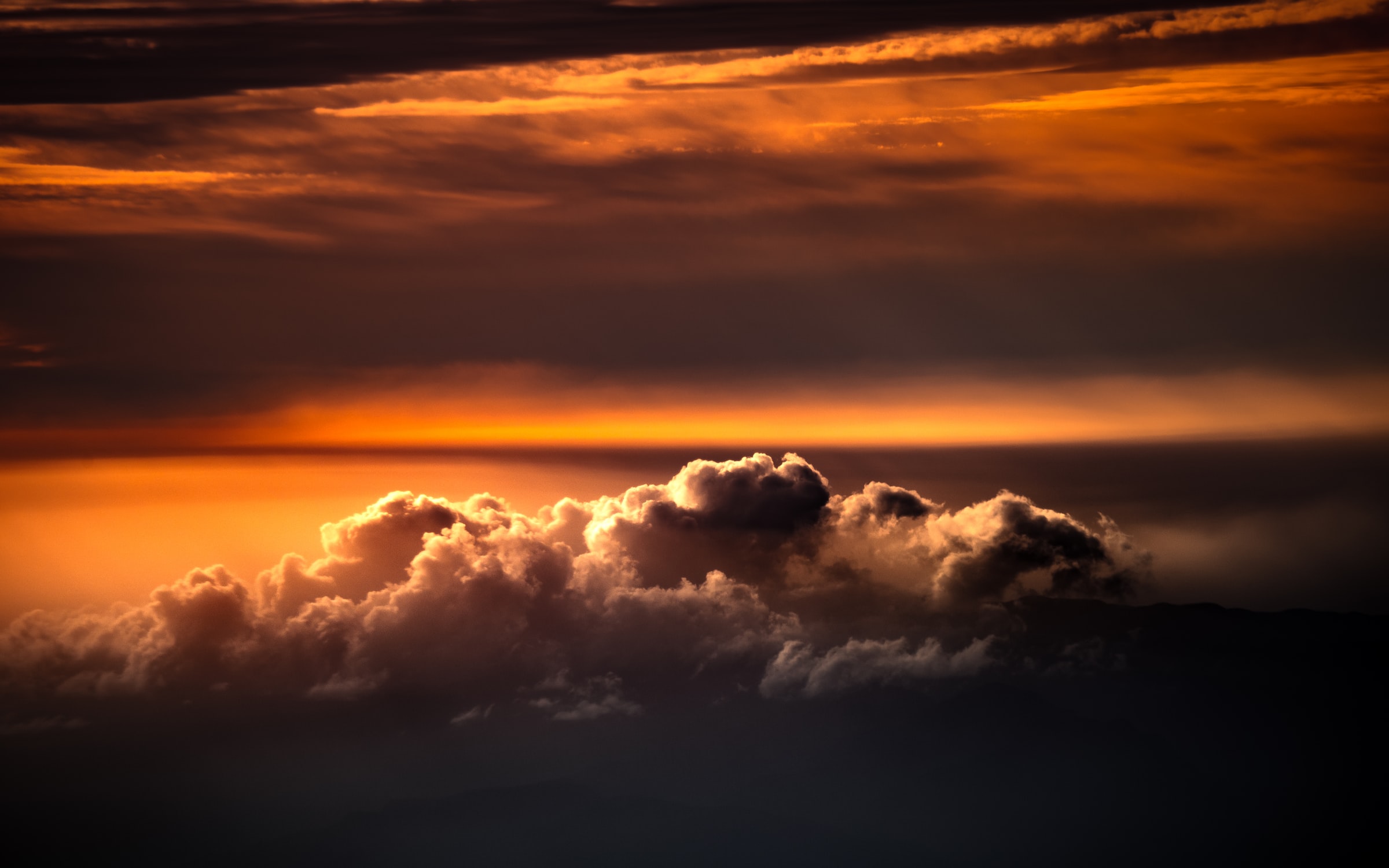
Clouds taking over La Gomera before the sunset, Tenerife, Spain.
If you can keep your head when all about you Are losing theirs and blaming it on you; If you can trust yourself when all men doubt you, But make allowance for their doubting too: If you can wait and not be tired by waiting, Or, being lied about, don’t deal in lies, Or being hated don’t give way to hating, And yet don’t look too good, nor talk too wise;
If you can dream – and not make dreams your master; If you can think – and not make thoughts your aim, If you can meet with Triumph and Disaster And treat those two impostors just the same:. If you can bear to hear the truth you’ve spoken Twisted by knaves to make a trap for fools, Or watch the things you gave your life to, broken, And stoop and build’em up with worn-out tools;
If you can make one heap of all your winnings And risk it on one turn of pitch-and-toss, And lose, and start again at your beginnings, And never breathe a word about your loss: If you can force your heart and nerve and sinew To serve your turn long after they are gone, And so hold on when there is nothing in you Except the Will which says to them: “Hold on!”
If you can talk with crowds and keep your virtue, Or walk with Kings – nor lose the common touch, If neither foes nor loving friends can hurt you, If all men count with you, but none too much: If you can fill the unforgiving minute With sixty seconds’ worth of distance run, Yours is the Earth and everything that’s in it, And – which is more – you’ll be a Man, my son!
The End of the World, commonly known as The Great Day of His Wrath, an 1851–1853 oil painting on canvas by the English painter John Martin.
The Bible refers to divine retribution as, in most cases, being delayed or “treasured up” to a future time. Sight of God’s supernatural works and retribution would militate against faith in God’s Word. William Lane Craig says, in Paul’s view, God’s properties, his eternal power and deity, are clearly revealed in creation, so that people who fail to believe in an eternal, powerful creator of the world are without excuse. Indeed, Paul says that they actually do know that God exists, but they suppress this truth because of their unrighteousness.
Some religions or philosophical positions have no concept of divine retribution, nor posit a God being capable of or willing to express such human sentiments as jealousy, vengeance, or wrath. For example, in Deism and Pandeism, the creator does not intervene in our Universe at all, either for good or for ill, and therefore exhibits no such behavior. In Pantheism (as reflected in Pandeism as well), God is the Universe and encompasses everything within it, and so has no need for retribution, as all things against which retribution might be taken are simply within God. This view is reflected in some pantheistic or pandeistic forms of Hinduism, as well.
According to Frances Carey, the painting by John Martin shows the “destruction of Babylon and the material world by natural cataclysm”. This painting, Frances Carey holds, is a response to the emerging industrial scene of London as a metropolis in the early nineteenth century, and the original growth of the Babylon civilisation and its final destruction.
Some other scholars such as William Feaver see John Marin’s painting as “the collapse of Edinburgh in Scotland”. Charles F. Stuckey is sceptical of the link with Edinburgh. According to the Tate, the painting depicts a portion of Revelation 16, a chapter from the New Testament.
According to the Torah, the kingdoms of Sodom and Gomorrah were allied with the cities of Admah, Zeboim, and Bela. These five cities, also known as the “cities of the plain” (from Genesis in the King James Version), were situated on the Jordan River plain in the southern region of the land of Canaan. The plain was compared to the garden of Eden[Gen.13:10] as being well-watered and green, suitable for grazing livestock. Divine judgment was passed upon them and four of them were consumed by fire and brimstone. Neighboring Zoar (Bela) was the only city to be spared. In Abrahamic religions, Sodom and Gomorrah have become synonymous with impenitent sin, and their fall with a proverbial manifestation of divine retribution.[5][6][Jude 1:7] The Bible mentions that the cities were destroyed for their sins, haughtiness, egoism, and attempted rape.
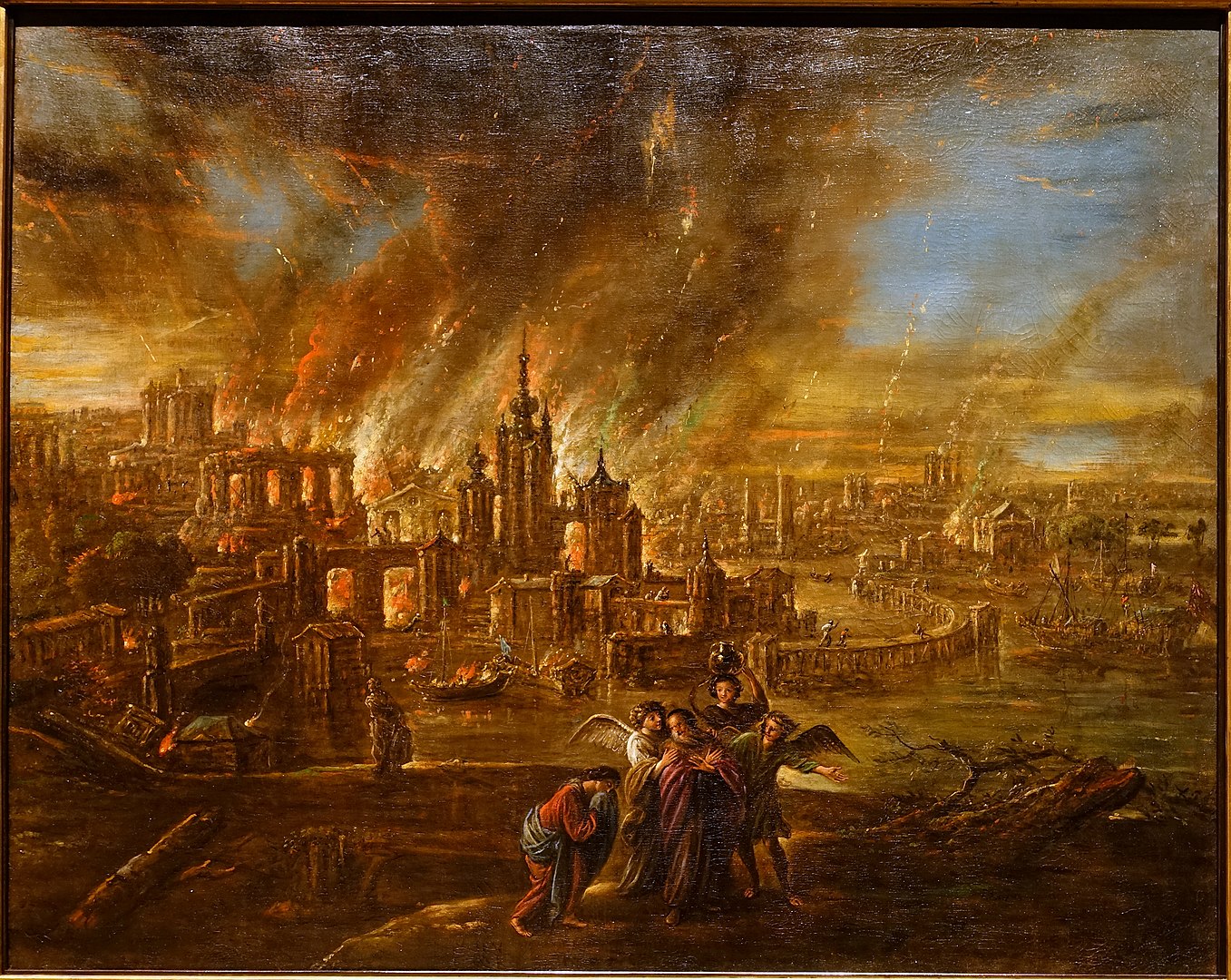
Sodom and Gomorrah being destroyed in the background of Lucas van Leyden‘s 1520 painting Lot and his Daughters
Sodom and Gomorrah have been used historically and in modern discourse as metaphors for homosexuality, and are the origin of the English words sodomite, a pejorative term for male homosexuals, and sodomy, which is used in a legal context under the label “crimes against nature” to describe anal or oral sex (particularly homosexual) and bestiality. This is based upon exegesis of the Biblical text interpreting divine judgement upon Sodom and Gomorrah as punishment for the sin of homosexual sex, though some contemporary scholars dispute this interpretation. Some Islamic societies incorporate punishments associated with Sodom and Gomorrah into sharia.
NOTE: This post was about the art, not about morality and the views above were accompanying the artwork and added for context.
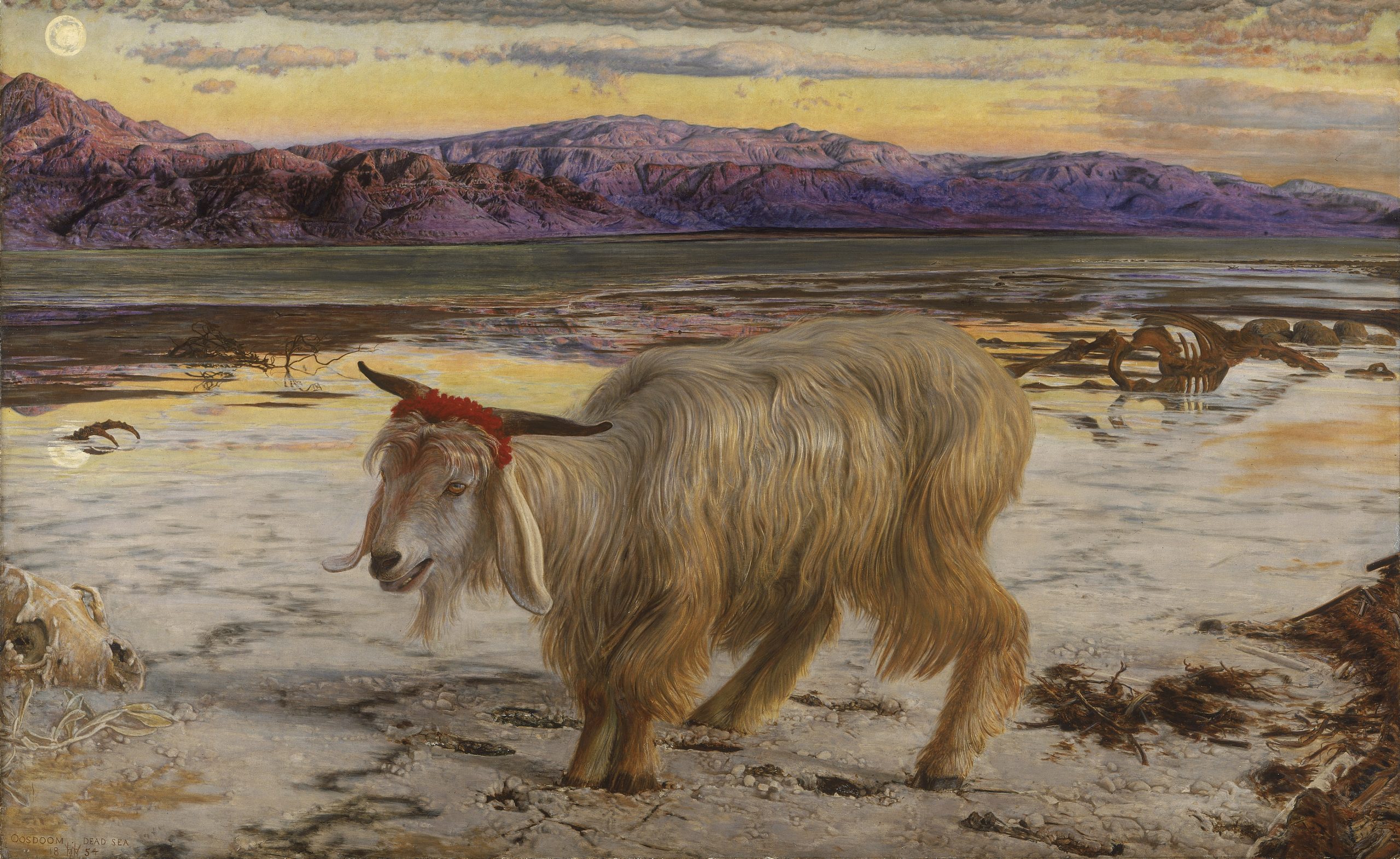
The Book of Leviticus (/lɪˈvɪtɪkəs/) is the third book of the Torah and of the Old Testament; scholars generally agree that it developed over a long period of time, reaching its present form during the Persian Period between 538–332 BC. Today I was revisiting these scriptures and decided to share, interesting history of from the brother of Aaron. (click on the scapegoat 🙂
Most of its chapters (1–7, 11–27) consist of God’s speeches to Moses, which God commands Moses to repeat to the Israelites. This takes place within the story of the Israelites’ Exodus after they escaped Egypt and reached Mt. Sinai (Exodus 19:1). The Book of Exodus narrates how Moses led the Israelites in building the Tabernacle (Exodus 35–40) with God’s instructions (Exodus 25–31). Then in Leviticus, God tells the Israelites and their priests how to make offerings in the Tabernacle and how to conduct themselves while camped around the holy tent sanctuary. Leviticus takes place during the month or month-and-a-half between the completion of the Tabernacle (Exodus 40:17) and the Israelites’ departure from Sinai (Numbers 1:1, 10:11).
The Yanov Torah rescued from the Holocaust as presented to seminary students at InterSem 2009 in Malibu, CA
The instructions of Leviticus emphasize ritual, legal and moral practices rather than beliefs. Nevertheless, they reflect the world view of the creation story in Genesis 1 that God wishes to live with humans. The book teaches that faithful performance of the sanctuary rituals can make that possible, so long as the people avoid sin and impurity whenever possible. The rituals, especially the sin and guilt offerings, provide the means to gain forgiveness for sins (Leviticus 4–5) and purification from impurities (Leviticus 11–16) so that God can continue to live in the Tabernacle in the midst of the people.
The Tabernacle and the Camp (19th-century drawing)
The English name Leviticus comes from the Latin Leviticus, which is in turn from the Ancient Greek: Λευιτικόν, Leuitikon, referring to the priestly tribe of the Israelites, “Levi.” The Greek expression is in turn a variant of the rabbinicHebrewtorat kohanim, “law of priests”, as many of its laws relate to priests.
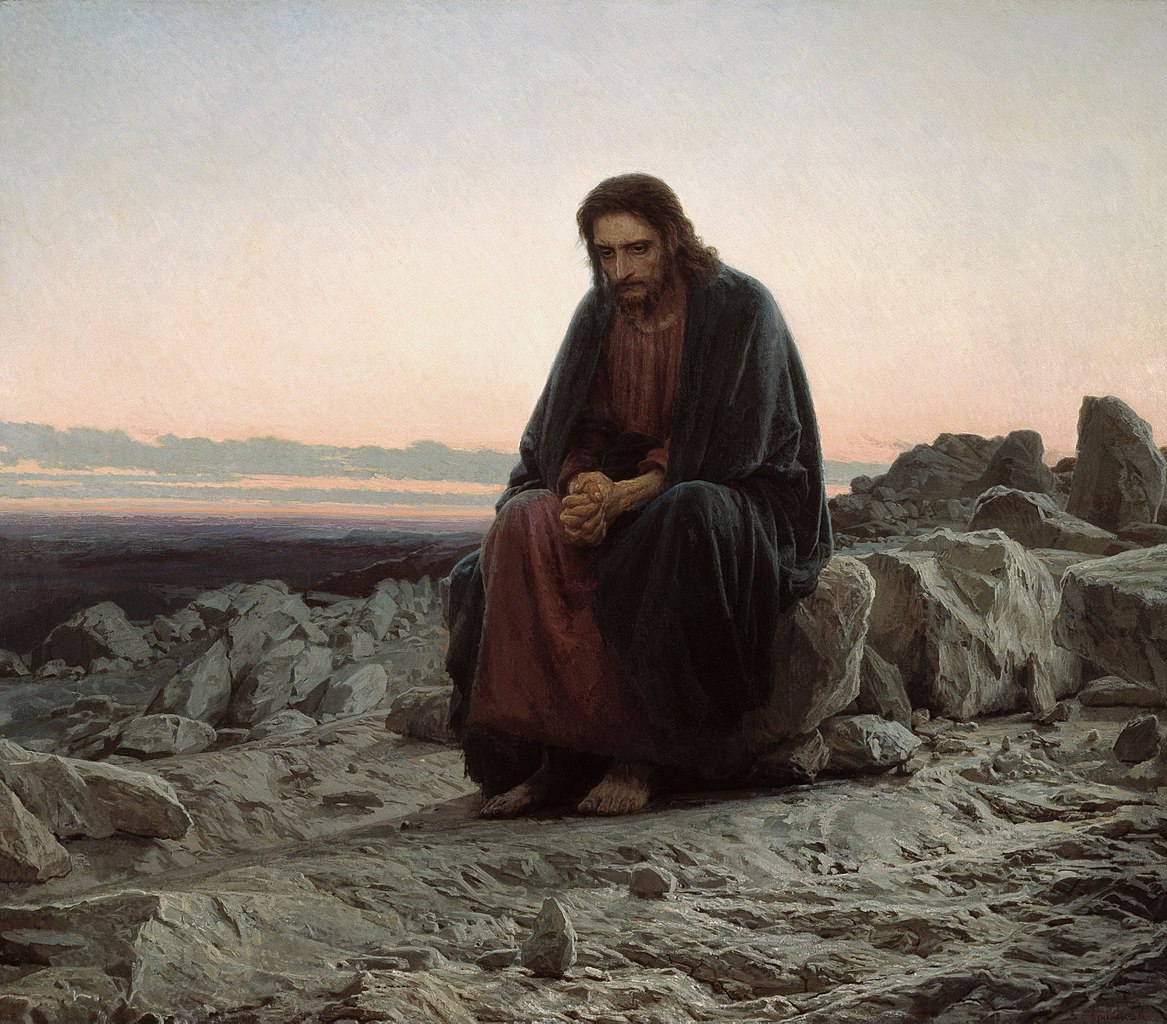
Christ in the Wilderness by Ivan Kramskoi. This great artist lived in Russia, born in 1837 and died at 50 years old in 1887 but left behind this amazing painting called “Jesus in the Desert” (or wilderness). This image is a scan by the Google Cultural Institute, as the original hangs in the Tretyakov Gallery in Russia.
Ivan Kramskoi was able to capture an intense feeling in this depiction of man confronting his fear and desperate for a communication with God, compelled to seek drastic measures to force and outcome to a deep conviction. The artists is able to sit us on that rock in anguish.
Many other artists have created works to depict the Temptation of Christ, including a powerful masterpiece by James Tissot, which hangs in Brooklyn.
Jesus Tempted in the Wilderness (Jésus tenté dans le désert), James Tissot, Brooklyn Museum
Temptation of Christ
Discussion of status as parable
Discussion of the literary genre includes whether what is represented is a history, a parable, a myth, or compound of various genres. This relates to the reality of the encounter. Sometimes the temptation narrative is taken as a parable, reading that Jesus in his ministry told this narrative to audiences relating his inner experience in the form of a parable. Or it is autobiographical, regarding what sort of Messiah Jesus intended to be.
Writers including William Barclay have pointed to the fact that there is “no mountain high enough in all the world to see the whole world” as indication of the non-literal nature of the event, and that the narrative portrays what was going on inside Jesus’ mind.
“In regard to the words, ‘He showed Him all the kingdoms of the world, and the glory of them,’ we are not to understand that He saw the very kingdoms, with the cities and inhabitants, their gold and silver: but that the devil pointed out the quarters in which each kingdom or city lay, and set forth to Him in words their glory and estate.”
The debate on the literality of the temptations goes back at least to the 18th century discussion of George Benson and Hugh Farmer.
The Catholic understanding is that the temptation of Christ was a literal and physical event. “Despite the difficulties urged, …against the historical character of the three temptations of Jesus, as recorded by St. Matthew and St. Luke, it is plain that these sacred writers intended to describe an actual and visible approach of Satan, to chronicle an actual shifting of places, etc., and that the traditional view, which maintains the objective nature of Christ’s temptations, is the only one meeting all the requirements of the Gospel narrative.”
The Catechism of the Catholic Church states:
The Gospels speak of a time of solitude for Jesus in the desert immediately after his baptism by John. Driven by the Spirit into the desert, Jesus remains there for forty days without eating; he lives among wild beasts, and angels minister to him. At the end of this time Satan tempts him three times, seeking to compromise his filial attitude toward God. Jesus rebuffs these attacks, which recapitulate the temptations of Adam in Paradise and of Israel in the desert, and the devil leaves him “until an opportune time…” The temptation in the desert shows Jesus, the humble Messiah, who triumphs over Satan by his total adherence to the plan of salvation willed by the Father.
Use of Old Testament references
The account of Matthew uses language from the Old Testament. The imagery would be familiar to Matthew’s contemporary readers. In the Septuagint Greek version of Zechariah 3 the name Iesous and term diabolos are identical to the Greek terms of Matthew 4. Matthew presents the three scriptural passages cited by Jesus (Deut 8:3, Deut 6:13, and Deut 6:16) not in their order in the Book of Deuteronomy, but in the sequence of the trials of Israel as they wandered in the desert, as recorded in the Book of Exodus.
Luke’s account is similar, though his inversion of the second and third temptations “represents a more natural geographic movement, from the wilderness to the temple”. Luke’s closing statement that the devil “departed from him until an opportune time” may provide a narrative link to the immediately following attempt at Nazareth to throw Jesus down from a high place, or may anticipate a role for Satan in the Passion (cf. Luke 22:3).
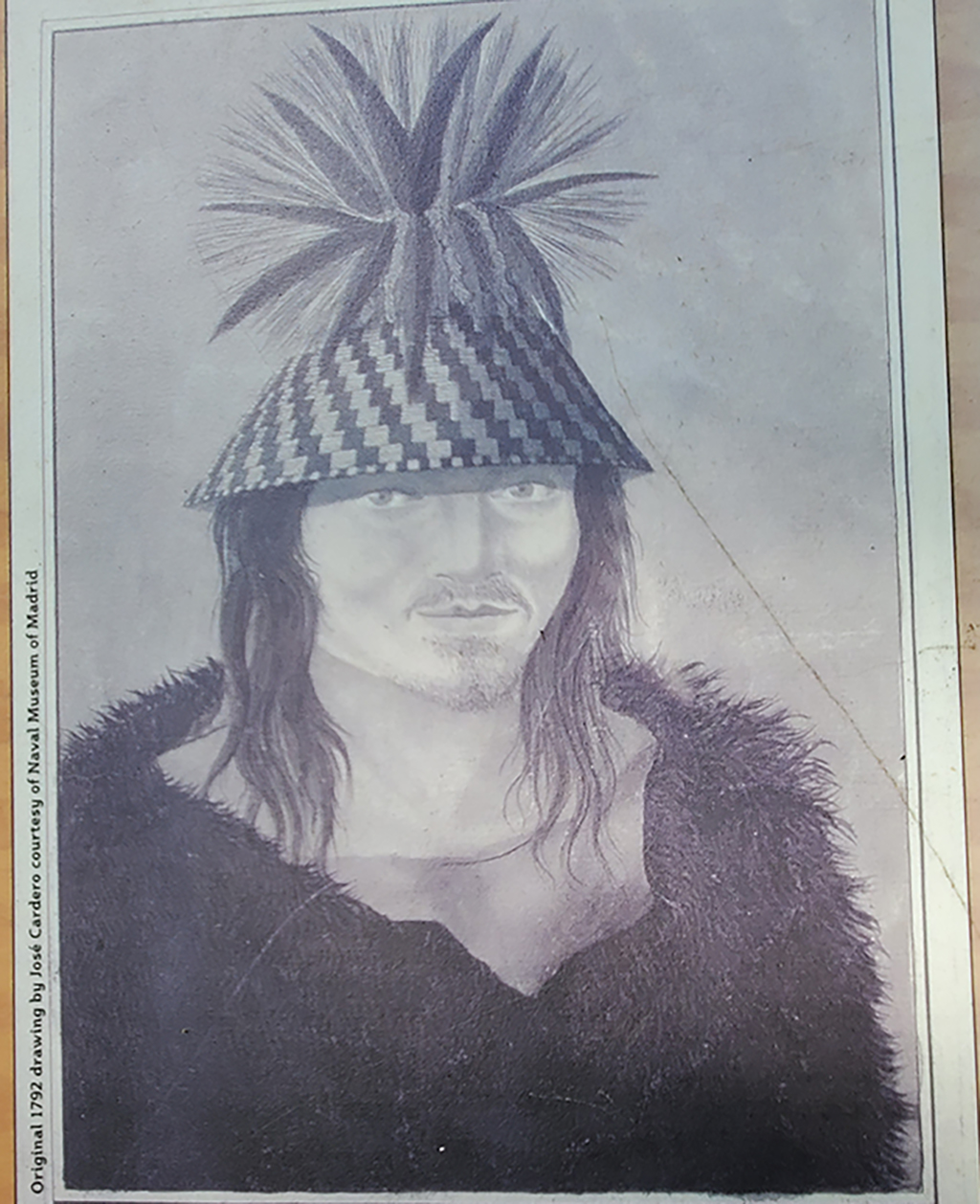
Qeyapaplanewx demands respect and deserves to be honored. Over 300 years ago Vancouver was his Kingdom, he was the Chief of the Musqueam Nation.
His place marker overlooks the Pacific from a perch above the cliffs and if it were not for a memorial he’d be all but forgotten. Not anymore because I will always have this page to remind me, and anyone else who stumbles upon it, that a man’s face tells an important story and this chief’s tale is epic.
So I searched out Qeyapaplanewx online and found a story of his European vacation and subsequent return to Canada, via Toronto, after 280 years.
Centuries-old sketch comes home
Little-known work showing Musqueam chief made in 1792 by Spanish cabin boy
VANCOUVER — He stares at us from centuries past, a clear, unflinching gaze attesting to his status as a great warrior chief of the Musqueam. Strands of long, dark hair curl past his shoulders and he wears a stylish conical cedar hat adorned with feathers.
Call him Qeyapaplanewx. That we know about him at all is thanks to a young Spanish cabin boy with an agile sketch pen who drew the Musqueam chief during a visit by his country’s navy to the waters off Point Grey in June of 1792.
As such, he is the first identified resident of what has long been Canada’s third-largest city, on lands once fished and hunted solely by the Musqueam.
Yet Jose Cardero’s remarkable drawing, squirrelled away for years in a dark storage area of the Naval History Museum in Madrid, is virtually unknown in Vancouver.
This image of Qeyapaplanewx has sat for years in the storage area of a Madrid museum.
Not any more. Yesterday, the portrait came back – or at least a version of it.
In a ceremony on Qeyapaplanewx’s old stomping grounds (aka Vancouver City Hall) that stirred bittersweet native emotions, Spain’s ambassador to Canada presented vivid, framed replicas of Mr. Cordero’s historic sketch to the city and to the Musqueam band.
Struck by the majesty of the little-seen portrait, viewers hoped that the Musqueam chief might now achieve some of the prominence of the city’s non-native namesake, Captain George Vancouver, who was in the harbour on his own ship at the same time as Mr. Cordero made his drawing.
“Capt. Vancouver had artists, too, but they ignored the natives,” said historian Robin Inglis.
Musqueam lawyer Jim Reynolds suggested the portrait be used on the front of the city’s tourist brochures. “It’s a reminder that we have a tremendous history that all of us should cherish. I’m surprised it’s so little known.”
Band councillor Howard Grant, wearing a business suit with no conical cedar cap in sight, claimed to be a descendant of the Musqueam leader from long ago.
“I remember meeting my great-uncle who was 106 when he died in 1954. So he’d have been born in 1848, and his grandfather would have been there when the Spanish came,” said Mr. Grant, 62.
“So the warrior chief would have been my great, great ancestor.
“Now, we can loop it all back to 2008. The drawing has a dramatic significance for us. Is this not clear evidence that we used to own all our territory? It makes me proud.”
Former chief Delbert Guerin called the replica an amazing depiction of the 18th-century Musqueam warrior.
“It makes me very happy to have this. I only even heard about this picture a couple of years ago. To me this a very honourable day.”
But Mr. Guerin said his joy is tempered by the portrait’s unspoken indication of how much the band has lost since the Spaniards and British arrived.
“It’s a reminder of all that has taken place, so there’s a strong sense of loss. This is still our unceded territory, and I think our chief would have been very disappointed at what has happened.”
The gift from Spanish Ambassador Mariano Alonso-Buron was also a reminder of the almost-forgotten presence of Spain in the early days of West Coast exploration.
While Capt. Vancouver and Captain James Cook, who first met B.C. natives at Nootka on Vancouver Island in 1778, are celebrated by local historians and residents alike, few know that most of the early charting of the West Coast was carried out by Spanish mapmakers.
During June of 1792, for instance, there was perhaps the city’s first traffic jam, as Capt. Vancouver’s vessel was joined by two Spanish naval ships in Burrard Inlet.
But the British had staying power, as reflected by Capt. Vancouver’s immediate renaming of the point where the University of B.C. and many mansions are today as Point Grey.
The Spanish had called the imposing peninsula Langara, a name that lives on in a few city locations, including Langara Community College.
Not many know that such well-known place names as the city’s Spanish Banks, Tofino, Port Alberni, Galiano, Valdes Island and Malaspina stem from the early Spanish naval explorers who prowled up and down the coast for the last 50 years of the 18th century.
Even Jose Cordero, the cabin boy-turned-artist, is remembered by the Strait of Cordero, which runs between the north of Vancouver Island and the mainland.
“With this drawing, he will always have a local significance,” said Mr. Inglis, the historian. “His subject, the Musqueam chief, is the first known citizen of what is now Vancouver.”
CORAL GABLES, Fla., Feb. 21, 2020 /PRNewswire/ — The U.S. Postal Service celebrates the striking beauty of wild orchids with the release of the Wild Orchids Forever stamps. Part of the largest family of plants on Earth, orchids grow in many climates and thrive under a variety of conditions.
Wild Orchids stamps unveiled by the Postal Service. Part of the largest family of plants on Earth, orchids grow in many climates and thrive under a variety of conditions.
The stamps were dedicated at the American Orchid Society Library at the Fairchild Tropical Botanic Garden, Coral Gables, FL. News about the stamps is being shared on social media using the hashtags #OrchidStamps and #FlowerStamps. Followers of the Postal Service’s Facebook page can view video of the ceremony at facebook.com/usps.
Art director Ethel Kessler designed the stamps with photographs taken by James A. Fowler.
“Orchids can be hard to find in a natural setting and today there is a conservation effort to preserve these beautiful flowers,” said Jakki Krage Strako, chief customer and marketing officer and executive vice president, U.S. Postal Service, who served as the event’s dedicating official. “Each of these stamps represent a masterpiece of nature that blossoms with color. They also continue the Postal Service tradition of showcasing the natural beauty of flowers on stamps.”
Joining Strako to dedicate the stamps were Georgia Tasker, author, horticulture writer and Pulitzer Prize finalist; Susan Wedegaertner, president, American Orchid Society; photographer James A. Fowler; and Lawrence Zettler, director of the orchid recovery program, Illinois College.
“Orchids are the world’s most familiar group of flowers and these charming stamps showcase nine of the over 200 orchid species native to the United States,” said Zettler. “These stamps also serve as a reminder of their beauty and their vulnerability.”
Each stamp features a photograph of one of these nine species: Cypripedium californicum, Hexalectris spicata, Cypripedium reginae, Spiranthes odorata, Triphora trianthophoros, Platanthera grandiflora, Cyrtopodium polyphyllum, Calopogon tuberosus and Platanthera leucophaea. The booklet contains 10 stamp designs and each design is featured twice for a total of 20 stamps. Triphora tranthophoros is featured on two stamps designs, to include the booklet cover.
The Wild Orchids stamps will also be issued in coils of 3,000 and 10,000.
There are more than 30,000 species of wild orchids in the world. Many that are native to North America are endangered or threatened, making sightings in their natural environment increasingly rare.
These striking flowers are native to damp woodlands, and numerous organizations across the country are working to preserve orchid habitats. Orchids also thrive in cultivated gardens or as houseplants.
“It’s amazing that my passions of photographing wild orchids and stamp collecting have converged today with the release of these stamps,” said Fowler. “My childhood interest in photography began on the knee of my mother, who was an accomplished photographer; my passion for the beauty of plants, I learned from my great-grandmother, who was a botanist at the Department of Agriculture; and the hobby of stamp collecting, I picked up from my older brother.”
The Wild Orchids stamps are being issued as Forever stamps, which will always be equal in value to the current First-Class Mail 1-ounce price.
Postal Products
Customers may purchase stamps and other philatelic products through the Postal Store at usps.com/shopstamps, by calling 800-STAMP24 (800-782-6724), by mail through USA Philatelic, or at Post Office locations nationwide. Videos of most stamp ceremonies will be available on facebook.com/usps.
Information on ordering first-day-of-issue postmarks and covers is at usps.com/shopstamps under “Collectors.”
The Postal Service receives no tax dollars for operating expenses and relies on the sale of postage, products and services to fund its operations.
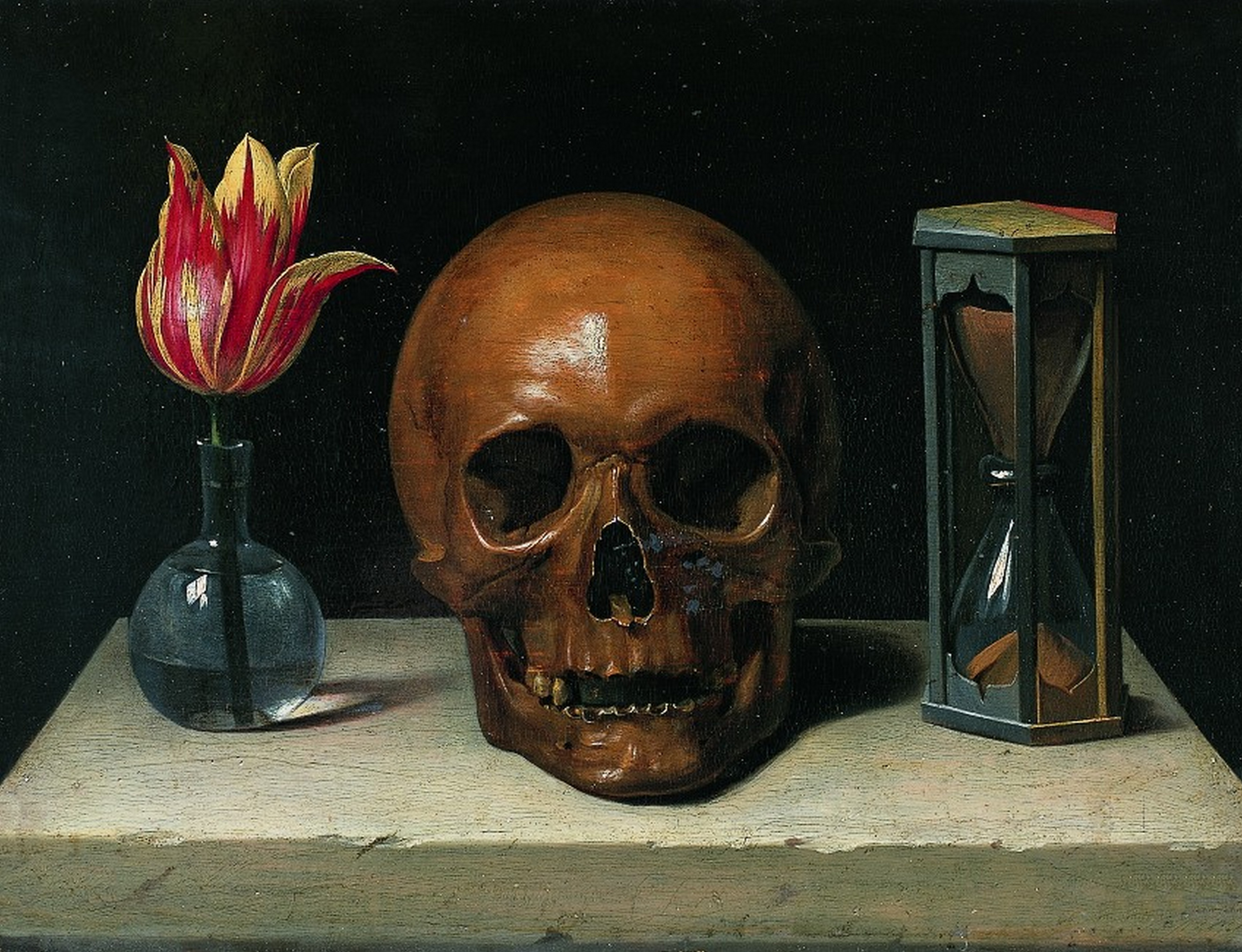
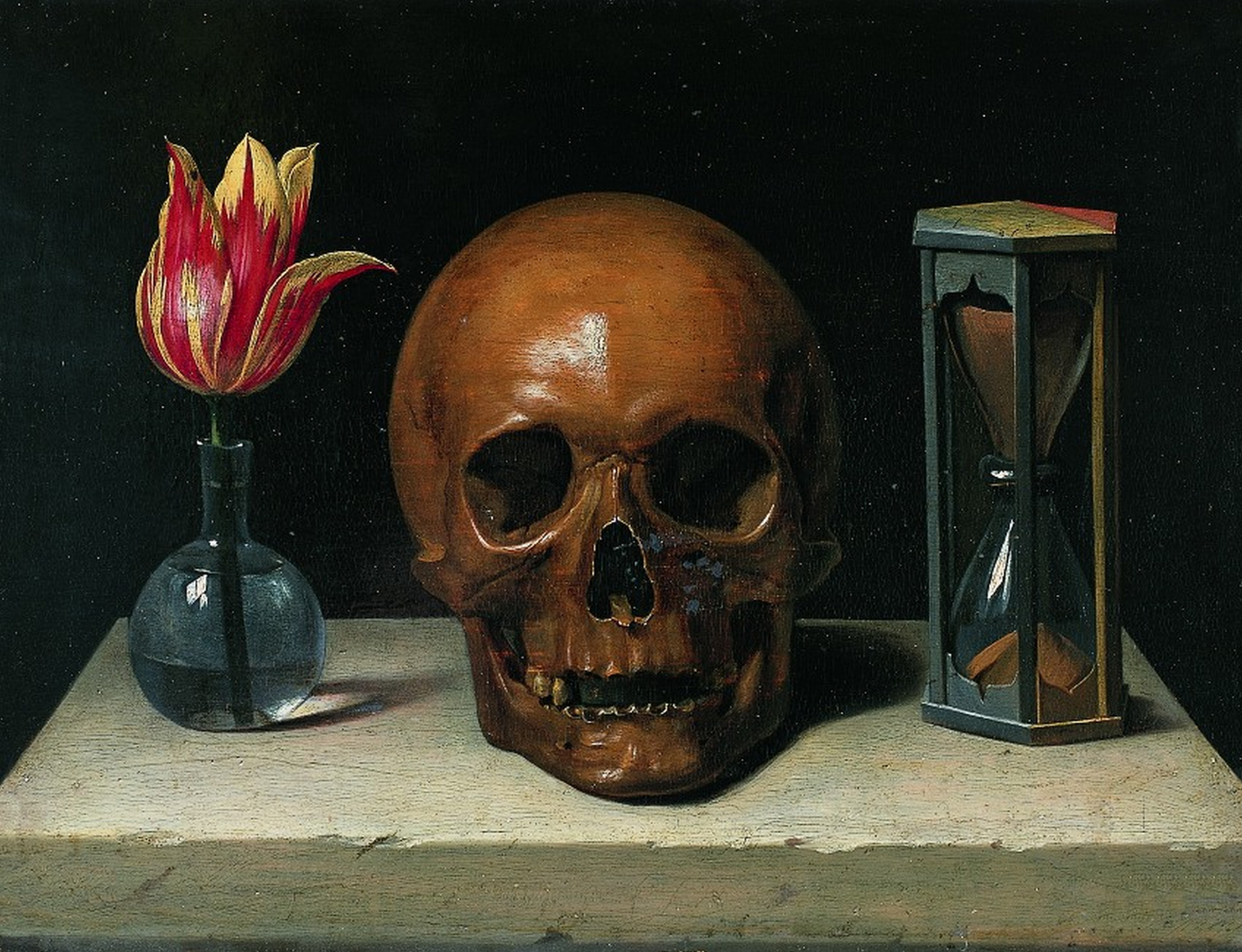
Día de Muertos (day of the dead) recently passed and reminded me of Memento Mori, which I thought was made famous by Roman Generals but can’t find proof, however I did find the cool painting called Vanitas (below) and more nuggets of knowledge about life, death and time.
A memento mori (Latin ‘remember that you must die’) is an artistic or symbolic reminder of the inevitability of death. “The expression ‘memento mori’ developed with the growth of Christianity, which emphasized Heaven, Hell, and salvation of the soul in the afterlife.
Philippe de Champaigne’s Vanitas (c. 1671) is reduced to three essentials: Life, Death, and Time
Albert Camus stated “Come to terms with death, thereafter anything is possible.” Jean-Paul Sartre expressed that life is given to us early, and is shortened at the end, all the while taken away at every step of the way, emphasizing that the end is only the beginning every day.
In Buddhism
The Buddhist practice maraṇasati meditates on death. The word is a Pāli compound of maraṇa ‘death’ (an Indo-European cognate of Latin mori) and sati ‘awareness’, so very close to memento mori. It is first used in early Buddhist texts, the suttapiṭaka of the Pāli Canon, with parallels in the āgamas of the “Northern” Schools.
In Japanese Zen and samurai culture
In Japan, the influence of Zen Buddhist contemplation of death on indigenous culture can be gauged by the following quotation from the classic treatise on samurai ethics, Hagakure:
The Way of the Samurai is, morning after morning, the practice of death, considering whether it will be here or be there, imagining the most sightly way of dying, and putting one’s mind firmly in death. Although this may be a most difficult thing, if one will do it, it can be done. There is nothing that one should suppose cannot be done.
In the annual appreciation of cherry blossom and fall colors, hanami and momijigari, the samurai philosophized that things are most splendid at the moment before their fall, and to aim to live and die in a similar fashion.
In Tibetan Buddhism
Tibetan Citipati mask depicting Mahākāla. The skull mask of Citipati is a reminder of the impermanence of life and the eternal cycle of life and death.
In Tibetan Buddhism, there is a mind training practice known as Lojong. The initial stages of the classic Lojong begin with ‘The Four Thoughts that Turn the Mind’, or, more literally, ‘Four Contemplations to Cause a Revolution in the Mind’. The second of these four is the contemplation on impermanence and death. In particular, one contemplates that;
All compounded things are impermanent.
The human body is a compounded thing.
Therefore, death of the body is certain.
The time of death is uncertain and beyond our control.
There are a number of classic verse formulations of these contemplation meant for daily reflection to overcome our strong habitual tendency to live as though we will certainly not die today.
Living life to it’s fullest is what Memento Mori means to me. Carpe Diem!
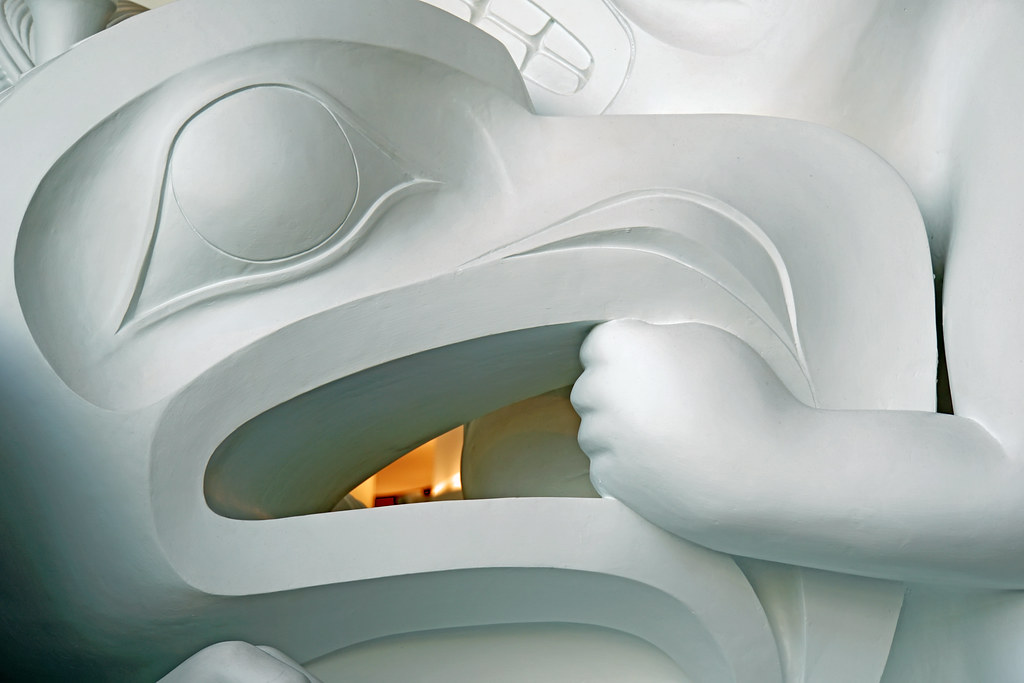
First Nations Art is something I want to learn more about, so I decided to create this page and begin gathering information about the various artists and mediums of art from Native Artisans in Canada.
Anyone who knows me, knows that I like the work of Emily Carr and occasionally visit her collection in a permanent exhibit of the Vancouver Art Gallery. It wasn’t until recently that began thinking about collecting First Nations Art myself.
Haida Gwaii
The northern Pacific Northwest Coast, showing the position of the archipelago in relation to other islands in the region. The southern half of Prince of Wales Island is Kaigani Haida territory, but is not included in the term Haida Gwaii.
Haida Gwaii is considered by archaeologists as an option for a Pacific coastal route taken by the first humans migrating to the Americas from the Bering Strait. At this time Haida Gwaii was likely not an island, but connected to Vancouver Island and the mainland via the now submerged continental shelf.
It is unclear how people arrived on Haida Gwaii, but archaeological sites have established human habitation on the islands as far back as 13,000 years ago. Populations that formerly inhabited Beringia expanded into northern North America after the Last Glacial Maximum, and gave rise to Eskimo-Aleuts and Na-Dené Indians.
Underwater archaeologists from the University of Victoria are seeking to confirm that stone structures discovered in 2014 on the seabed of Hecate Strait may date back 13,700 or more years ago and be the earliest known signs of human habitation in Canada. Coastal sites of this era are now deep underwater
Australia (Oz) taught me so much and I was so green in my twenties that looking back, I consider my years from the age of twenty one to twenty five to have been my college education. Also, it was the years leading up to the move to Australia, where I worked in the toughest jobs in Canada, from work camps inside the Arctic circle and up the sides of the Rocky Mountains. Seasonal work in every industry, such as mining, logging, tree-planting and lot’s of pipeline construction, with a stint in seismic to boot.
I was RWA (ready willing and able) in Oz
I survived the first part of my youth and felt well prepared for Australia and one lesson I learned there from the very beginning, well two, always say “Good day” to people you pass in the morning, whether you know them or not, and the second and most important lesson; there’s no free lunch. Although I did here about young Brits who had come to exploit the unemployment insurance that accept people who had never previously worked to pay into it. That was what they called “the Dole” since they doled it out and some people surfed every day while collecting free money.
We all know that there’s a massive inequity in the distribution of wealth on our planet, much of it has to do with access to information. Yes, really, often times people just don’t know the same things other people know and usually it’s because we are not asking the right questions. However, what you come to learn, is that knowledge is power, not money and that is why Oz was part of my journey to find, obtain and consume knowledge.
Starting with the Penguin Classics I read every great author and anything recommended to me. From the start of my journey I’ve never had less than 3 books on the go at a time, same as now. I let each book suggest the next and follow all topics to their source, until I feel satisfied I understand and then move on. Some classic authors are harder to relate to, like James Joyce for example, it takes longer to appreciate than Joseph Conrad, for example but within every single book was the clues to my path to current day.
Fast forward to 2010 where the library in Youtube had now grown to encompass every single writer, every single book and all the ideas contained within them and indexed out into incredible byte sized downloads, to meet the maximum data input rate, of an information addict (me) accustomed to the highest doses, that is how I am. I turned that logic analysis machine, which is my mind, into a funnel with filters and then poured as much information through it as was possible.
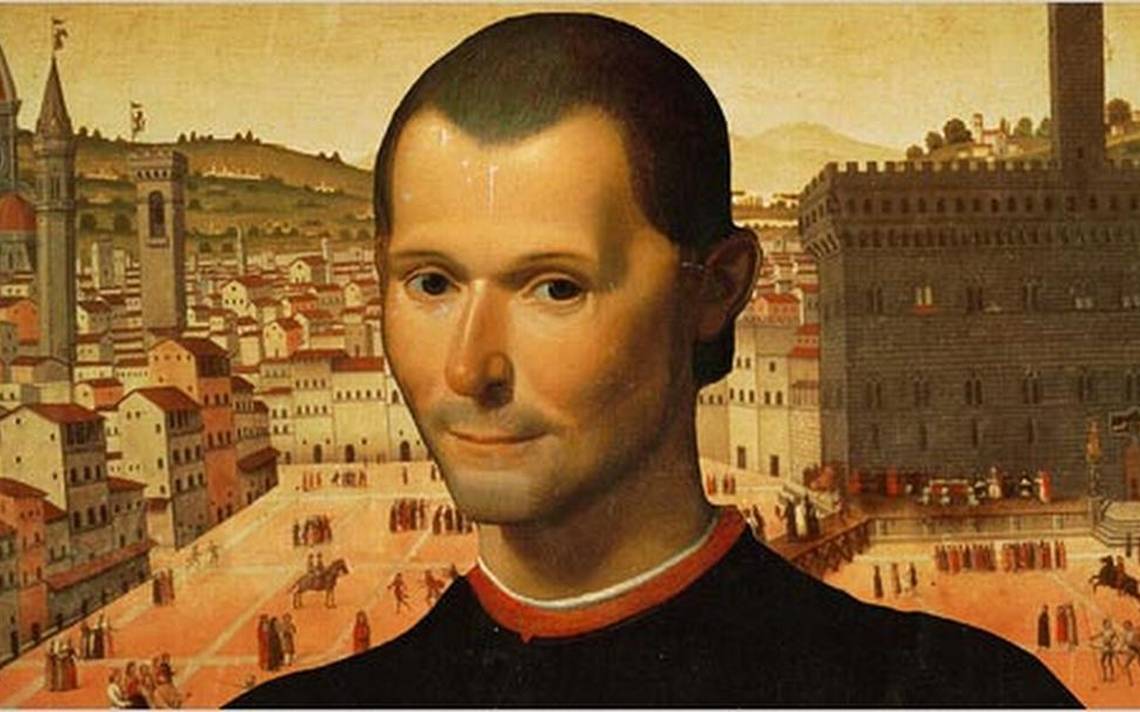
One of my main questions, especially because I have been the editor of Invest Offshore and report on cross-border banking, is there an evil cabal of people who intentionally control the world through the central banking system? Then, secondly, and largely because of my favourite classic that touches upon this topic with historical context; The Prince by Niccolò Machiavelli what knowledge can I derive from this information.
The answer is to the first is yes, and corroborated by the The Creature from Jekyll Island (1994) by G. Edward Griffin. The answer to the second is to become an agent of Private Placement Programs (PPP) and to become knowledgeable in Bank Trading Platforms. Then with this knowledge, seek and find qualified participants and inform them of this knowledge, explain how it can benefit them and provide an introduction to the experts.
The lion cannot protect himself from traps, and the fox cannot defend himself from wolves. One must therefore be a fox to recognize traps, and a lion to frighten wolves.
Niccolò Machiavelli
The Prince is an extended analysis of how to acquire and maintain political power. It includes 26 chapters and an opening dedication to Lorenzo de Medici. The dedication declares Machiavelli’s intention to discuss in plain language the conduct of great men and the principles of princely government.
So in the end, it’s who you know and what you know, then being able to prove that you can help them. That sounds an awful lot like politics to me : ). So, all you need to know, is someone with vast amounts of money and show them Private Placement Programs (PPP) and Bank Trading Platforms, then introduce them to a banker that is willing to award you for introducing the person with vast quantities of money.
Sounds simple right? Like Money for nothing, just remember though, that there’s no free lunch.




















You must be logged in to post a comment.