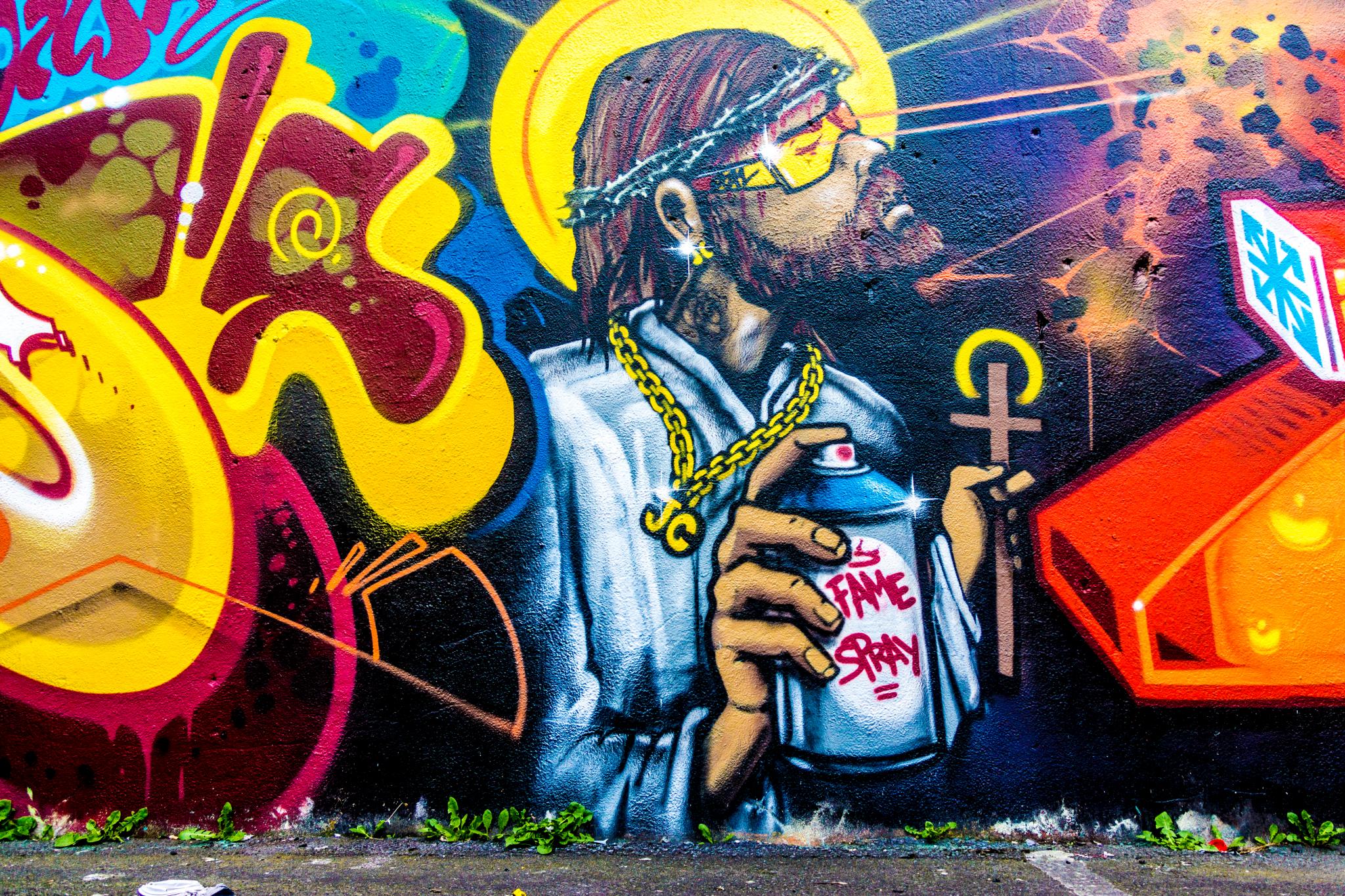
When I think about Brazil I think about art, I think about music, the people and the feeling of love. Once you have Brazil in you, it will never come out. It’s the art of life in the tropics, and living there to create art, that’s what I miss most about Brazil as a muse. Every culture has it’s own flair and style, often best reflected in the street art but in my experience nothing quite compares to Brazil.
Street art takes a snap shot of a time in a place, evoking feelings of what is happening to the people living there…. are they happy or angry?
I always ride a bicycle wherever I go and riding in the daylight through parts of a city that no man dare traverse at night time, exposes the street art and makes for the the most interesting urban safari, through the city jungle of struggle and angst, reflected in the graffiti and evident everywhere.
When all else fails, we have art is actually a famous quote but I don’t know who it was that coined it. I’m the artist that added “Create Art” to the phrase and it’s meant to message myself. Since the only way to become a professional is to begin as an amateur.
Years ago when I divested myself of my book collection I kept Ralph Waldo Emerson, partly because I hadn’t finished it but also because he was one person who’s ideas really made sense to me and still do. Maybe that was also partly why I abandoned the idea of owning things, like book collections for example. Now everything I own can be easily carted off to a cabin in the woods, if I should so desire.
I am a city dweller, that’s why you won’t find me living on Waldon’s Pond, which was written by his protege Henry David Thoreau but espoused the same ideas as Emerson and also recommended the beauty of nature but more that anything introduced the concept of individual freedom and the power of art.
Ralph Waldo Emerson (May 25, 1803 – April 27, 1882)[5] was an American essayist, lecturer, philosopher, and poet who led the transcendentalist movement of the mid-19th century. He was seen as a champion of individualism
and a prescient critic of the countervailing pressures of society, and
he disseminated his thoughts through dozens of published essays and more
than 1,500 public lectures across the United States.
Emerson gradually moved away from the religious and social
beliefs of his contemporaries, formulating and expressing the philosophy
of transcendentalism in his 1836 essay “Nature“. Following this work, he gave a speech entitled “The American Scholar” in 1837, which Oliver Wendell Holmes Sr. considered to be America’s “intellectual Declaration of Independence.”[6]
Emerson wrote most of his important essays as lectures first and then revised them for print. His first two collections of essays, Essays: First Series (1841) and Essays: Second Series (1844), represent the core of his thinking. They include the well-known essays “Self-Reliance“,[7] “The Over-Soul“, “Circles“, “The Poet“, and “Experience.” Together with “Nature“,[8]
these essays made the decade from the mid-1830s to the mid-1840s
Emerson’s most fertile period. Emerson wrote on a number of subjects,
never espousing fixed philosophical tenets, but developing certain ideas such as individuality, freedom,
the ability for mankind to realize almost anything, and the
relationship between the soul and the surrounding world. Emerson’s
“nature” was more philosophical than naturalistic:
“Philosophically considered, the universe is composed of Nature and the
Soul.” Emerson is one of several figures who “took a more pantheist or pandeist approach by rejecting views of God as separate from the world.”[9]
He remains among the linchpins of the American romantic movement,[10]
and his work has greatly influenced the thinkers, writers and poets
that followed him. “In all my lectures,” he wrote, “I have taught one
doctrine, namely, the infinitude of the private man.”[11] Emerson is also well known as a mentor and friend of Henry David Thoreau, a fellow transcendentalist.[12]
I met a beautiful women from Beijing, at Kitsilano Beach. On an impulse I invited her to the Chinese Opera and to my delight she said yes. It wasn’t completely planned or by accident, the tickets had been given to me by friends, one of whom was singing in the cast of performers.
To protect the identity (of my date) I’ll call her Coco, as in Chanel. A striking beauty with business savvy and a background of distinguished achievement, associated with Beijing elite. Coco traded gilded luxury for the steep learning-curve of Canadian integration, so her daughter could benefit. However, the immersion wasn’t going to suit her Ex, so now he’s an Ex (lucky me : ).
Coco speaks Mandarin and could understand as much Cantonese language as me, zero.
We arrived fashionably late but in great style, since who knows how to dress for the Chinese Opera? Middle of July in BC dictates more casual attire, so we were a perfect match. Coco dressed in an off-white light linen top over matching long flowing skirt and leather shoes, earth tones, tasteful accessories and no gold, for an overall elegant look and sophisticated style. My trousers were off-white too, chic shirt and blazer, we looked like a set.
To use a Brazilian expression about Coco and I, she is too much sand for my truck…. Lol ! But how was I supposed to know how special she was in China? My power of intention works. So anyway, there we are, sitting in the best seats (for us) in Michael J. Fox Theatre in Burnaby, and neither of us can understand Cantonese. Fortunately there’s a giant screen over to the side of the stage, so we could read along to the words of the songs.
The spectacle and the music involved in Chinese Opera is certainly very cool and well worth witnessing, however it’s not something worth putting on your bucket list. Highlights are that you don’t have to understand what they’re saying in the songs, because the costumes and the mime acting to accompany the songs explain what’s happening. Good versus evil is the main theme, also the punishment of authority. In many ways the great characteristics of Chinese culture are the plots of the songs.
It’s the music that accompanies Chinese Opera that I like the most, I’m sure you have heard it before, just not aware that you have… but it’s found in Kung Foo movies, played in Chinese restaurants and interlaced into China culture like Reggae to Jamaica. One of the best things about the Chinese Opera in Vancouver is the live orchestra, in a pit stage-right.
Worthy mention on the costumes too, the lighting has a way of shinning on the sparkles in the headdress and hats of the leading characters. Sets remain the same and it’s the costumes that provide the big surprises at the right moments in the story. It’s rather memorizing and pleasant.
The reason the seats were the best seats for us, is that we were near the exit and able to split during the intermission. I really appreciate the Coco had the courage to grab me by the arm and slip us out the back-jack. See, truthfully just to experience one full set is maximum perfect. It was all I had ever dreamed of. If we had stayed until 11:30, and gone back-stage, as was the plan, it would have put Coco in an embarrassing situation. So instead, by 9 we were sipping champagne and critiquing the performance. Two thumbs up!
Coco was so gracious to explain some of the nuances of what happens among the divergent groups, found within her culture. China has over 30 distinct sub-cultures and Cantonese is just one of them. Beijing is famous for the Peking Opera, which obviously is not written in Cantonese. All Chinese celebrate the diversity of China but not always all want to socialize together. For good reason, to the lovely Coco, the idea of being foist into unknown social circles, with a completely older generation and crowd, speaking another language (yet from China) was not fun.
Watching the sunset as we cruised along Kingsway was fun. Laughing and smiling all the way back to the beach was fun. Seeing the marvel of the city that is Vancouver, sparkling on the horizon, that is fun. Since we live on the beach and even though we were 12 miles away, no GPS necessary, just drive towards the sun, all roads lead to the sea and back to Kitsilano Beach.
Once upon a time, I was in Haight-Ashbury of San Francisco and bought a huge fabric mural wall hanging of Bob Marley with a smile, which adorns an entrance wall in my home. It completely covers the wall with Rasta colors, and has a Lion of Judah in each corner. The BobMarley.com brand and the Lion are inseparable and the history of King Solomon lives on through Rastafarian legend, as well as Ethiopian history.
The French inscription on the statue’s base reads: “To his majesty the King Tafari Makonnen/In remembrance of his coronation/The Franco-Ethiopian Railway Company” Tafari Makonnen was the given name of Ethiopian Emperor Haile Selassie I. He used that name until he was crowned Emperor of Ethiopia on November 2, 1930. The Franco-Ethiopian Railway Company was the successor to the Ethiopian Imperial Railway Company. The Ethiopian Imperial Railway Company was formed in 1894 to build a railroad from Addis Ababa to the Red Sea port of Djibouti in French Somaliland. When the Ethiopian Imperial Railway Company failed in 1906, the rails reached only from Djibouti to Dire Dawa in eastern Ethiopia. According to Wikipedia: “In 1908, the assets of the [Ethiopian Imperial Railway] company were transferred to a new firm, the Comagnie de Chemin de Fer Franco-Ethiopien de Jibuti à Addis Abeba [The Franco-Ethiopian Railway Company], which received a new concession to finish the line to Addis Ababa. After a year of wrangling with the previous financiers and their governments, construction began anew. By 1915 the line reached Akaki, only 23 kilometers from the capital, and two years later came all the way to Addis Ababa itself.” hence; “Lion of Judah” is one of the titles used by the Emperors of Ethiopia. That title harkens back to the Queen of Sheba’s visit to King Solomon in biblical times. The Lion of Judah symbolized the person of the emperor. It is also a national symbol of Ethiopia. In the collection of the National Museum, Addis Ababa, Ethiopia.
The Lion of Judah (Hebrew: אריה יהודה Aryeh Yehudah) is a Jewish national and cultural symbol, traditionally regarded as the symbol of the Israelitetribe of Judah. According to the Torah, the tribe consists of the descendants of Judah, the fourth son of Jacob. The association between Judah and the lion can first be found in the blessing given by Jacob to his son Judah in the Book of Genesis.
Large Lion of Judah ornament on a lion-fur cape. In paintings of battles, Ethiopian royalty are shown wearing lion-fur capes. The Lion of Judah symbolized the Ethiopian state and the person of the Ethiopian emperor. In the collection of the National Museum, Addis Ababa, Ethiopia.
The Lion of Judah is also mentioned in the Book of Revelation, as a term representing Jesus, according to Christian theology. The lion of Judah was also one of the titles of the Solomonic Emperors of Ethiopia. It was depicted on a map of the Upper Nile published in 1683 by the Italian Jobi Ludolfi describing the Lion of Judah symbol as the Royal Insignia of the Ethiopian empire. The Solomonic dynasty of Ethiopia lasted three thousand years according and has its patrilineal origin in the Israelite Royal House of Judah.
Imperial Standard of Haile Selassie I of Ethiopia
The Lion of Judah served as the hereditary title of the Solomonic Ethiopian emperors including Menelik and Haile Selassie and was depicted on the flag of Ethiopia from 1897 to 1974. Due to its association with Haile Selassie, it continues to be an important symbol among members of the Rastafari movement.
There’s plenty of incredible art and artifacts related to this big biblical cat, so I assembled a gallery of some of my favourites, here:
Lion of Zion make reference to a very specific place
Zion (Hebrew: צִיּוֹן Ṣîyōn, modern Tsiyyon; also transliteratedSion, Sayon, Syon, Tzion, Tsion) is a placename often used as a synonym for Jerusalem as well as for the biblical Land of Israel as a whole. The word is first found in 2 Samuel 5:7 which dates from c. 630–540 BCE according to modern scholarship. It originally referred to a specific hill in Jerusalem (Mount Zion), located to the south of Mount Moriah (the Temple Mount).
Mount Zion held a Jebusite fortress of the same name that was conquered by David and was re-named the City of David; see Names of Jerusalem. That specific hill (“mount”) is one of the many squat hills that form Jerusalem, which also includes Mount Moriah (the Temple Mount), the Mount of Olives, etc. Over many centuries, until as recently as the Ottoman era, the city walls of Jerusalem were rebuilt many times in new locations, so that the particular hill known as Mount Zion is no longer inside the city wall, but its location is now just outside the portion of the Old City wall forming the southern boundary of the Jewish Quarter of the current Old City. Most of the original City of David itself is thus also outside the current city wall.
The term Tzion came to designate the area of Davidic Jerusalem where the fortress stood, and was used as well as synecdoche for the entire city of Jerusalem; and later, when Solomon’s Temple was built on the adjacent Mount Moriah (which, as a result, came to be known as the Temple Mount) the meanings of the term Tzion were further extended by synecdoche to the additional meanings of the Temple itself, the hill upon which the Temple stood, the entire city of Jerusalem, the entire biblical Land of Israel, and “the World to Come“, the Jewish understanding of the afterlife.
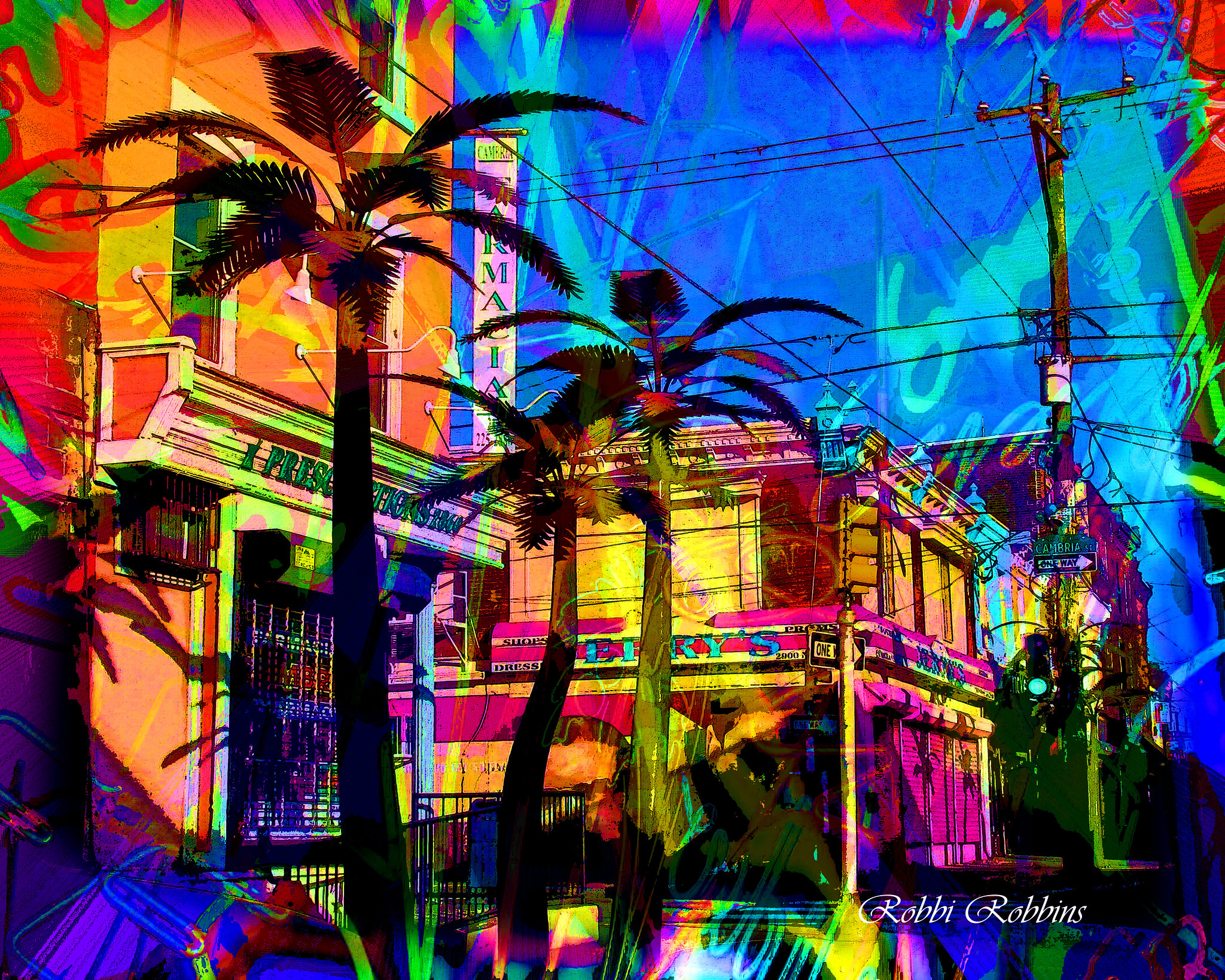
Peace in Chaos completely captured my attention, from the first second I saw this image I was drawn to it. I have a thing for roses lately but also I think the name fits the collage and represents the feeling I get from meditation and bike riding along the Pacific, after a challenging day.
I looked up the artist and found Robbi Robbins Work on Flickr with a sweet CC license, so I’ll borrow one more on his fabulous pieces and share this post her on my blog and encourage people to click on over to Robbie’s gallery and marvel at this visionary artist.
I’ve been thinking about South Florida and USA allot today and there it was, or what appears to be; Ocean Drive in South Beach. This artwork inspired me to depart from the normal and freestyle this post to convey my own good feelings of joy and happiness for United States of America on this Independence Day.
The country that inspires us all and for better or worse, leads the world. God Bless America! The land of the free and the home of the brave.
The Star-Spangled Banner
Cover of sheet music for “The Star-Spangled Banner”, transcribed for piano by Ch. Voss, Philadelphia: G. Andre & Co., 1862
O say can you see, by the dawn’s early light, What so proudly we hailed at the twilight’s last gleaming, Whose broad stripes and bright stars through the perilous fight, O’er the ramparts we watched, were so gallantly streaming? And the rockets’ red glare, the bombs bursting in air, Gave proof through the night that our flag was still there; O say does that star-spangled banner yet wave O’er the land of the free and the home of the brave?
On the shore dimly seen through the mists of the deep, Where the foe’s haughty host in dread silence reposes, What is that which the breeze, o’er the towering steep, As it fitfully blows, half conceals, half discloses? Now it catches the gleam of the morning’s first beam, In full glory reflected now shines in the stream: ‘Tis the star-spangled banner, O long may it wave O’er the land of the free and the home of the brave.
And where is that band who so vauntingly swore That the havoc of war and the battle’s confusion, A home and a country, should leave us no more? Their blood has washed out their foul footsteps’ pollution. No refuge could save the hireling and slave From the terror of flight, or the gloom of the grave: And the star-spangled banner in triumph doth wave, O’er the land of the free and the home of the brave.
O thus be it ever, when freemen shall stand Between their loved homes and the war’s desolation. Blest with vict’ry and peace, may the Heav’n rescued land Praise the Power that hath made and preserved us a nation! Then conquer we must, when our cause it is just, And this be our motto: ‘In God is our trust.’ And the star-spangled banner in triumph shall wave O’er the land of the free and the home of the brave!
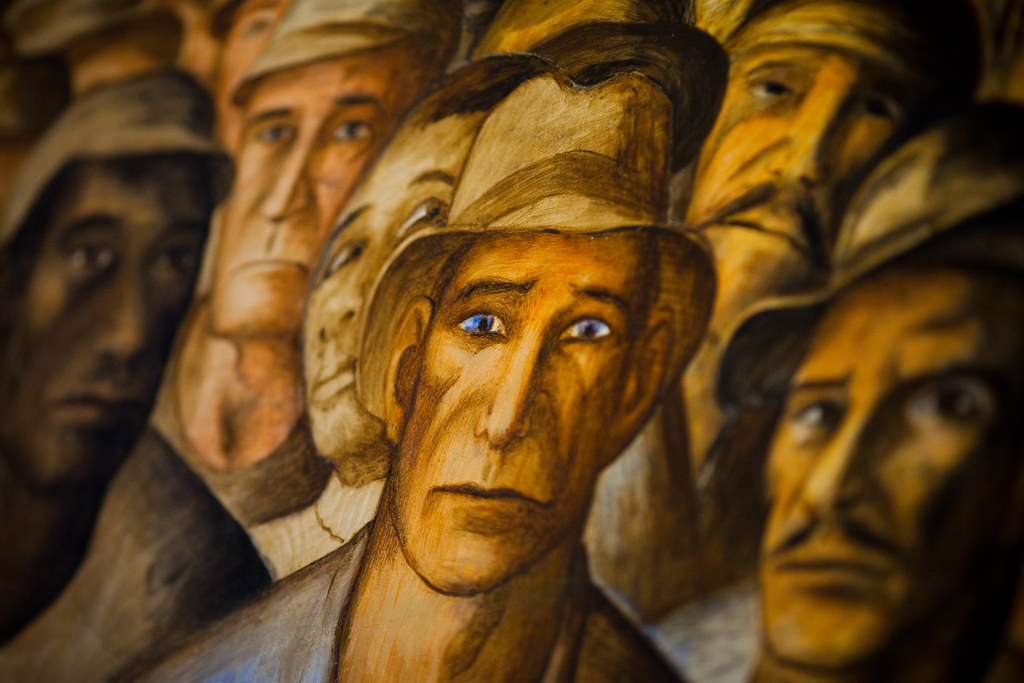
The Coit Tower murals were carried out under the auspices of the Public Works of Art Project, the first of the New Deal federal employment programs for artists. Ralph Stackpole and Bernard Zakheim successfully sought the commission in 1933, and supervised the muralists, who were mainly faculty and student of the California School of Fine Arts (CSFA), including Maxine Albro, Victor Arnautoff, Ray Bertrand, Rinaldo Cuneo, Mallette Harold Dean, Clifford Wight, Edith Hamlin, George Harris, Robert B. Howard, Otis Oldfield, Suzanne Scheuer, Hebe Daum and Frede Vidar. After Diego Rivera’s Man at the Crossroads mural was destroyed by its Rockefeller Center patrons for the inclusion of an image of Lenin, the Coit Tower muralists protested, picketing the tower. Sympathy for Rivera led some artists to incorporate leftist ideas and composition elements in their works. Bernard Zakheim’s “Library” depicts fellow artist John Langley Howard crumpling a newspaper in his left hand as he reaches for a shelved copy of Karl Marx’s Das Kapital with his right, and Stackpole is painted reading a newspaper headline announcing the destruction of Rivera’s mural; Victor Arnautoff’s “City Life” includes the The New Masses and The Daily Worker periodicals in the scene’s news stand rack; John Langley Howard’s mural depicts an ethnically diverse Labor March as well as showing a destitute family panning for gold while a rich family observes; and Stackpole’s Industries of California was composed along the same lines as an early study of the destroyed Man at the Crossroads.[4] Two of the murals are of San Francisco Bay scenes. Most murals are done in fresco; the exceptions are one mural done in egg tempera (upstairs, in the last decorated room) and the works done in the elevator foyer, which are oil on canvas. While most of the murals have been restored, a small segment (the spiral stairway exit to the observation platform) was not restored but durably painted over with epoxy surface.
Art for art sake, is one thing but for virtue and beauty is more valid, however it’s just not something taught in the mainstream. Perhaps the institutionalization of education, which started in Britain and ran the course of the world, changing private education forever and diminishing the value of art education and practice.
Art saves! Art can make anything better. If all else fails, we have art and when we are gone, there will remain art. Art exists where there is consciousness.
“Art for art’s sake” is the usual English rendering of a Frenchslogan from the early 19th century, “l’art pour l’art“, and expresses a philosophy that the intrinsic value of art, and the only “true” art, is divorced from any didactic, moral, or utilitarian function. Such works are sometimes described as “autotelic“, from the Greek autoteles, “complete in itself”, a concept that has been expanded to embrace “inner-directed” or “self-motivated” human beings.
The term is sometimes used commercially. A Latin version of this phrase, “ARS GRATIA ARTIS“, is used as a motto by Metro-Goldwyn-Mayer and appears in the circle around the roaring head of Leo the Lion in its motion picture logo.
History
“L’art pour l’art” (translated as “art for art’s sake”) is credited to Théophile Gautier (1811–1872), who was the first to adopt the phrase as a slogan in the preface to his 1835 book, Mademoiselle de Maupin. Gautier was not, however, the first to write those words: they appear in the works of Victor Cousin,[1]Benjamin Constant, and Edgar Allan Poe. For example, Poe argues in his essay “The Poetic Principle” (1850):
We have taken it into our heads that to write a poem
simply for the poem’s sake […] and to acknowledge such to have been
our design, would be to confess ourselves radically wanting in the true
poetic dignity and force: – but the simple fact is that would we but
permit ourselves to look into our own souls we should immediately there
discover that under the sun there neither exists nor can exist any work
more thoroughly dignified, more supremely noble, than this very poem,
this poem per se, this poem which is a poem and nothing more, this poem written solely for the poem’s sake.[2]
“Art for art’s sake” was a bohemiancreed in the nineteenth century, a slogan raised in defiance of those who – from John Ruskin to the much later Communist advocates of socialist realism – thought that the value of art was to serve some moral or didactic purpose. It was a rejection of the marxist aim of politicising art. “Art for art’s sake” affirmed that art was valuable as
art, that artistic pursuits were their own justification and that art
did not need moral justification – and indeed, was allowed to be morally
neutral or subversive.
In fact, James McNeill Whistler
wrote the following in which he discarded the accustomed role of art in
the service of the state or official religion, which had adhered to its
practice since the Counter-Reformation
of the sixteenth century: “Art should be independent of all claptrap –
should stand alone […] and appeal to the artistic sense of eye or ear,
without confounding this with emotions entirely foreign to it, as
devotion, pity, love, patriotism and the like.”[3]
Such a brusque dismissal also expressed the artist’s distancing himself from sentimentalism. All that remains of Romanticism in this statement is the reliance on the artist’s own eye and sensibility as the arbiter.
The explicit slogan is associated in the history of English art and letters with Walter Pater and his followers in the Aesthetic Movement, which was self-consciously in rebellion against Victorian moralism. It first appeared in English in two works published simultaneously in 1868: Pater’s review of William Morris‘s poetry in the Westminster Review and in William Blake by Algernon Charles Swinburne. A modified form of Pater’s review appeared in his Studies in the History of the Renaissance (1873), one of the most influential texts of the Aesthetic Movement.
In Germany, the poet Stefan George was one of the first artists to translate the phrase (“Kunst für die Kunst“) and adopt it for his own literary programme which he presented in the first volume of his literary magazine Blätter für die Kunst (1892). He was inspired mainly by Charles Baudelaire and the French Symbolists whom he had met in Paris, where he was friends with Albert Saint-Paul and consorted with the circle around Stéphane Mallarmé.
Criticism
Friedrich Nietzsche claimed that there is no art for art’s sake, arguing that the artist still expresses his/her being through it:
When the purpose of moral preaching and of improving man
has been excluded from art, it still does not follow by any means that
art is altogether purposeless, aimless, senseless — in short, l’art pour l’art,
a worm chewing its own tail. “Rather no purpose at all than a moral
purpose!” — that is the talk of mere passion. A psychologist, on the
other hand, asks: what does all art do? does it not praise? glorify?
choose? prefer? With all this it strengthens or weakens certain
valuations. Is this merely a “moreover”? an accident? something in which
the artist’s instinct had no share? Or is it not the very
presupposition of the artist’s ability? Does his basic instinct aim at
art, or rather at the sense of art, at life? at a desirability of life?
Art is the great stimulus to life: how could one understand it as
purposeless, as aimless, as l’art pour l’art?[4]
Criticism by Marxists
Marxists have argued that art should be politicised for the sake of transmitting the socialist message[5].
George Sand, who was a socialist writer[6][7], wrote in 1872 that L’art pour l’art
was an empty phrase, an idle sentence. She asserted that artists had a
“duty to find an adequate expression to convey it to as many souls as
possible,” ensuring that their works were accessible enough to be
appreciated.[8]
Former Senegal president and head of the Socialist Party of SenegalLeopold Senghor and anti colonial Africanist writer Chinua Achebe
have criticised the slogan as being a limited and Eurocentric view on
art and creation. In “Black African Aesthetics,” Senghor argues that
“art is functional” and that “in black Africa, ‘art for art’s sake’ does
not exist.” Achebe is more scathing in his collection of essays and
criticism entitled Morning Yet on Creation Day, where he asserts that “art for art’s sake is just another piece of deodorised dog shit” (sic).[9]
Walter Benjamin, one of the developers of Marxist hermeneutics[10], discusses the slogan in his seminal 1936 essay “The Work of Art in the Age of Mechanical Reproduction.”
He first mentions it in regard to the reaction within the realm of
traditional art to innovations in reproduction, in particular photography. He even terms the “L’art pour l’art” slogan as part of a “theology of art” in bracketing off social aspects. In the Epilogue to the essay Benjamin discusses the links between fascism and art. His main example is that of Futurism and the thinking of its mentor Filippo Tommaso Marinetti.
One of the slogans of the Futurists was “Fiat ars – pereat mundus”
(“Let art be created, though the world perish”). Provocatively, Benjamin
concludes that as long as fascism expects war “to supply the artistic
gratification of a sense of perception that has been changed by
technology,” then this is the “consummation,” the realization, of “L’art
pour l’art.”[11]
Diego Rivera, who in life was a member of the Mexican Communist Party and “a supporter of the revolutionary cause”[12],
claims that the “art for art’s sake” theory would further divide the
rich from the poor. Rivera goes on to say that since one of the
characteristics of so called “pure art” was that it could only be
appreciated by a few superior people, the art movement would strip art
from its value as a social tool and ultimately make art into a
currency-like item that would only be available to the rich. [13]
Former Chinese communist leader Mao Zedong said: “There is in fact no such thing as art for art’s sake, art that stands above classes, art that is detached from or independent of politics. Proletarian literature and art are part of the whole proletarian revolutionary cause; they are, as Lenin said, cogs and wheels in the whole revolutionary machine.
Amazing myself that Blue Star Kachina hadn’t been entered into this Blog, as you know the main purpose of my posts is to begin topics for further research and/or to keep references, videos and links for later (to myself). My hope is to return to pages and improve, update and provide more information to corroborate. Therefore, I apologize to the reader in advance, if some of the material, such as Blue Star Kachina copied from Wikipedia (as below). Note, there are many resources for Hopi knowledge.
Red Earth Consultants is a collaboration with First Nations from Canada to design and build high-tech green-homes using Insulated Concrete Forms (ICF) imported from China and assembled in British Columbia. The BC corp is strategically aligned with Port Alberni Groups to assemble homes en-mass in Canada, to address a critical housing shortage for Canada’s indigenous people. The next-generation, smart-homes are built to last, safe, strong and hi-tech with a custom west coast finish and native -art touch.
Wisdom of all indigenous people becomes more valuable as we witness climate changes and experience weather challenges on a local and regional level. Now more than ever, we will appreciate the logic of a tribe or band as can learn much about co-operation from our native friends and colleagues. First Nations deserve the title and we need to honour them as such and be grateful now, that tribes remained strong.
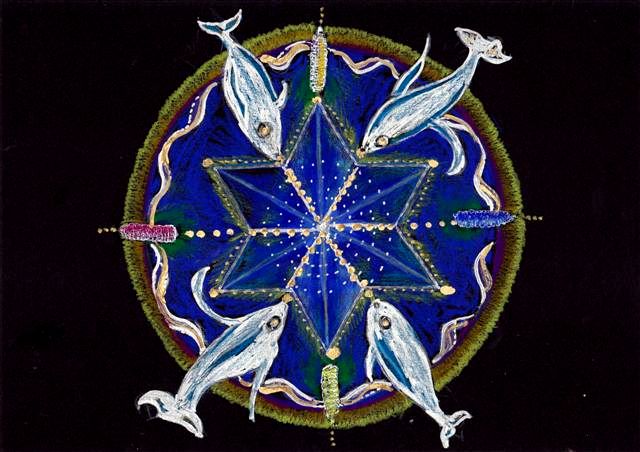
Blue Star Kachina
In Frank Waters‘s writings on Hopi mythology, the Blue Star Kachina or Saquasohuh, is a kachina or spirit, that will signify the coming of the beginning of the new world by appearing in the form of a blue star. The Blue Star Kachina is said to be the ninth and final sign before the “Day of Purification”, described as a catastrophe or a “world engulfing cataclysm” that will lead to the purification of planet Earth. Author Jason Colavito investigated this prophecy and found no reference to it before the late twentieth century.
According to Hopi prophecy (as reported by Waters), shortly after the Blue Star Kachina is visible to all and the Day of Purification is realized, the True White Brother will come to earth in search of Hopi “who steadfastly adhere to their ancient teachings.” It is said that if the True White Brother fails in his mission and is unable to find uncorrupted men and women, that the earth will be completely destroyed and none will be spared. However, if successful in bringing the symbols and finding those who still follow the true Hopi way of life, the world will be created anew and all the faithful will be saved from destruction.
Do we categorize crop circles under Art, Design, Projects or Mind? Maybe it involves all? How do you begin to explain these magnificent land tattoos? Naughty Beaver and other people can read these things like breakfast cartoons, so perhaps we should listen to what they are saying about them, besides who does not want to Learn the Truth About Crop Circles?
Let’s start with the newest beauty – Notre Dame of France, Nr Moisselles, France. Reported 1st June, 2019.Images Aéroclub Les Ailerons d’Enghien Moisselles Copyright 2019
From the onset there can only be two main considerations; man-made, or ET, on that we can agree, it either has to be one or the other. Humans put them there, or another species put them there. It’s great learning about something that has only the two variables. Let’s take a listen to what Naughty Beaver says about Crop Circles….
When gods Speak To Men. The PI Crop Circle Explained. Naughty Beaver
Personally, I can’t imagine organizing the number of people it would take to covertly make these things, while no-one was watching, doing this over such an extended period of time. Also, people have tried to fake some and are not able to bend the plant stems in such perfect unison, plus human activities are so obvious to researchers, and they can’t find proof.
This is a bad time in human history to discount any ideas provided by someone who legally calls himself Naughty Beaver, or anyone else who has some idea what the meanings of these geometric designs. Can we at least agree that these are coded messages? Also, consider that they’re created by “Extra Dimensional” or perhaps, as the eye witnesses suggest, super high-energy hovering orbs, that appear to be acting collectively as a devices to tattoo the earth, in places that humans will find, record, and decipher.
Scientific community no longer functions as it should, to investigate natural phenomena and to measure, record and hypothesize. Go-ahead; give it your best shot to explain and see if you’re institute of higher learning will grant you a scholarship to study this magnificent bread-crumb trail. Good luck!
Some of us know intuitively that it’s a meaningful and beneficent message. On a much deeper level it’s possible that when star seeds see these markings it triggers in some of us, embedded code to begin preparing for something that all crop circles seem to be telling us, a planet is coming. It’s like the High Electrical Voltage danger warning sign, it doesn’t require allot of imagination.
NOTE: The Research community is well established and contains some of the world’s smartest deductive thinkers. The best and brightest have tried to debunk or solve crop circles.
The Crop Circle Connector is just one of the best but there are many Crop Circle Hunters, let’s start learning the truth about crop circles, don’t you think we deserve to know what they say?
Creation of the Sun and Moon by Michelangelo, face detail of God.
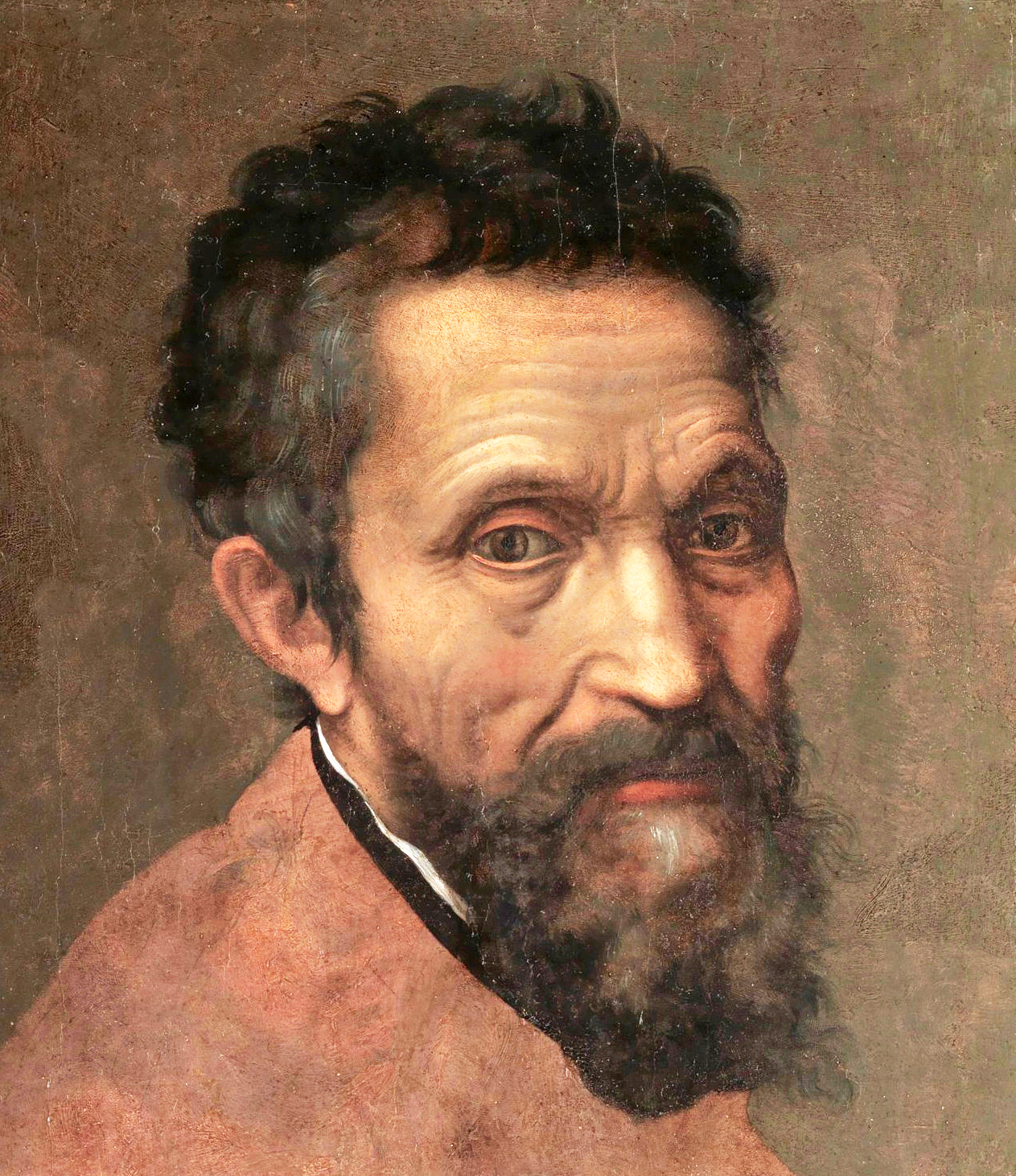
Michelangelo is the GOAT of art, sculpture and Architecture. His life and career spanned almost 100 years of creative genius on the next level. He was 74 years old when he began the Saint Peter Basilica, to claim his place as an unsurpassed architect. Michelangelo remains the greatest of all time, in more categories than anyone else in human history.
Daniele da Volterra of Michelangelo Buonarroti, probably ca. 1544
Oil on wood; 34 3/4 x 25 1/4 in. (88.3 x 64.1 cm)
The Metropolitan Museum of Art, New York, Gift of Clarence Dillon, 1977
Michelangelo di Lodovico Buonarroti Simoni or more commonly known by his first name Michelangelo (6 March 1475 – 18 February 1564) was an Italian sculptor, painter, architect and poet of the High Renaissance born in the Republic of Florence, who exerted an unparalleled influence on the development of Western art. Considered by many the greatest artist of his lifetime, and by some the greatest artist of all time, his artistic versatility was of such a high order that he is often considered a contender for the title of the archetypal Renaissance man, along with his rival, the fellow Florentine and client of the Medici, Leonardo da Vinci.
Michelangelo was the first Western artist whose biography was published while he was alive. In fact, two biographies were published during his lifetime. One of them, by Giorgio Vasari, proposed that Michelangelo’s work transcended that of any artist living or dead, and was “supreme in not one art alone but in all three”.
Detail from The Creation of Adam, portraying the creation of mankind by God
A number of Michelangelo’s works of painting, sculpture and architecture rank among the most famous in existence. His output in these fields was prodigious; given the sheer volume of surviving correspondence, sketches and reminiscences, he is the best-documented artist of the 16th century. He sculpted two of his best-known works, the Pietà and David, before the age of thirty. Despite holding a low opinion of painting, he also created two of the most influential frescoes in the history of Western art: the scenes from Genesis on the ceiling of the Sistine Chapel in Rome, and The Last Judgment on its altar wall. His design of the Laurentian Library pioneered Mannerist architecture. At the age of 74, he succeeded Antonio da Sangallo the Younger as the architect of St. Peter’s Basilica. He transformed the plan so that the western end was finished to his design, as was the dome, with some modification, after his death.
God dividing the waters, showing the illusionary architecture, and the positions of the Ignudi and shields
In his lifetime, Michelangelo was often called Il Divino (“the divine one”). His contemporaries often admired his terribilità—his ability to instil a sense of awe. Attempts by subsequent artists to imitate Michelangelo’s impassioned, highly personal style resulted in Mannerism, the next major movement in Western art after the High Renaissance.
See: The Renaissance – the Age of Michelangelo and Leonardo da Vinci
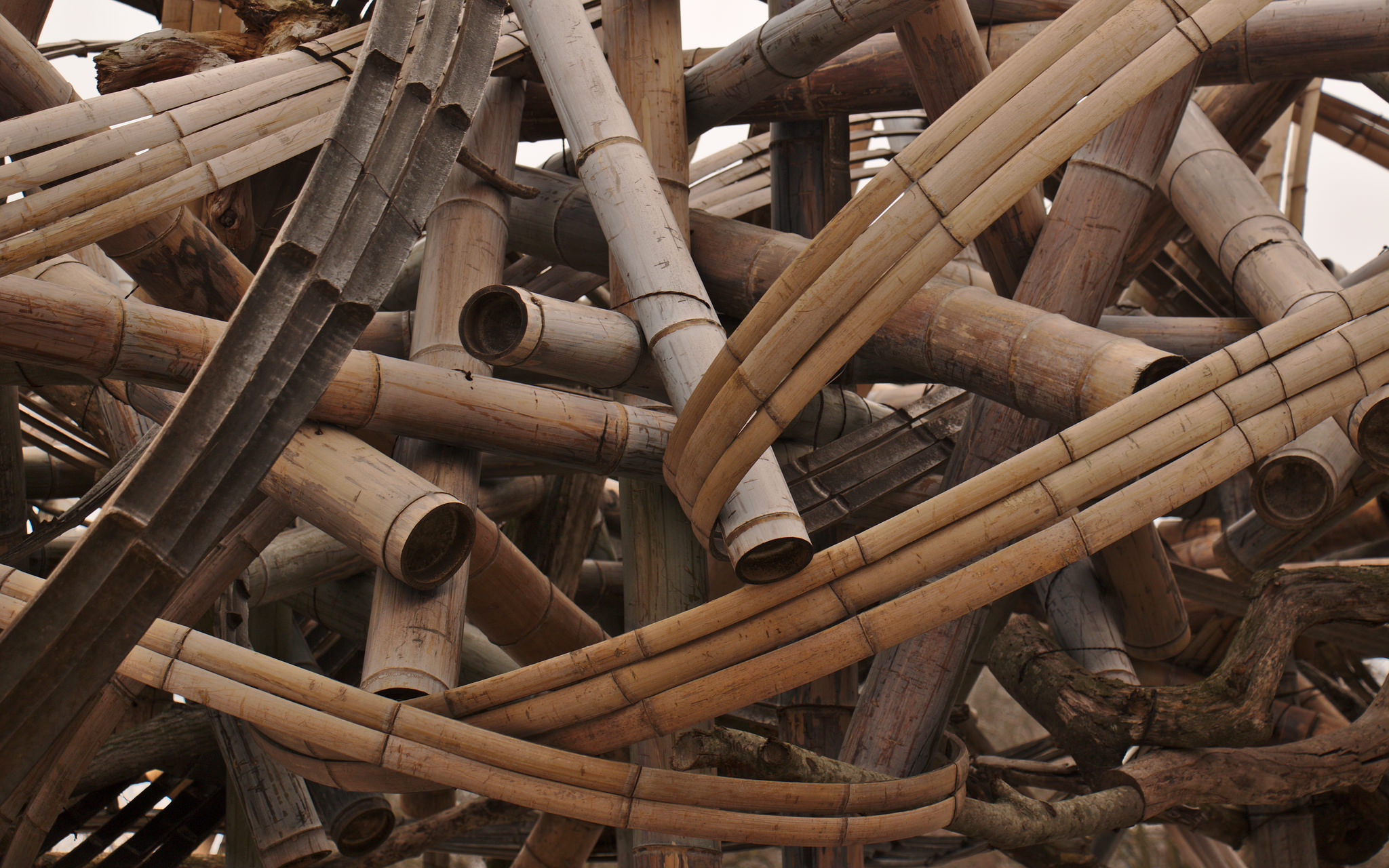
Bamboo has been used in China, India and throughout the tropics around the globe for centuries. As a construction material once you understand it’s superior qualities and it’s suitability for certain jobs, why use anything else? Maybe it’s because we don’t have bamboo growing naturally in Europe and North America and bamboo is being used in a major populated areas but often for the wrong purpose (scaffolding) and not as a design feature.
Crazy cool fact about flowering bamboo is that all plants of one species develop flowers at the same time, no matter where they are located in the world.
Bamboo is not well suited for mass producing apartment buildings, or cookie cutter box style houses en mass, since everything to do with Bamboo is custom, one stick at a time but that’s what makes it so great and unique for building with but it’s the superior quality construction material that makes it one of the most Super-Awesome plants on earth.
Bamboos seldom and unpredictably flower, and the frequency of flowering varies greatly from species to species. Once flowering takes place, a plant declines and often dies entirely. In fact, many species only flower at intervals as long as 65 or 120 years.
Any plant derived through clonal propagation from this cohort will also flower regardless of whether it has been planted in a different location. The longest mass flowering interval known is 130 years, and it is for the species Phyllostachys bambusoides (Sieb. & Zucc.). In this species, all plants of the same stock flower at the same time, regardless of differences in geographic locations or climatic conditions, and then the bamboo dies.
The lack of environmental impact on the time of flowering indicates the presence of some sort of “alarm clock” in each cell of the plant which signals the diversion of all energy to flower production and the cessation of vegetative growth. This mechanism, as well as the evolutionary cause behind it, is still largely a mystery.
Interesting facts about bamboo:
There are 1,500 species of bamboo that can be found in Asia, Australia, North and South America and Sub-Saharan Africa.
Bamboo is the fastest growing plant on the planet. Bamboo grows at 2 inches an hour. Some species grow one and a half meters a day.
Bamboo strands release 35% more oxygen than equivalent stands of trees.
Some bamboo even sequester up to 12 tons of carbon dioxide from the air per hectare.
Bamboo can also lower light intensity and protects against ultraviolet rays.
Bamboo is a pioneering plant and can be grown in soil damaged by overgrazing and poor agricultural techniques.
Bamboo’s tensile strength is 28,000 pounds per square inch versus 23,000 pounds per square inch for steel.
One clump can produce 200 poles in the three to five years.
Bamboo can be harvested in 3-5 years versus 10-20 years for most softwoods.
The largest species of bamboo can reach 130 feet in height.
Some species of bamboo develop flowers after 65 or 120 years.
A wonderful resource for understanding bamboo and bamboo treatment is Bamboo Central, founded by Linda Garland and her son, Arief Rabik.
Bamboo U and Ibuku Design from Indonesia
Bamboo U is for you if your mind is ready for the coolest school for learning bamboo construction techniques on earth. And see firsthand the work of the company Ibuku which is the bespoke luxury home designers that grew as an entrepreneurial off-shoot of Bamboo U.
Bamboo Distribution
Most bamboo species are native to warm and moist tropical and warm temperate climates, However, many species are found in diverse climates, ranging from hot tropical regions to cool mountainous regions and highland cloud forests.
In the Asia-Pacific region they occur across East Asia, from north to 50 °N latitude in Sakhalin, to south to northern Australia, and west to India and the Himalayas. China, Japan, Korea, India and Australia, all have several endemic populations. They also occur in small numbers in sub-Saharan Africa, confined to tropical areas, from southern Senegal in the north to southern Mozambique and Madagascar in the south.
In the Americas, bamboo has a native range from 47 °S in southern Argentina and the beech forests of central Chile, through the South American tropical rainforests, to the Andes in Ecuador near 4,300 m (14,000 ft). Bamboo is also native through Central America and Mexico, northward into the Southeastern United States, Canada and continental Europe are not known to have any native species of bamboo. As garden plants, many species grow readily outside these ranges, including most of Europe and the United States.
Recently, some attempts have been made to grow bamboo on a commercial basis in the Great Lakes region of east-central Africa, especially in Rwanda. In the United States, several companies are growing, harvesting, and distributing species such as Phyllostachys nigra (Henon) and Phyllostachys edulis (Moso).
Bamboo, like true wood, is a natural composite material with a high strength-to-weight ratio useful for structures.
In its natural form, bamboo as a construction material is traditionally associated with the cultures of South Asia, East Asia, and the South Pacific, to some extent in Central and South America, and by extension in the aesthetic of Tiki culture. In China and India, bamboo was used to hold up simple suspension bridges, either by making cables of split bamboo or twisting whole culms of sufficiently pliable bamboo together. One such bridge in the area of Qian-Xian is referenced in writings dating back to 960 AD and may have stood since as far back as the third century BC, due largely to continuous maintenance.
Bamboo has also long been used as scaffolding; the practice has been banned in China for buildings over six stories, but is still in continuous use for skyscrapers in Hong Kong. In the Philippines, the nipa hut is a fairly typical example of the most basic sort of housing where bamboo is used; the walls are split and woven bamboo, and bamboo slats and poles may be used as its support. In Japanese architecture, bamboo is used primarily as a supplemental and/or decorative element in buildings such as fencing, fountains, grates, and gutters, largely due to the ready abundance of quality timber.
Various structural shapes may be made by training the bamboo to assume them as it grows. Squared sections of bamboo are created by compressing the growing stalk within a square form. Arches may similarly be created by forcing the bamboo’s growth into the desired form, costing much less than it would to obtain the same shape with regular wood timber. More conventional forming methods, such as the application of heat and pressure, may also be used to curve or flatten the cut stalks.
Bamboo can be cut and laminated into sheets and planks. This process involves cutting stalks into thin strips, planing them flat, and boiling and drying the strips; they are then glued, pressed, and finished. Long used in China and Japan, entrepreneurs started developing and selling laminated bamboo flooring in the West during the mid-1990s; products made from bamboo laminate, including flooring, cabinetry, furniture, and even decorations, are currently surging in popularity, transitioning from the boutique market to mainstream providers such as Home Depot. The bamboo goods industry (which also includes small goods, fabric, etc.) is expected to be worth $25 billion by 2012. The quality of bamboo laminate varies among manufacturers and varies according to the maturity of the plant from which it was harvested (six years being considered the optimum); the sturdiest products fulfill their claims of being up to three times as hard as oak hardwood while others may be softer than standard hardwood.
Bamboo intended for use in construction should be treated to resist insects and rot. The most common solution for this purpose is a mixture of borax and boric acid. Another process involves boiling cut bamboo to remove the starches that attract insects.
Bamboo pavilion in the Shenzhen Biennale 2009
Bamboo has been used as reinforcement for concrete in those areas where it is plentiful, though dispute exists over its effectiveness in the various studies done on the subject. Bamboo does have the necessary strength to fulfil this function, but untreated bamboo will swell with water absorbed from the concrete, causing it to crack. Several procedures must be followed to overcome this shortcoming.
Several institutes, businesses, and universities are researching the use of bamboo as an ecological construction material. In the United States and France, it is possible to get houses made entirely of bamboo, which are earthquake- and cyclone-resistant and internationally certified. Three ISO standards are given for bamboo as a construction material.
In parts of India, bamboo is used for drying clothes indoors,
both as a rod high up near the ceiling to hang clothes on, and as a
stick wielded with acquired expert skill to hoist, spread, and to take
down the clothes when dry. It is also commonly used to make ladders,
which apart from their normal function, are also used for carrying
bodies in funerals. In Maharashtra, the bamboo groves and forests are called Veluvana, the name velu for bamboo is most likely from Sanskrit, while vana means forest.
Furthermore, bamboo is also used to create flagpoles for saffron-coloured, Hindu religious flags, which can be seen fluttering across India, especially in Bihar and Uttar Pradesh, as well as in Guyana and Suriname in South America.
Bamboo was used for the structural members of the India pavilion at Expo 2010 in Shanghai. The pavilion is the world’s largest bamboo dome, about 34 m (112 ft) in diameter, with bamboo beams/members overlaid with a ferro-concrete slab, waterproofing, copper plate, solar PV panels, a small windmill, and live plants. A total of 30 km (19 mi) of bamboo was used. The dome is supported on 18-m-long steel piles and a series of steel ring beams. The bamboo was treated with borax and boric acid as a fire retardant and insecticide and bent in the required shape. The bamboo sections were joined with reinforcement bars and concrete mortar to achieve the necessary lengths.
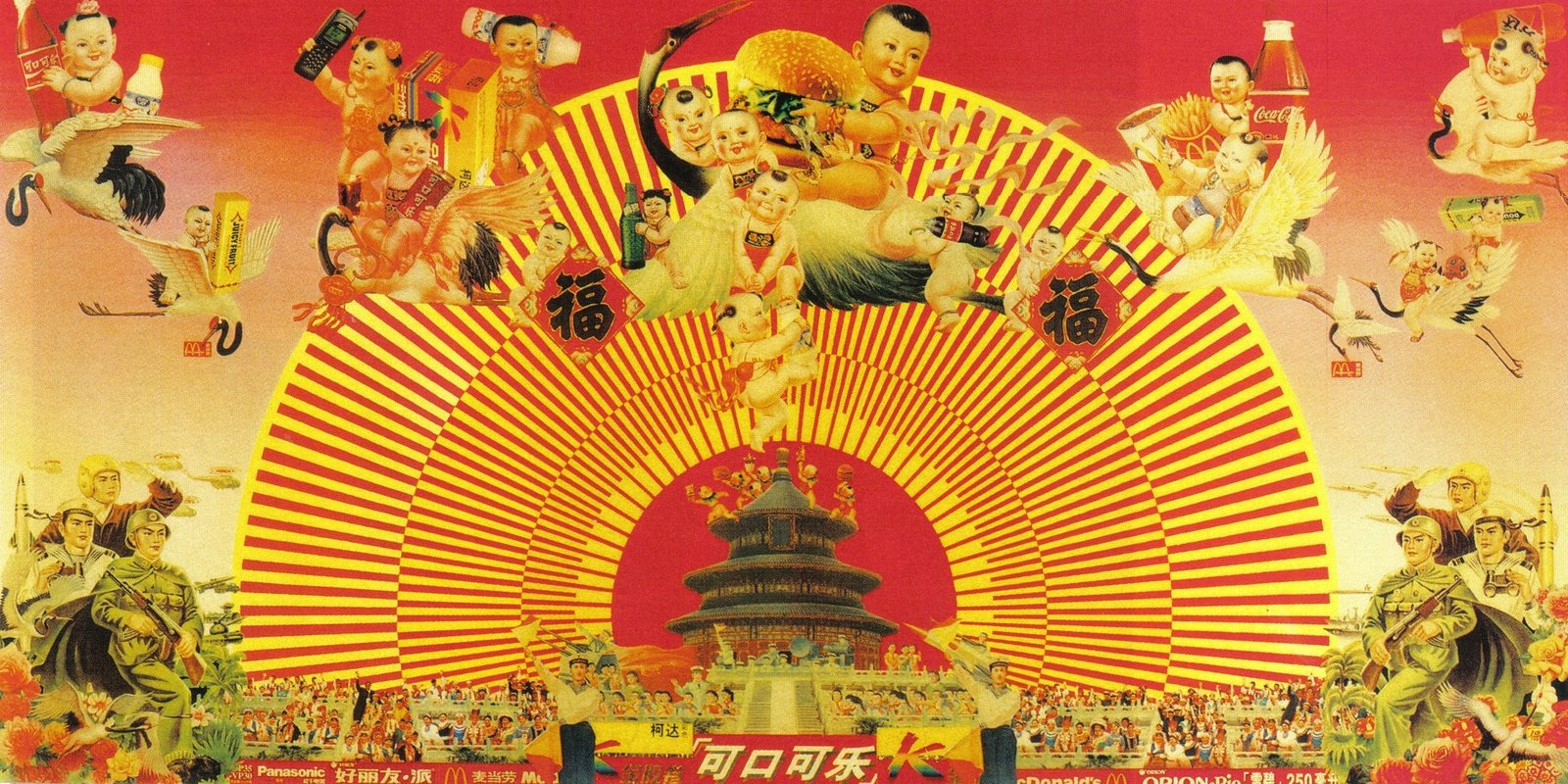
Luo Brothers – Welcome to the world’s famous brands
While waiting to meet a colleague in Hong Kong, I was served an espresso, chocolate wafer and sparkling water in small conference room of UBS, on the wall was an original Luo Brothers piece from the collection called “Welcome to the world’s famous brands. The Swiss bank UBS are the owners of a collection of paintings, photographs, drawings, sculptures and video art by some of the world’s major artists from 1960 onward and are recognized as having one of the most important corporate collections of contemporary art in the world.
Luo Brothers are a Chinese artist trio best known for their Pop Art take on propaganda and kitsch items produced during the Cultural Revolution in China. They often create collaged images in rich reds replete with flowers, chubby babies, fish, and fruit, which are then screenprinted and lacquer painted. The Luo Brothers also create painted fiberglass sculptures of children which are figures from Chinese advertisements. Consisting of three brothers, Luo Wei Dong (b. 1963), Luo Wei Bing (b. 1964), and Luo Wei Guo (b. 1972) from Nanning, China, they went on to attend the Guangxi Academy of Art, the Guangzhou Academy of Fine Art, and the Central Academy of Applied Arts.
The artists began their collaboration during the mid-1990s, and their work is meant to serve as a barometer of the socio-economic and cultural change in China rather than a critique of either Communism or Capitalism. The visibility of art by Robert Rauschenberg and Jeff Koons in China in the late 1980s proved to be a powerful influence on the Luo Brothers’ development of yansu, or “gaudy,” art. Their works are in the collections of the Denver Art Museum, the San Francisco Museum of Modern Art, and the Fukuoka Art Museum in Japan, among others. The brothers live and work in Beijing, China. Source: Artnet



















You must be logged in to post a comment.