Austin Steinbart is recent to me And to be clear, I have followed QAnon from it’s inception and always had the feeling that the information was useful and from a benevolent source. The posts were military style and evidently code written by an intelligence agency, or experts in that field. These are signals, to use the correct jargon and I wanted to learn them.
Austin Steinbart has helped me learn more about the quantum Internet and the future of information warfare by the use of “drip nurture” strategic marketing. Whether or not he is actually Q is not for debate, he doesn’t say he is and is guarded about telling the exact truth. Machiavellian for sure and if he were not, then he would be fake. If he can’t follow orders, then he wouldn’t win the position, which is to make the Q movement go public.
Q has an obsession with zero delta and time stamps to a level of precision that I’d never seen before. Having a background in online poker software, random number generators and systems to detect card cheating, it became clear, early on to me, that Q was super sophisticated and I could sense that these signals were not meant for me specifically but were aiming at an equally lethal, sophisticated enemy.
My impression as I was drawn into the content was that we are witnessing a high-stakes game of war, being conducted by AI running on quantum computers. I knew this tech was in use and heard about the release of Tyler, so it was intriguing to imagine that good versus evil was happening via quantum computing and an insane form of time-warp tactics, where the future proves the past. Austin Steinbart calls it “drip nurture”.
Part 3 of the series
Knowing as we know now, that Google is working with China and have Andreno the Quantum and Chrome the worlds most popular web browser. Therefor if the two giants team up, as it appears they have, then all the data vacuumed up by Jack Ma with Alibaba Quantum (the world’s most powerful super computer). The marriage is Andreno Chrome on Alibaba steroids when NEW AI is deployed on the top of that massive twin platform.
Elon Musk is the wildcard in the game and as hard as it may be to understand; Julian Assange and together the promise of unleashing the Nikola Tesla treasury trove of anti-gravity, free energy and frequency medicine. The man to lead us towards the disclosure is Austin Steinbart and he has a plan that includes bringing QAnon movement into the light and normalize the strategy. This is the great awakening.
Austin Steinbart is bringing the Defence Intelligence Agency (DIA) into the light and promises to represent us with honesty and integrity. The hope and promise is that Space Force will have a civilian division where a new type of keyboard warrior can help defend America from threats foreign and domestic online and that these people will have authority and support of military strike force units that can put boots at the door of a crime.
Austin Steinbart Rocks as QAnon! Give him a chance and re-think how Space Force can be a force of good in the future. Peace!
Alameda, CA – June 23, 2020: Aunt Jemima pancake mix next to a bottle of original syrup. The pancake mix debuted in 1889, the first ready mix, and became one of the most recognized names in US history
The world knew her as “Aunt Jemima,” but her given name was Nancy Green and she was a true American success story. She was born a slave in 1834 Montgomery County, KY, and became a wealthy superstar in the advertising world, as its first living trademark
Green was 56-yrs old when she was selected as spokesperson for a new ready-mixed, self-rising pancake flour and made her debut in 1893 at a fair and exposition in Chicago. She demonstrated the pancake mix and served thousands of pancakes… and became an immediate star. She was a good storyteller, her personality was warm and appealing, and her showmanship was exceptional.
Her exhibition booth drew so many people that special security personnel were assigned to keep the crowds moving. Nancy Green was signed to a lifetime contract, travelled on promotional tours all over the country, and was extremely well paid.
Her financial freedom and stature as a national spokesperson enabled her to become a leading advocate against poverty and in favour of equal rights for folks in Chicago. She was one of the very first black millionaires when she died.
General Mills bought her name and likeness from her. She maintained her job until her death in 1923, at age 89. I would bet most protesters know absolutely nothing about Nancy Green. Nancy Green was a remarkable woman… and she has just been ERASED.
Thomas Jefferson managed to achieve more remarkable accomplishments in his lifetime, than anyone I have ever heard about, except Jesus Christ.
At a time when Bibles were imported from Europe and costs a month salary, he edited and published his own book in 1802, and it’s a masterpiece. Thomas Jefferson used a scalpel and a stack of Bibles, to glue and edit his own version. Now it’s the most valuable book in the world.
In my opinion Jefferson was also an ascended master and the only man to have ever read everything of import, that was available at that time. He could read and write in many languages and was undaunted by any manuscript. There was nothing mysterious on earth that he wasn’t aware of, as his interests spanned every possible category.
Actions define a man, not the words they say and Jefferson made a book with his owns hands and it is not named the Jefferson Bible, he would be insulted to know that’s what it’s called. The real name puts shame on some people who prefer down-play the value of it’s meaning, since even the Library of Congress was once upon a time the books of Jefferson.
The Library of Congress was founded to house the collection of books donated by Thomas Jefferson to U.S. House of Representatives, and he knew it was priceless (even then). Now it’s a National Treasure and the Library of Congress is vast. In the beginning of my career the Library of Congress hosted Bulletin Board Servers, we called BBS in 1992 pre-WWW and allowed remote access to digital archives. By the people, for the people. Back then my first Domain name registration (investoffshore.com) was from the National Science Foundation and was free.
The Life and Morals of Jesus of Nazareth, commonly referred to as the Jefferson Bible, is one of two religious works constructed by Thomas Jefferson. The first, The Philosophy of Jesus of Nazareth, was completed in 1804, but no copies exist today.
Thomas Jefferson, the third President of the United States.
The second, The Life and Morals of Jesus of Nazareth, was completed in 1820 by cutting and pasting with a razor and glue numerous sections from the New Testament as extractions of the doctrine of Jesus. Jefferson’s condensed composition excludes all miracles by Jesus and most mentions of the supernatural, including sections of the four gospels that contain the Resurrection and most other miracles, and passages that portray Jesus as divine.
Jefferson Bible 1. Jefferson correction: Detail shot- on the English clipping verse 38, TJ cut out as, 65 Recto
Jefferson Bible 1. Jefferson correction: Detail shot-iron-gall ink annotations on English clippings out becomes up, 6 Recto
Jefferson Bible Close-up shots of the binding idiosyncrasie (doubled over page )
The Jefferson Bible at the Smithsonian National Museum of American History
Jefferson accomplished a more limited goal in 1804 with The Philosophy of Jesus of Nazareth, the predecessor to The Life and Morals of Jesus of Nazareth. He described it in a letter to John Adams dated October 12, 1813:
In extracting the pure principles which he taught, we should have to strip off the artificial vestments in which they have been muffled by priests, who have travestied them into various forms, as instruments of riches and power to themselves. We must dismiss the Platonists and Plotinists, the Stagyrites and Gamalielites, the Eclectics, the Gnostics and Scholastics, their essences and emanations, their logos and demiurges, aeons and daemons, male and female, with a long train of … or, shall I say at once, of nonsense. We must reduce our volume to the simple evangelists, select, even from them, the very words only of Jesus, paring off the amphibologisms into which they have been led, by forgetting often, or not understanding, what had fallen from him, by giving their own misconceptions as his dicta, and expressing unintelligibly for others what they had not understood themselves. There will be found remaining the most sublime and benevolent code of morals which has ever been offered to man. I have performed this operation for my own use, by cutting verse by verse out of the printed book, and arranging the matter which is evidently his, and which is as easily distinguishable as diamonds in a dunghill. The result is an octavo of forty-six pages, of pure and unsophisticated doctrines.
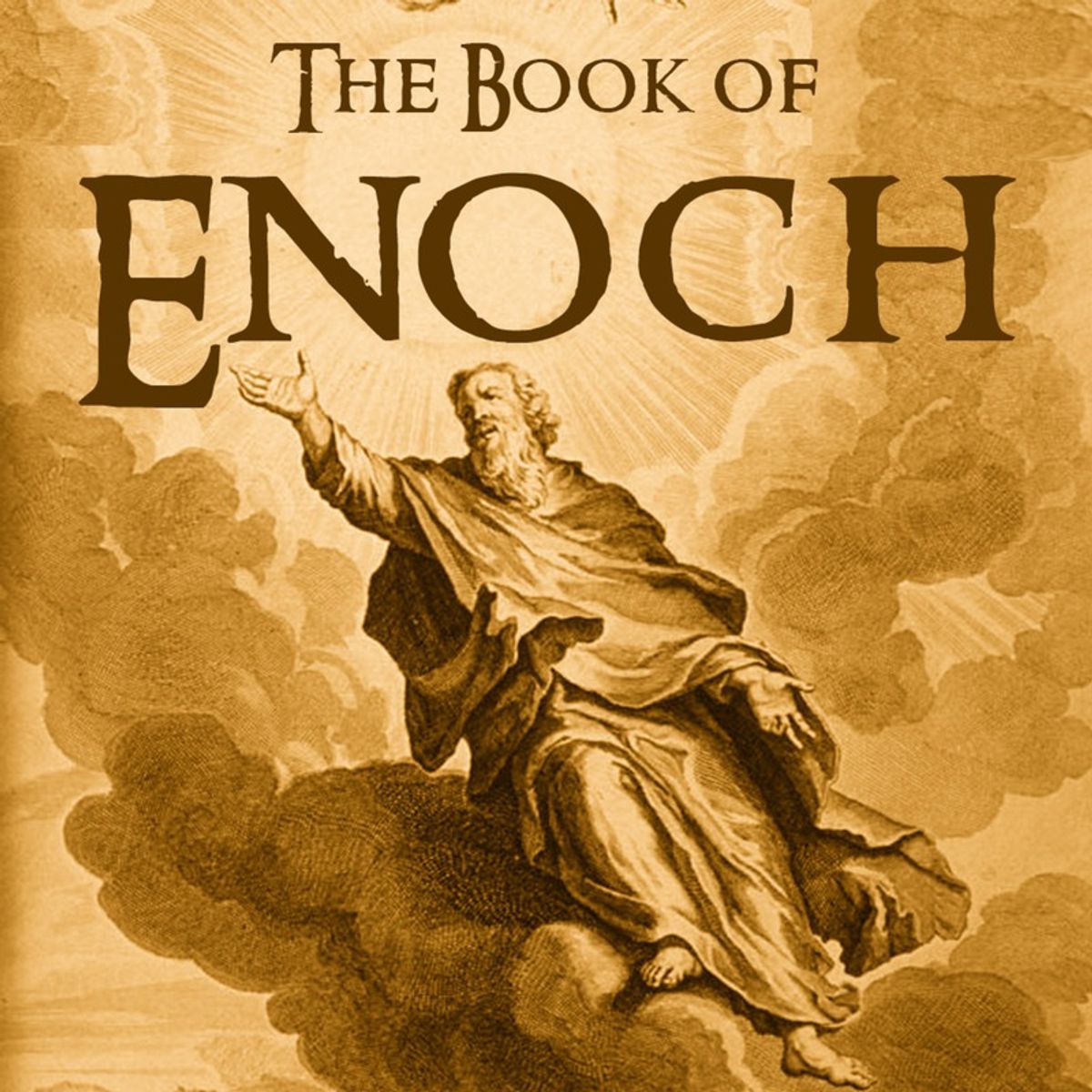
The Book of Enoch is unto itself a most important read, not only for it’s historic significance but primarily for it’s testimony of gods beyond our imaginations (without these teachings). It’s fun and easy to read, there’s many free options but here’s the main: https://book-ofenoch.com/
The Book of Enoch (also 1 Enoch; Ge’ez: መጽሐፈ ሄኖክ maṣḥafa hēnok) is an ancient Hebrewapocalyptic religious text, ascribed by tradition to Enoch, the great-grandfather of Noah.
Enoch contains unique material on the origins of demons and giants, why some angels fell from heaven, an explanation of why the Great Flood was morally necessary, and prophetic exposition of the thousand-year reign of the Messiah.
The older sections (mainly in the Book of the Watchers) of the text are estimated to date from about 300–200 BCE, and the latest part (Book of Parables) probably to 100 BCE.
Authors of the New Testament were also familiar with some content of the story. A short section of 1 Enoch (1:9) is cited in the New Testament, Epistle of Jude, Jude 1:14–15, and is attributed there to “Enoch the Seventh from Adam” (1 En 60:8), although this section of 1 Enoch is a midrash on Deuteronomy 33:2. Several copies of the earlier sections of 1 Enoch were preserved among the Dead Sea Scrolls.
It is wholly extant only in the Ge’ez language, with Aramaic fragments from the Dead Sea Scrolls and a few Greek and Latin fragments. For this and other reasons, the traditional Ethiopian belief is that the original language of the work was Ge’ez, whereas modern scholars argue that it was first written in either Aramaic or Hebrew; Ephraim Isaac suggests that the Book of Enoch, like the Book of Daniel, was composed partially in Aramaic and partially in Hebrew.
No Hebrew version is known to have survived. It is asserted in the book itself that its author was Enoch, before the Biblical Flood.
The most complete Book of Enoch comes from Ethiopic manuscripts, maṣḥafa hēnok, written in Ge’ez; which was brought to Europe by James Bruce in the late 18th century and was translated into English in the 19th century.
Book of Enoch excerpt photo credit: Extrait du Livre du Prophète Hénoc écrit dans l’ancienne langue d’Abyssine / Nord Éthiopie
Patriots from around the world are praying for AMERICA
We are all bound by a feeling deep inside, a feeling that cannot be publicly expressed for fear of ridicule, a feeling that challenges the mainstream (narrative), against that which we are told to accept and dare not question, put simply, that people are being abused by those in power and time is running out.
Remember the battles of Lexington and Concord – “Give Me Liberty or Give Me Death!”
For far too long we have been silent and allowed our bands of strength, that we once formed to defend FREEDOM and LIBERTY, to deteriorate.
We became divided. We became weak. We elected TRAITORS to govern us. We allowed EVIL to prey on us.
Those who claimed to represent us gave us false hope, made false promises. The evil and corruption only grew.
Q
This is more than party politics. This is about restoring OLD GLORY. This is about saving our land and our people from those who wish us harm. This is about preserving our REPUBLIC. This is about preserving our SAFETY. This is about restoring our STRENGTH. This is about LIFE, LIBERTY, and the PURSUIT OF HAPPINESS. This is about PROTECTING our children.
THIS IS ABOUT SAVING AMERICA
We are all God’s children. We are, FATHERS. We are, MOTHERS. We are, DAUGHTERS. We are, SONS. We are, BROTHERS. We are, SISTERS. We do not look at race. We do not look at skin color. We are UNITED in these STATES OF AMERICA. We are, and will always be, PATRIOTS. WE MUST RISE AGAIN. WE MUST UNITE AGAIN. WE MUST FIGHT AGAIN. FOR GOD & COUNTRY.
GOD BLESS AMERICA.
WWG1WGA!!! Q
Dear God, in the name of Jesus Christ, please Bless America Indeed! – A
In him was life; and the life was the light of men.
Of all the ideas ever enacted, nothing staggers the imagination for it’s achievement, than the conservation work of Douglas Tompkins.
“If anything can save the world, I’d put my money on beauty”
Douglas Tompkins
Douglas Tompkins (born 1943 in New York) was an American environmentalist and former businessman.
Douglas Tompkins was a world-renowned adventurer, entrepreneur, and conservationist. Co-founder of The North Face and Esprit, Doug spent the first half of his life building successful, global brands, while simultaneously adventuring around the world, completing first descents of the world’s toughest rivers.
In 1968 Doug embarked on a trip to Chile, driving with friends from California to the tip of Patagonia. Documented in the film Mountain of Storms, the trip solidified Doug’s place as rock climbing legend. In the early 1990s, Doug sold his part of Esprit and moved down to Chile to do conservation work full time with his wife, Kristine McDivitt Tompkins, the former CEO of Patagonia, Inc.
Together, over the last 25 years ( written 8 Jul 2016 ), Doug and Kris have protected 2.2 million acres, more land than any other individuals. The foundations under the Tompkins Conservation umbrella, along with their partners, have created five national parks in Chile and Argentina and are in the process of creating five more.
A Wild Legacy tells the story of Doug’s incredible life, his lasting impact on the wild landscapes of Patagonia, and Kris and the Tompkins Conservation team’s efforts to continue his audacious mission. Doug was tragically killed in a kayaking accident on Lago General Carrera, north of Patagonia Park, on December 8th, 2015. Douglas Tompkins: A Wild Legacy was presented to audiences at the Telluride Mountain Film Festival on May 24th, 2016 during the festival’s tribute to Doug.
Tompkins was born in Conneaut, Ohio on March 20, 1943, the son of an antiques dealer and decorator. He spent the first few years of his life in New York City before his family moved to Millbrook, New York. He graduated from Indian Mountain School, a pre-prep school in Lakeville, Connecticut, in 1957. In his senior year at Pomfret School in Connecticut, Tompkins was expelled for various minor infractions. He returned to his hometown in Millbrook, but did not graduate from high school.
Tompkins spent the years between 1960 and 1962 ski racing and rock climbing in Colorado, Europe, and South America. In 1963, Tompkins founded the California Mountaineering Guide Service. It was during this time he met Susie Russell, a casino employee who gave him a lift while hitch-hiking to Lake Tahoe. They married in 1964 in San Francisco, where Tompkins borrowed $5,000 from a bank to set up The North Face, now a global retailing company.
The North Face, Inc.
In 1964, Douglas and Susie Tompkins started The North Face, Inc. as a mail order and retail company, selling rock climbing and camping equipment. The early years set the design standard of good quality sleeping bags, backpacks, and mountaineering tents. The Tompkinses designed tents that were some of the first to avoid a pole in the middle, by using bendable rods threaded through exterior sleeves instead. This design also increased the strength of the tent because the domed shape allowed the wind to roll over it. These tents have been widely copied throughout the world. In 1966, the first The North Face store was opened; the band The Grateful Dead played at the grand opening. Two years later, Tompkins sold out his stake to Kenneth “Hap” Klopp for $50,000, using the profit to join his wife in co-founding Esprit, a fashion house. Tompkins sold The North Face with the intention of a focus on adventure film making.
Adventure film-making
In 1968, Tompkins headed off on a six-month road-adventure trip from California to Patagonia, along with Yvon Chouinard and two other climbing friends. They put up a new route on Mount Fitzroy, and made an adventure film, Mountain of Storms, about their experience. The 2010 film 180 Degrees South: Conquerors of the Useless describes a modern-day recreation of this journey and also highlights the conservation work on which Tompkins had been working.
Tompkins also became a skilled whitewater kayaker, claiming first descents of rivers in California, Africa, and South America. In addition, he was a skilled bush pilot.
Esprit
In 1968, Tompkins, his wife Susie, and her friend Jane Tise began selling girls dresses, which they had planned on the kitchen table, out of the back of a VW bus. In 1971 they incorporated the booming business under the name “Plain Jane”, which later became Esprit. By 1978, sales topped $100 million a year and the company had formed partnerships in Germany and Hong Kong. Tompkins appointed himself “image director”, developing his own marketing approach: overseeing all aspects of the company’s image, from store design to catalogue layout, while his wife served as design director.
Emerging as one of the hottest brands of the era, the company grew into a transnational company operating in 60 countries. In 1989, the Japanese art publisher Robundo published Esprit, the Comprehensive Design Principle (ISBN4947613203), which documented the all-encompassing design principles that Tompkins had created for the brand.
Growing increasingly concerned about the ecological impacts of the fashion industry, Tompkins decided to leave the business world in the late 1980s. In 1989, he sold his share of the American company back to Susie, from whom he had separated, putting most of his profits into land conservation. Subsequently, in 1989 and 1994, he sold his interests in the other Esprit entities around the world.
Land conservation
After selling his interest in Esprit, Tompkins turned his efforts toward southern Chile, where he had spent much time climbing, kayaking, and skiing, to focus on land conservation and environmental activism. He founded the Foundation for Deep Ecology in 1990, which supports environmental activism (see deep ecology), and The Conservation Land Trust in 1992, which works to protect wildlands, primarily in Chile and Argentina.
In 1993, he married Kristine L. McDivitt, a former chief executive of the Patagonia retail chain; the two worked together on conservation projects. The Tompkinses’ conservation efforts focused on preserving wild landscapes and biodiversity. After purchasing large blocks of wilderness, they worked to create national parks, believing that this governmental designation serves as the best mode of guaranteeing long-term conservation.
Pumalín Park
Tompkins’s first major conservation project was Pumalín Park in the Palena Province of Chile, an 800,000-acre (320,000 ha) area of Valdivian temperate rain forest, high peaks, lakes, and rivers. In 1991 he bought the Reñihué farm, a semi-abandoned farm at the end of the Reñihué Fjord,
planning to set aside 42,000 acres (17,000 ha) of this unique forest
from possible exploitation. In the next decade, The Conservation Land
Trust added another 700,000 acres (280,000 ha) in nearly contiguous
parcels to create Pumalín Park, which eventually stretched from the
Corcovado Gulf to the Andes mountains, over an area of 800,000 acres.
In 2005, then-president Ricardo Lagos declared this area a Nature Sanctuary, a special designation of the Chilean state, granting it additional environmental and non-developmental protection. The Conservation Land Trust (a U.S. environmental foundation) donated these protected lands to Fundación Pumalín (a Chilean foundation), for their administration and continual development as a type of National Park with public access under a private initiative. Through creating public-access infrastructure, including trails, campgrounds, visitor centers, and a restaurant, Tompkins sought to promote wilderness experience, in hopes of inspiring a deeper environmental ethic in the park’s many thousands of visitors.
In March 2017, the Chilean president Michelle Bachelet announced that the government was accepting the gift of 1 million acres from Fundación Pumalín and creating a national park covering 11 million acres in all, the largest such park in South America. At a ceremony for signing of the accord between government and the foundation, Tompkins’ long-term friend Yvon Chouinard claimed that “No other human has ever created this many acres of protected wildlands”.
Corcovado National Park
Just to the south of Pumalin, Corcovado National Park represents one of Tompkins’s completed conservation projects. In 1994, The Conservation Land Trust (CLT), along with U.S. philanthropist Peter Buckley, acquired 208,000 acres (84,000 ha) of native forest that was slated for logging, adjacent to vast areas of federal land under the jurisdiction of the Chilean Armed Forces. CLT offered to donate this parcel back to the Chilean state, provided that the whole area became a national park. In 2005, then-president Ricardo Lagos accepted this proposal, and the 726,000-acre (294,000 ha) Corcovado National Park was born.
Iberá Project
The Iberá Project was a private conservation enterprise that was spearheaded by Tompkins, working with George Soros, Harvard University, and Tompkins’ Conservation Land Trust.[19] Its goal was to expand land ownership and strengthen protection for the Iberá Wetlands natural preserve, in Corrientes Province, Argentina. The Iberá Natural Reserve, established in 1983, consisted of 553,000 hectares of protected floodplains, providing safe habitat for a range of native species, and encouraging a transition from “an exploitative economy” to “an economy of conservation and ecotourism“. Led by Tompkins, the Conservation Land Trust acquired 150,000 hectares of old cattle ranches bordering the existing natural reserve, lands that include habitats not then represented in the reserve.
In December 2015, the Trust donated these lands, including espinal, malezal grasslands, and forests, to the Argentine government to add to the reserve, creating a new, strictly-conserved national park to be called the Great Iberá Park. This new park, which would total 700,000 hectares, would be the largest national park in Argentina and home to hundreds of bird species, giant anteaters, and wild macaw parrots.
Other conservation projects
Other conservation projects that Tompkins spearheaded include:
The Melimoyu and Isla Magdalena conservation projects in coastal Chile, 200 km and 300 km respectively south of Pumalín Park
Envisioning “conservation as a consequence of production,” Tompkins developed models of sustainable organic farming, which maintain soil health and ecological integrity at the same time that they provide for families and support the local economy.
In the area around Pumalin, the Hornopiren, Vodudahue, Ventisquero, Pillan, and Reñihue farms serve as exemplars of small-scale ecological agriculture and as informal park ranger stations. Each of these farms produces a variety of products, including sheep, cattle, honey, berries, and organic vegetables. A small facility in the Pillan farm processes honey and berries for jams, which are sold under the name Pillan Organics.
In northeastern Argentina, Tompkins managed cattle ranches in Corrientes Province and polyculture grain and fruit farms in Entre Ríos Province. Each farm pays close attention to developing sustainable practices.
Environmental activism
Through
the Foundation for Deep Ecology, Tompkins published a series of
large-format, activist photograph books on environmental issues,
including:
Clearcut: The Tragedy of Industrial Forestry (ed. Bill Devall, 1993, ISBN0871564947)
Fatal Harvest: The Tragedy of Industrial Agriculture (ed. Andrew Kimbrell, 2002, ISBN1559639407)
Welfare Ranching: The Subsidized Destruction of the American West (eds. George Weurthner and Mollie Yoneko Madison, 2002, ISBN1559639423)
Wildfire: A Century of Failed Forest Policy (ed. George Weurthner, 2006, ISBN159726069X)
In addition, The Foundation for Deep Ecology had a long history as a grant-maker in categories such as Biodiversity and Wilderness, Ecological Agriculture, and Megatechnology and Economic Globalization, although in-house publishing is now its main focus.
Tompkins also was involved in several large environmental campaigns in Chile and Argentina, such as the “Patagonia Sin Represas” campaign, which opposed the construction of dams on two of the largest and wildest rivers in the Patagonia region of Chile.
Honours
Despite considerable controversy within Chile and Argentina, Tompkins’ environmental work won him respect and accolades outside of South America: in 2012, the African Rainforest Conservancy awarded Tompkins and his wife its “New Species Award”; in 2007, the International Conservation Caucus Foundation awarded its “Good Steward” award to him and his wife, Kris; in 2008, the American Alpine Club awarded him the David R. Brower Award, for his work preserving mountain regions; in 2009, Latin Trade named him the “Environmental Leader of the Year”.
In 2007, he was appointed as an honorary member of the American Society of Landscape Architects, in recognition of his work restoring damaged landscapes. Eco Barons, Edward Humes‘ 2009 account of the “dreamers, schemers, and millionaires who are saving our planet,” uses Tompkins as the first example of this new group of philanthropists.
Death
On December 8, 2015, Tompkins was kayaking with five others on General Carrera Lake
in southern Chile when strong waves caused their kayaks to capsize.
Tompkins spent a “considerable amount of time” in 40 °F (4 °C) waters.
He was flown, by helicopter, to a hospital in nearby Coyhaique, where he died hours later from severe hypothermia. He was 72 years old and survived by his second wife, Kristine (McDivitt), two daughters, brother and mother.
Tompkins is buried at a small cemetery near the Lodge at Valle Chacabuco in Parque Patagonia.
“Freedom is a two-edged sword of which one edge is liberty and the other responsibility, on which both edges are exceedingly sharp,”
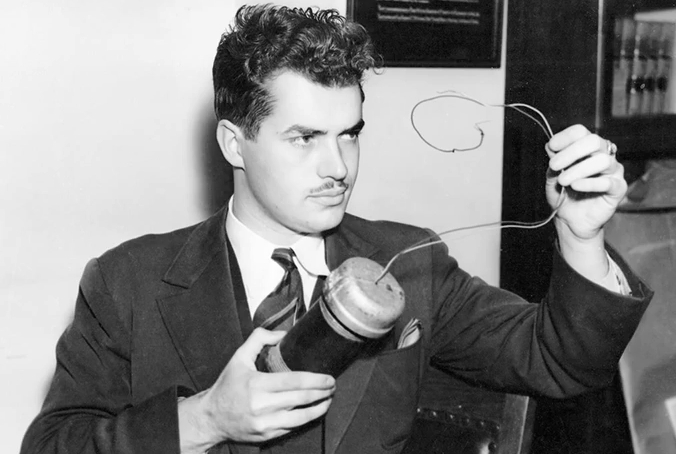
Jack Whiteside Parsons an American rocket scientist.
Jack Parsons in 1938, holding the replica car bomb used in the murder trial of police officer Captain Earl Kynette. Anonymous – Los Angeles Times. This image is published in John Carter’s Sex and Rockets: The Occult World of Jack Parsons without attribution (2004, p. 187) and appears on the front cover of George Pendle’s Strange Angel: The Otherworldly Life of Rocket Scientist John Whiteside Parsons (2005) also without a copyright notice, indicating that it is in the public domain. Los Angeles Times publicity photo of John Whiteside “Jack” Parsons during the murder trial of police officer Earl Kynette. Public Domain – Created: 30 April 1938
Self-Government is the challenge, when people are given complete freedom and coupled with free-will, in such an over-stimulated world, far too many of us will make the wrong choices too often and can’t come back from the cycle of pain and drudgery.
A return to faith is so important and understanding how far the attacks on faith have gone is fundamental to healing our society & culture.
A Course in Miracles provides software for your mind that enables it to observe concepts, theories and ideas to ask if it’s real and/or does it exist? Then compare feelings to those of peace, knowing that with this new discernment (ACIM) and assuming that you do experience peace through that test…. then conceptually anything can be explored without fear.
By hacking your moral code related to guilt and sin to expand the circumference of your own perception. Knowing everything already exists, and that all we’re really doing is bringing light of understanding to ideas. For this reason, if you have evil intentions, you’ll experience evil results. The enlightened way is more fun and less pain.
Channelling exists without a doubt, and in my mind a Course in Miracles was sent from Jesus Christ. However, believing so, doesn’t add or diminish the effectiveness of the course. The methods contained in the course are reliable, it doesn’t matter who produced them or how.
Faith is one thing but experience is another, therefore you must personally validate your own true happiness. Perhaps you need an Aleister Crowley type experience like Babalon Working in order to understand who you are, why you’re here and what your purpose might be.
Jack Parsons is a fascinating man that died far too young and before he could share his discoveries, which may have subverted the entire Babalon Working project, as it certainly turned macabre, as we’re told in the recent stunning revelations shared in a video by STG report.
The Babalon Working was a series of magic ceremonies or rituals performed from January to March 1946 by author, pioneer rocket-fuel scientist, and occultist Jack Parsons and Scientology founder L. Ron Hubbard. This ritual was essentially designed to manifest an individual incarnation of the archetypal divine feminine called Babalon. The project was based on the ideas of Aleister Crowley, and his description of a similar project in his 1917 novel Moonchild.
There’s so much more to our universe than we can begin to comprehend, which is why the framework contained in A Course in Miraclesactually work, albeit a little heavy in forgiveness, whereas some of the entities we learn to exist deserve zero forgiveness. In spiritual battle it’s all, or nothing.
Evil exists, it’s natural and necessary to free will, which is fundamental to liberty. The key is that the power of the light of love is embedded in the universe itself, whether we be a thought in the mind of God, a controlled play like in the matrix, or just random chaos, the fact is; energy is coming from somewhere, and therein lays the ray of love and beauty.
Who cares where the ray comes from, we want the love, each one of us, from the first gasp, to the last breath. We all want what we want, which is more of what makes us feel happy. This is where self-government needs to come in, since evidently, we are not evolved enough to live in peace.
Some people prefer to rage against the machine than face the daunting work of upgrading themselves to adapt to a world that changed around them, faster than they could adjust. Plus, science and technology replaced the majority of the workforce and food growing skills and knowledge deleted and removed from the equation. So now it’s zombie time.
Worst thing of all that has happened, somehow or another, is a sense of entitlement that our Government has a responsibility to solve everything, feed and shelter the sick and help immigrants while keeping the law and order, here and all over the world. We’ve become a nanny state.
As in all things of nature, every dog has it’s day. What’s a great day for the dog, may not be so great for the tick that’s been burrowing into the dog but none the less everything must return from where it came. The question is; do you prefer to go singing and dancing, or kicking and screaming?
In the early 1990s, psychedelic advocate and ethnobotanist Terence McKenna published his book Food of the Gods in which he surmised that homo sapiens’ cognitive leap forward was due to their discovery of magic mushrooms.
Can’t get rid of Terence McKenna in my mind lately, then it dawned on me that the reason I’m meant to write about him, is that someone is meant to learn about Stoned Ape Theory. After all, if conscientiousness works in the way, then there’s a reader out there who needs to know.
Singularity was the reason I had started thinking about Terence McKenna, so recently I kept reminding myself to go back and learn more myself, about this great thinker, since I want to understand what compelled him to devote so much of his life to the i-Ching and what did he learn, besides that singularity was in the future.
The I Ching or Yi Jing, also known as Classic of Changes or Book of Changes, is an ancient Chinese divination text and the oldest of the Chinese classics. There’s a study, that requires study, before you study. Still, the singularity concept is just so far ahead of anyone else and yet he found it from something written in the way distant past.
The I Ching uses a type of divination called cleromancy, which produces apparently random numbers. Six numbers between 6 and 9 are turned into a hexagram, which can then be looked up in the I Ching book, arranged in an order known as the King Wen sequence.
The interpretation of the readings found in the I Ching is a matter of centuries of debate, and many commentators have used the book symbolically, often to provide guidance for moral decision making as informed by Confucianism, Taoism and Buddhism. The hexagrams themselves have often acquired cosmological significance and paralleled with many other traditional names for the processes of change such as yin and yang and Wu Xing.
The amount of work that Terrence McKenna produced in lifetime is staggering and especially at a time when he would have been met with maximum resistance to much of what he was ascribing.
McKenna formulated a concept about the nature of time based on fractal patterns he claimed to have discovered in the I Ching, which he called novelty theory,[3][5] proposing this predicted the end of time, and a transition of consciousness in the year 2012.[5][6][7][8] His promotion of novelty theory and its connection to the Maya calendar is credited as one of the factors leading to the widespread beliefs about 2012 eschatology.[9] Novelty theory is considered pseudoscience.[10][11]
60 meters taller than Mount Robson, standing at 4019 meters, Mount Waddington is the 3rd tallest mountain in British Columbia, after Mount Fairweather and Quincy Adams peaks on the Alaskan border. The mountain also has the second highest prominence in BC, at 3289 meters. Standing at the head of the Bute and Knight Inlets, the mountain is surrounded by such rugged, remote terrain that it is rare to even be able to see the peak.Mount Waddington Photo credit Kevin Teague (kteague)
Thank YouTube for giving us such an amazing platform for Left Coast Media, even if YT made mistakes with censorship and for unfair practices (towards some content creators) we can forgive them, or we never would see the Levi Allen video of a Man Riding a Walmart Raft off a 1000 ft. Waterfall.
Left Coast Media and the Slacklife Series was something I stumbled on today as I was seeking BC sailing videos and for the first time saw Levi Allen, and totally dug his style immediately.
The falls were named in 1947 after a Chilcotin Chief named Hana-lin, who used to fish below the falls in the autumn with a fish trap, and trap game nearby. In the 1930s it was sometimes called Mystery Falls and before that occasionally called Bella Coola Falls
Left Coast Media and the Slacklife Series create content that takes you into these incredible super natural places.
Royal Rife was famous for inventing a machine that could defeat cancer using Maxwell’s equations and crystals. Sadly for humanity, it was about that time of formation and rise to prominence of the American Medical Association (AMA) and the Federal Drug Administration (FDA), both biology based.
The scientific breakthrough work, to match pathogens to frequency, was proven by Royal Rife but his science was terminated and the man himself character-assassinated and run out of the country.
Royal Raymond Rife, June 1931 – Popular Science Magazine
Crystals and Maxwell’s equations are in the news again, and a similar invention for curing cancer. A Silicon Valley start-up company called Theranos and a founder, woman by the name of Elizabeth Holmes is the next Royal Rife to be ended.
The reason I mention Maxwell’s equations is in the title is because he’s the first scientist to observe, measure and calculate the math involved in wave dynamics, here’s how it happens to be in the news and views.
Maxwell’s equations describe how electric and magnetic fields are generated by charges, currents, and changes of the fields. An important consequence of the equations is that they demonstrate how fluctuating electric and magnetic fields propagate at a constant speed (c) in a vacuum.
Known as electromagnetic radiation, these waves may occur at various wavelengths to produce a spectrum of light from radio waves to γ-rays. The equations are named after the physicist and mathematician James Clerk Maxwell, who between 1861 and 1862 published an early form of the equations that included the Lorentz force law. Maxwell first used the equations to propose that light is an electromagnetic phenomenon.
The equations have two major variants. The microscopic Maxwell equations have universal applicability but are unwieldy for common calculations. They relate the electric and magnetic fields to total charge and total current, including the complicated charges and currents in materials at the atomic scale.
The “macroscopic” Maxwell equations define two new auxiliary fields that describe the large-scale behaviour of matter without having to consider atomic scale charges and quantum phenomena like spins. However, their use requires experimentally determined parameters for a phenomenological description of the electromagnetic response of materials.
In a geomagnetic storm, a surge in the flux of charged particles temporarily alters Earth’s magnetic field, which induces electric fields in Earth’s atmosphere, thus causing surges in electrical power grids. (Not to scale.)
In fact, Einstein developed special and general relativity to accommodate the invariant speed of light, a consequence of Maxwell’s equations, with the principle that only relative movement has physical consequences.
Since the mid-20th century, it has been understood that Maxwell’s equations are not exact, but a classical limit of the fundamental theory of quantum electrodynamics.
























You must be logged in to post a comment.