
I feel compelled to begin blogging again, since I have some ideas and information I’d like to share and also want to keep a few things posted here for myself. Actually, I’ve always thought the best thing about blogging was to collect information that makes me pleased that it’s been added.
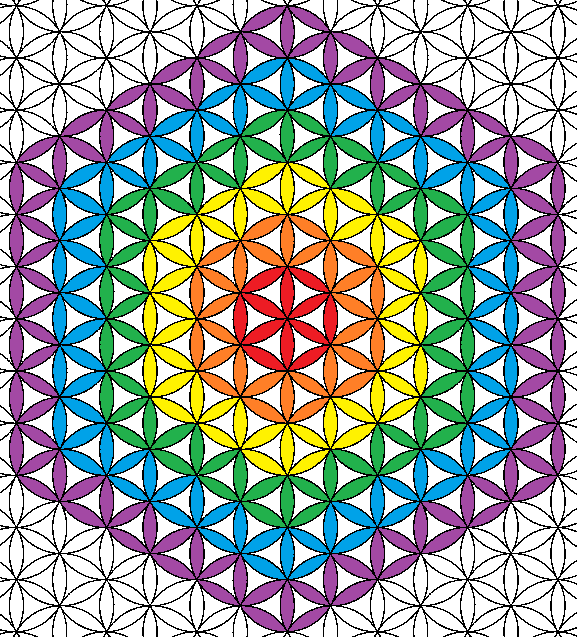
The Flower of Life has been partly what prompted me to make this post, as rumour has it, that particulates had been reported, containing this design, or similar, in the very molecular structure of the dust that had dropped.
The name “Flower of Life” is modern, associated with the New Age movement, and commonly attributed specifically to Drunvalo Melchizedek in his book The Ancient Secret of the Flower of Life (1999).
Cultural significance
Near East
The oldest known occurrence of the “overlapping circles” pattern is dated to the 7th or 6th century BCE, found on the threshold of the palace of Assyrian king Aššur-bāni-apli in Dur Šarrukin (now in the Louvre).
The design becomes more widespread in the early centuries of the Common Era. One early example are five patterns of 19 overlapping circles drawn on the granite columns at the Temple of Osiris in Abydos, Egypt, and a further five on column opposite the building. They are drawn in red ochre and some are very faint and difficult to distinguish. The patterns are graffiti, and not found in natively Egyptian ornaments. They are mostly dated to the early centuries of the Christian Era although medieval or even modern (early 20th century) origin cannot be ruled out with certainty, as the drawings are not mentioned in the extensive listings of graffiti at the temple compiled by Margaret Murray in 1904..
Similar patterns were sometimes used in England as apotropaic marks to keep witches from entering buildings. Consecration crosses indicating points in churches anointed with holy water during a churches dedication also take the form of overlapping circles.

A girih pattern that can be drawn with compass and straight edge

Window cage at Topkapı Palace, using pattern
| Further information: Girih |
In Islamic art, the pattern is one of several arrangements of circles (others being used for fourfold or fivefold designs) used to construct grids for Islamic geometric patterns. It is used to design patterns with 6- and 12-pointed stars as well as hexagons in the style called girih. The resulting patterns however characteristically conceal the construction grid, presenting instead a design of interlaced strapwork.
Europe
Patterns of seven overlapping circles are found on a Cypro-Archaic cup of the 8th-7th century BC in Cyprus] and Roman mosaics, for example at Herod’s palace in the 1st century BC. They are also found in the Hindu temple at Prambanan in Java. The design is found on one of the silver plaques of the Late Roman hoard of Kaiseraugst (discovered 1961). It is later found as an ornament in Gothic architecture, and still later in European folk art of the early modern period.
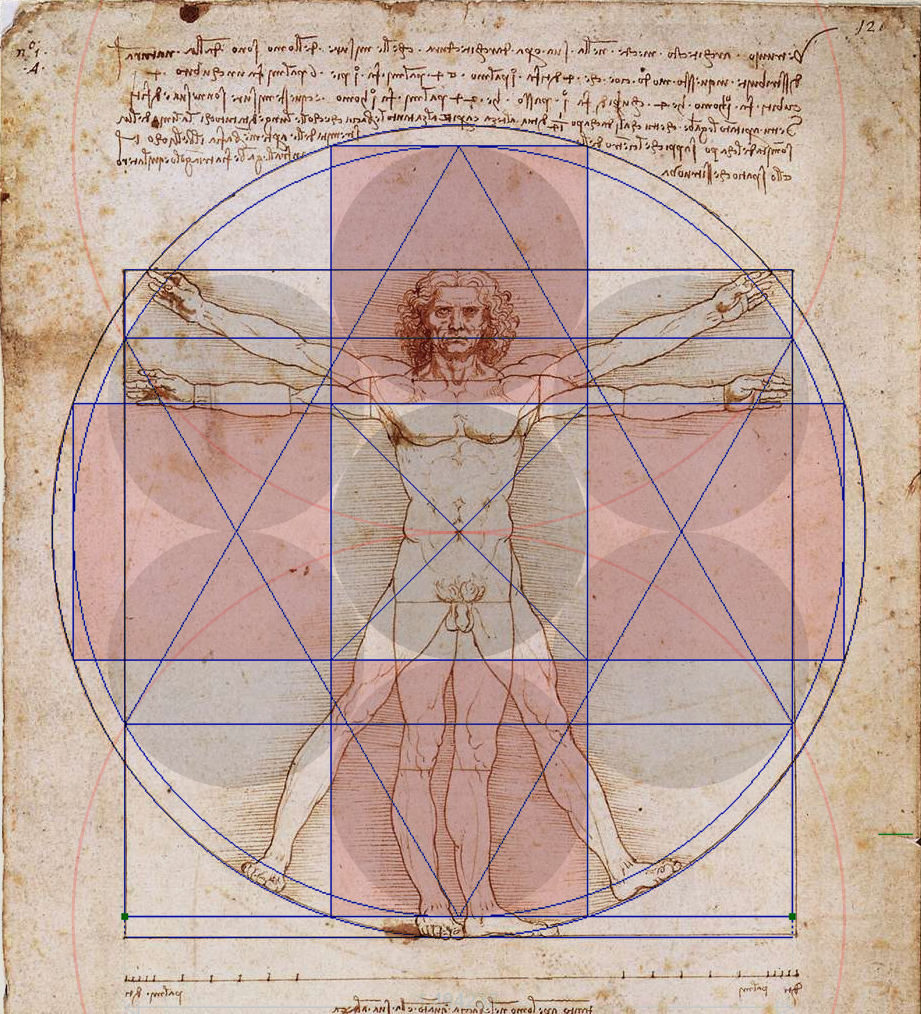
High medieval examples include the Cosmati pavements in Westminster Abbey (13th century). Leonardo da Vinci explicitly discussed the mathematical proportions of the design.
Modern usage

19-circle with arcs
Pendant, silver, ⌀ 27 mm
(commercial product, 2013)
The pattern and modern name have propagated into wide range of usage in popular culture, in fashion, jewelry, tattoos and decorative products. The pattern in quilting has been called diamond wedding ring or triangle wedding ring to contrast it from the square pattern. Besides an occasional use in fashion, it is also used in the decorative arts. For example, the album Sempiternal (2013) by Bring Me the Horizon uses the 61 overlapping circles grid as the main feature of its album cover, whereas the album A Head Full of Dreams (2015) by Coldplay features the 19 overlapping circles grid as the central part of its album cover. Teaser posters illustrating the cover art to A Head Full of Dreams were widely displayed on the London Underground in the last week of October 2015.
The “Sun of the Alps” (Italian Sole delle Alpi) symbol has been used as the emblem of Padanian nationalism in northern Italy since the 1990s. It resembles a pattern often found in that area on buildings.
 in it’s 15th edition since 2009 and originally published in 1994. A major part of the book is about sacred geometry. Sacred geometry is in everything, everywhere. Once you start to see it, you see it often but it probably never crossed your mind that it could be used as code, or software to unlock your mind. The core idea of “Nothing to something” (the original title) is to accelerate our planetary ascent into higher consciousness.
You must be logged in to post a comment.