First Nations Art is something I want to learn more about, so I decided to create this page and begin gathering information about the various artists and mediums of art from Native Artisans in Canada.
Anyone who knows me, knows that I like the work of Emily Carr and occasionally visit her collection in a permanent exhibit of the Vancouver Art Gallery. It wasn’t until recently that began thinking about collecting First Nations Art myself.
Haida Gwaii
The northern Pacific Northwest Coast, showing the position of the archipelago in relation to other islands in the region. The southern half of Prince of Wales Island is Kaigani Haida territory, but is not included in the term Haida Gwaii.
Haida Gwaii is considered by archaeologists as an option for a Pacific coastal route taken by the first humans migrating to the Americas from the Bering Strait. At this time Haida Gwaii was likely not an island, but connected to Vancouver Island and the mainland via the now submerged continental shelf.
It is unclear how people arrived on Haida Gwaii, but archaeological sites have established human habitation on the islands as far back as 13,000 years ago. Populations that formerly inhabited Beringia expanded into northern North America after the Last Glacial Maximum, and gave rise to Eskimo-Aleuts and Na-Dené Indians.
Underwater archaeologists from the University of Victoria are seeking to confirm that stone structures discovered in 2014 on the seabed of Hecate Strait may date back 13,700 or more years ago and be the earliest known signs of human habitation in Canada. Coastal sites of this era are now deep underwater
Mar is short for Mary Anne, or so my Mom tells me so. Mar was born in 1935 and became my mother in 1961. She’s the most amazing soul, always seeking things that others have overlooked. Recognizing value in art with an eye for style and a natural tendency to discover treasures. Mar finds art and second hand goods that improve or enhance the houses of her friends and family. A constant source of new used furniture, equipment and art, or the person to discover appliance or furniture for someone who needs something for home improvement. If there’s a “Restore or Value Village” she knows where but it’s her art collection that’s impressive containing a mix of original painting and sketches, plus several prints from Canadian artists including Emily Carr.
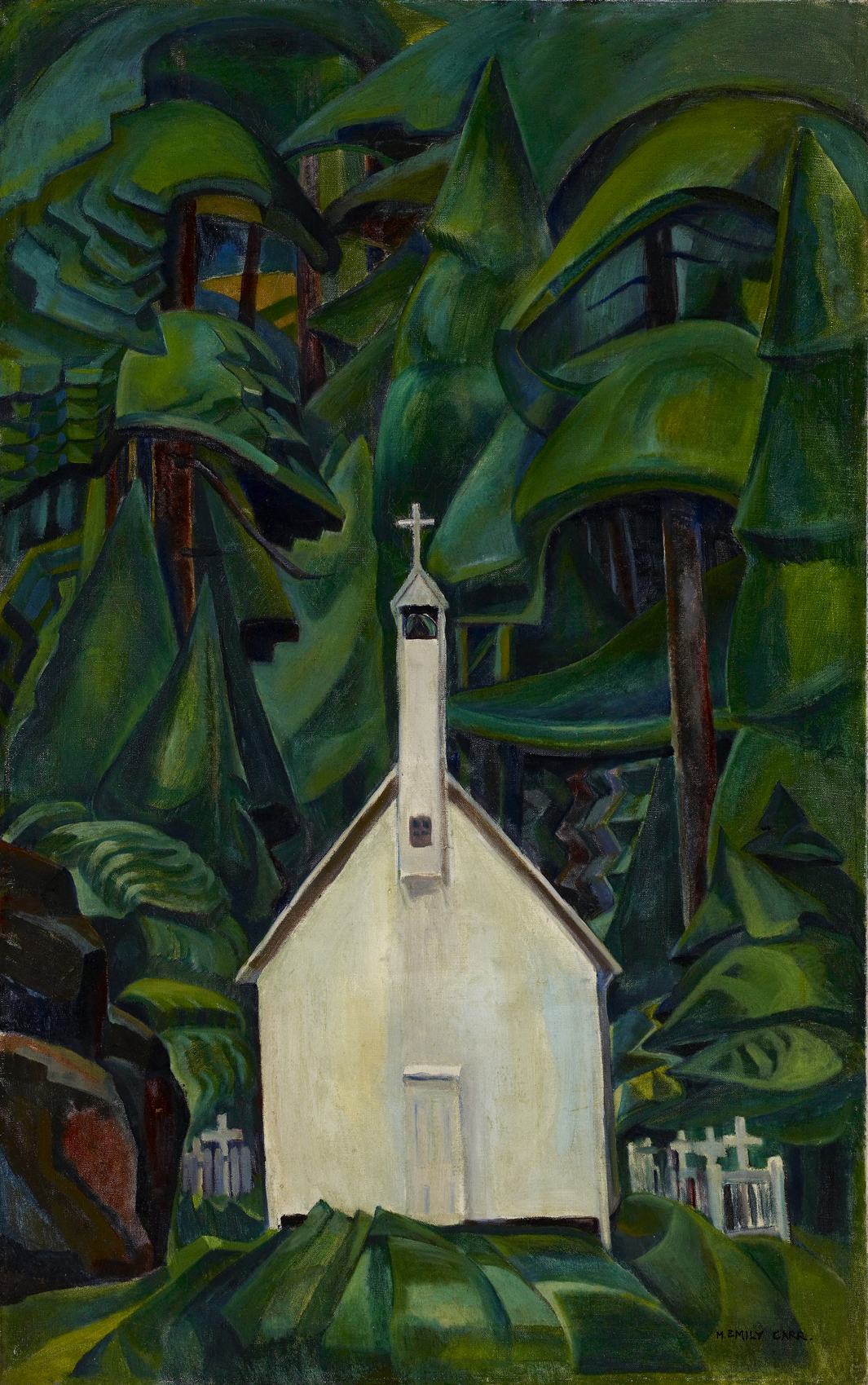
Mar keeps an entire collection of Emily Carr books and reviews of her large collection. Emily Carr has always been Mar’s favorite and reminds us of the story of Emily Carr’s life, before she became a famous artist. Recently Mar had to replace one of her favorite prints, of the painting that made Emily Carr famous; The Indian Church
Emily Carr – Wikipedia
The Indian Church is a 1929 painting by Canadian artist Emily Carr.Group of Seven artist Lawren Harris bought the painting to showcase it in his dining room, and called it Carr’s best work. In 1930, the work was shown in the Fifth Annual Exhibition of Canadian Art organised by the National Gallery of Canada. In 1938, the painting was chosen for an exhibition titled A Century of Canadian Art, at the Tate Gallery. The exhibition was described by Vincent Massey as “a most representative showing of Canadian painting and sculpture, including all schools and all periods.” It is considered a “transitional” painting because it reflects the transition of Carr’s artistic work from purely depicting Native Art to shifting her focus toward the land.
In her autobiography, Carr wrote that she “felt the subject deeply”. She painted it at Friendly Cove, near a lighthouse. When Carr saw her painting in Harris’s home, she exclaimed: “The house must have bewitched this thing! It was better than I had thought.” However she could not look at it, because she could not accept praise from other people, and felt embarrassed when others complimented her about her work. The painting is one of Carr’s most reproduced works, and was eventually donated to the Art Gallery of Ontario by Charles Band.
Creation
In the spring of 1929, Carr travelled by train through Vancouver Island to Port Alberni from where she went by steamer to Nootka Island. There she sketched, among other subjects, a white church that was in the area. When she returned to Victoria, she started painting crosses around the church, creating the impression of a graveyard. In the painting, she omitted adding any other buildings near the church, as was the case with the actual church, to emphasise the isolation of the church within its green environment. She also added an element of danger in the form of wavy dark green undergrowth erupting in front of the church.



You must be logged in to post a comment.