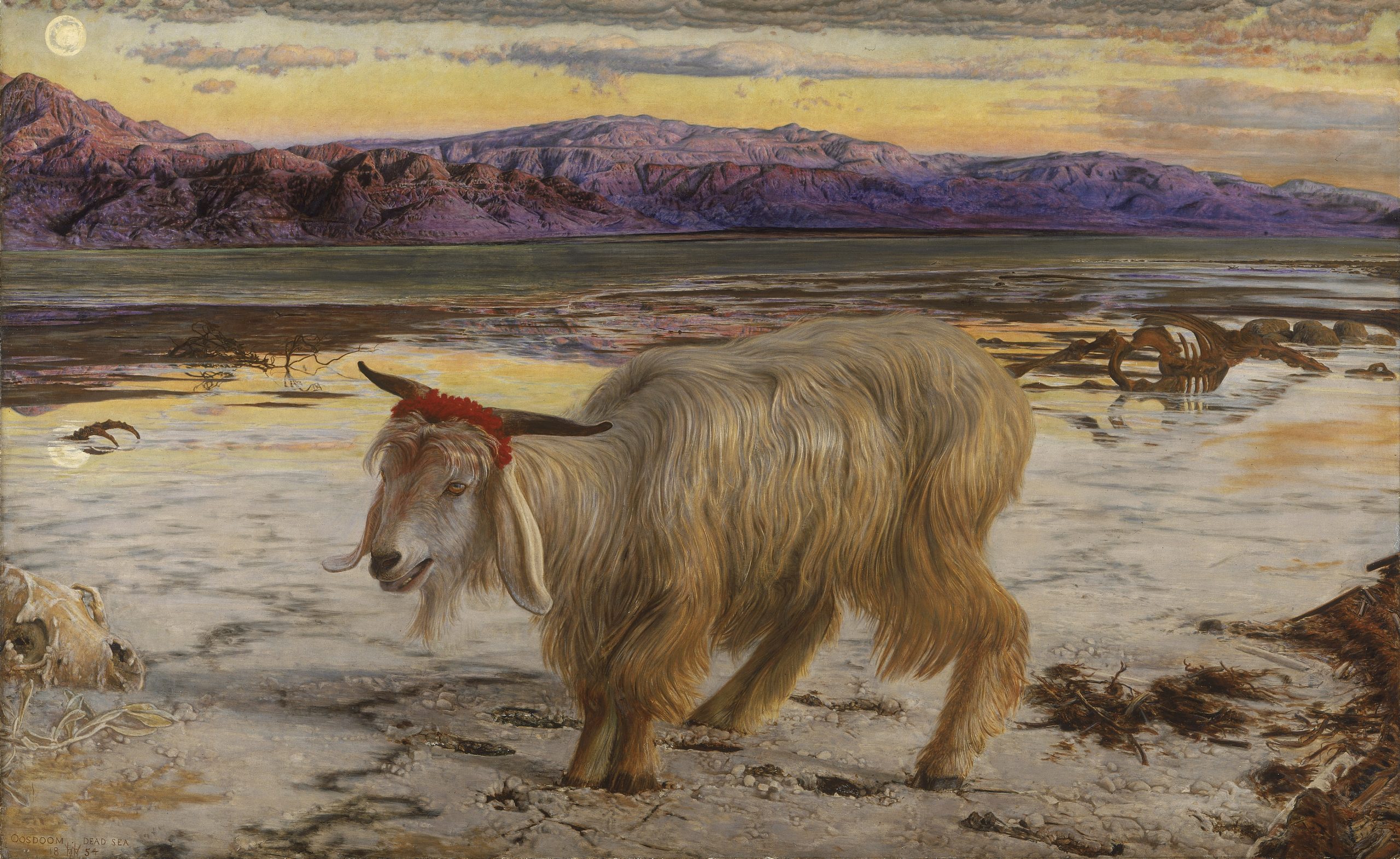
The Book of Leviticus (/lɪˈvɪtɪkəs/) is the third book of the Torah and of the Old Testament; scholars generally agree that it developed over a long period of time, reaching its present form during the Persian Period between 538–332 BC. Today I was revisiting these scriptures and decided to share, interesting history of from the brother of Aaron. (click on the scapegoat 🙂
Most of its chapters (1–7, 11–27) consist of God’s speeches to Moses, which God commands Moses to repeat to the Israelites. This takes place within the story of the Israelites’ Exodus after they escaped Egypt and reached Mt. Sinai (Exodus 19:1). The Book of Exodus narrates how Moses led the Israelites in building the Tabernacle (Exodus 35–40) with God’s instructions (Exodus 25–31). Then in Leviticus, God tells the Israelites and their priests how to make offerings in the Tabernacle and how to conduct themselves while camped around the holy tent sanctuary. Leviticus takes place during the month or month-and-a-half between the completion of the Tabernacle (Exodus 40:17) and the Israelites’ departure from Sinai (Numbers 1:1, 10:11).
The Yanov Torah rescued from the Holocaust as presented to seminary students at InterSem 2009 in Malibu, CA
The instructions of Leviticus emphasize ritual, legal and moral practices rather than beliefs. Nevertheless, they reflect the world view of the creation story in Genesis 1 that God wishes to live with humans. The book teaches that faithful performance of the sanctuary rituals can make that possible, so long as the people avoid sin and impurity whenever possible. The rituals, especially the sin and guilt offerings, provide the means to gain forgiveness for sins (Leviticus 4–5) and purification from impurities (Leviticus 11–16) so that God can continue to live in the Tabernacle in the midst of the people.
The Tabernacle and the Camp (19th-century drawing)
The English name Leviticus comes from the Latin Leviticus, which is in turn from the Ancient Greek: Λευιτικόν, Leuitikon, referring to the priestly tribe of the Israelites, “Levi.” The Greek expression is in turn a variant of the rabbinicHebrewtorat kohanim, “law of priests”, as many of its laws relate to priests.
Thomas Jefferson managed to achieve more remarkable accomplishments in his lifetime, than anyone I have ever heard about, except Jesus Christ.
At a time when Bibles were imported from Europe and costs a month salary, he edited and published his own book in 1802, and it’s a masterpiece. Thomas Jefferson used a scalpel and a stack of Bibles, to glue and edit his own version. Now it’s the most valuable book in the world.
In my opinion Jefferson was also an ascended master and the only man to have ever read everything of import, that was available at that time. He could read and write in many languages and was undaunted by any manuscript. There was nothing mysterious on earth that he wasn’t aware of, as his interests spanned every possible category.
Actions define a man, not the words they say and Jefferson made a book with his owns hands and it is not named the Jefferson Bible, he would be insulted to know that’s what it’s called. The real name puts shame on some people who prefer down-play the value of it’s meaning, since even the Library of Congress was once upon a time the books of Jefferson.
The Library of Congress was founded to house the collection of books donated by Thomas Jefferson to U.S. House of Representatives, and he knew it was priceless (even then). Now it’s a National Treasure and the Library of Congress is vast. In the beginning of my career the Library of Congress hosted Bulletin Board Servers, we called BBS in 1992 pre-WWW and allowed remote access to digital archives. By the people, for the people. Back then my first Domain name registration (investoffshore.com) was from the National Science Foundation and was free.
The Life and Morals of Jesus of Nazareth, commonly referred to as the Jefferson Bible, is one of two religious works constructed by Thomas Jefferson. The first, The Philosophy of Jesus of Nazareth, was completed in 1804, but no copies exist today.
Thomas Jefferson, the third President of the United States.
The second, The Life and Morals of Jesus of Nazareth, was completed in 1820 by cutting and pasting with a razor and glue numerous sections from the New Testament as extractions of the doctrine of Jesus. Jefferson’s condensed composition excludes all miracles by Jesus and most mentions of the supernatural, including sections of the four gospels that contain the Resurrection and most other miracles, and passages that portray Jesus as divine.
Jefferson Bible 1. Jefferson correction: Detail shot- on the English clipping verse 38, TJ cut out as, 65 Recto
Jefferson Bible 1. Jefferson correction: Detail shot-iron-gall ink annotations on English clippings out becomes up, 6 Recto
Jefferson Bible Close-up shots of the binding idiosyncrasie (doubled over page )
The Jefferson Bible at the Smithsonian National Museum of American History
Jefferson accomplished a more limited goal in 1804 with The Philosophy of Jesus of Nazareth, the predecessor to The Life and Morals of Jesus of Nazareth. He described it in a letter to John Adams dated October 12, 1813:
In extracting the pure principles which he taught, we should have to strip off the artificial vestments in which they have been muffled by priests, who have travestied them into various forms, as instruments of riches and power to themselves. We must dismiss the Platonists and Plotinists, the Stagyrites and Gamalielites, the Eclectics, the Gnostics and Scholastics, their essences and emanations, their logos and demiurges, aeons and daemons, male and female, with a long train of … or, shall I say at once, of nonsense. We must reduce our volume to the simple evangelists, select, even from them, the very words only of Jesus, paring off the amphibologisms into which they have been led, by forgetting often, or not understanding, what had fallen from him, by giving their own misconceptions as his dicta, and expressing unintelligibly for others what they had not understood themselves. There will be found remaining the most sublime and benevolent code of morals which has ever been offered to man. I have performed this operation for my own use, by cutting verse by verse out of the printed book, and arranging the matter which is evidently his, and which is as easily distinguishable as diamonds in a dunghill. The result is an octavo of forty-six pages, of pure and unsophisticated doctrines.




You must be logged in to post a comment.