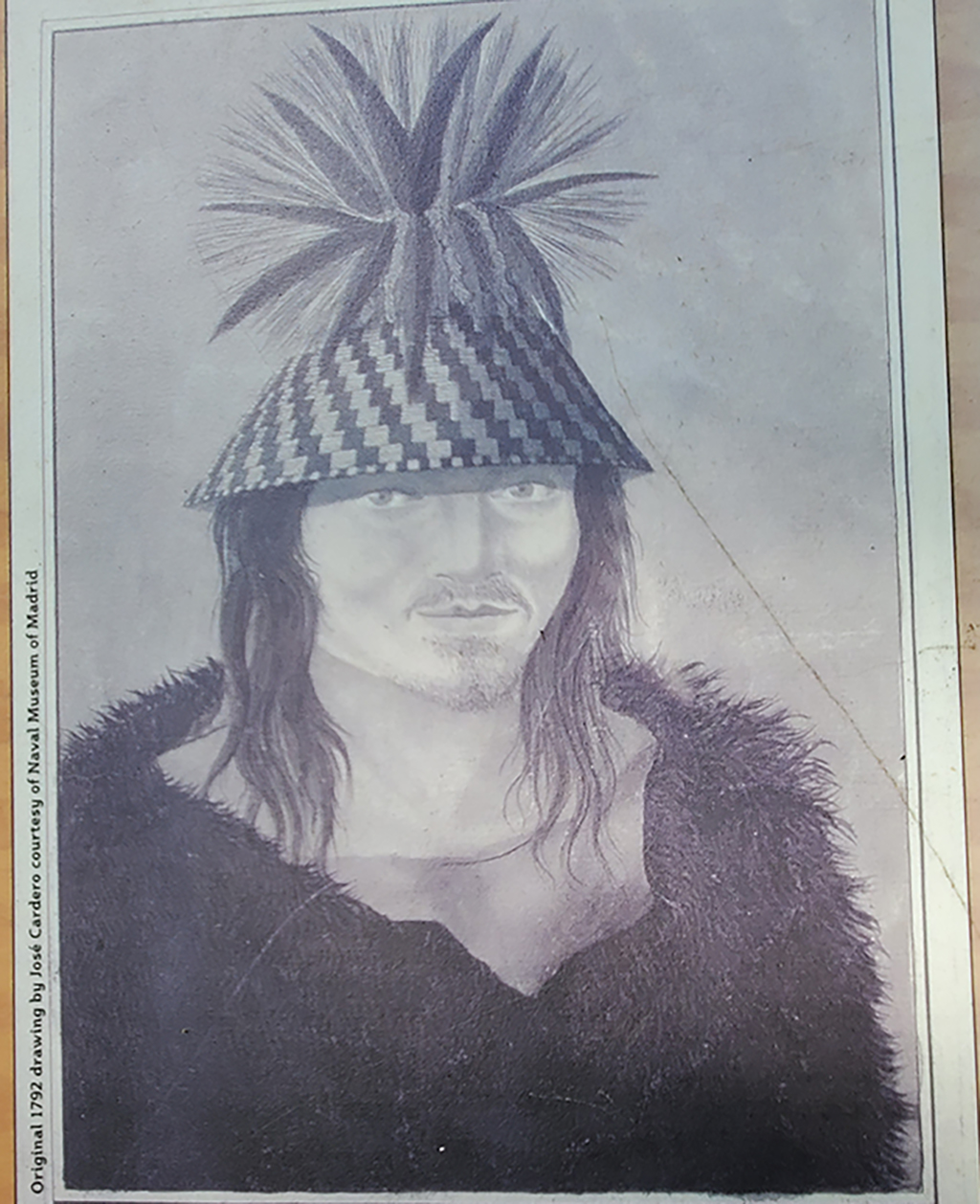

Qeyapaplanewx demands respect and deserves to be honored. Over 300 years ago Vancouver was his Kingdom, he was the Chief of the Musqueam Nation.

His place marker overlooks the Pacific from a perch above the cliffs and if it were not for a memorial he’d be all but forgotten. Not anymore because I will always have this page to remind me, and anyone else who stumbles upon it, that a man’s face tells an important story and this chief’s tale is epic.
So I searched out Qeyapaplanewx online and found a story of his European vacation and subsequent return to Canada, via Toronto, after 280 years.

Centuries-old sketch comes home
Little-known work showing Musqueam chief made in 1792 by Spanish cabin boy
ROD MICKLEBURGH
From Wednesday’s Globe and Mail
June 4, 2008 at 6:05 AM EDT
VANCOUVER — He stares at us from centuries past, a clear, unflinching gaze attesting to his status as a great warrior chief of the Musqueam. Strands of long, dark hair curl past his shoulders and he wears a stylish conical cedar hat adorned with feathers.
Call him Qeyapaplanewx. That we know about him at all is thanks to a young Spanish cabin boy with an agile sketch pen who drew the Musqueam chief during a visit by his country’s navy to the waters off Point Grey in June of 1792.
As such, he is the first identified resident of what has long been Canada’s third-largest city, on lands once fished and hunted solely by the Musqueam.
Yet Jose Cardero’s remarkable drawing, squirrelled away for years in a dark storage area of the Naval History Museum in Madrid, is virtually unknown in Vancouver.
This image of Qeyapaplanewx has sat for years in the storage area of a Madrid museum.
Not any more. Yesterday, the portrait came back – or at least a version of it.
In a ceremony on Qeyapaplanewx’s old stomping grounds (aka Vancouver City Hall) that stirred bittersweet native emotions, Spain’s ambassador to Canada presented vivid, framed replicas of Mr. Cordero’s historic sketch to the city and to the Musqueam band.
Struck by the majesty of the little-seen portrait, viewers hoped that the Musqueam chief might now achieve some of the prominence of the city’s non-native namesake, Captain George Vancouver, who was in the harbour on his own ship at the same time as Mr. Cordero made his drawing.
“Capt. Vancouver had artists, too, but they ignored the natives,” said historian Robin Inglis.
Musqueam lawyer Jim Reynolds suggested the portrait be used on the front of the city’s tourist brochures. “It’s a reminder that we have a tremendous history that all of us should cherish. I’m surprised it’s so little known.”
Band councillor Howard Grant, wearing a business suit with no conical cedar cap in sight, claimed to be a descendant of the Musqueam leader from long ago.
“I remember meeting my great-uncle who was 106 when he died in 1954. So he’d have been born in 1848, and his grandfather would have been there when the Spanish came,” said Mr. Grant, 62.
“So the warrior chief would have been my great, great ancestor.
“Now, we can loop it all back to 2008. The drawing has a dramatic significance for us. Is this not clear evidence that we used to own all our territory? It makes me proud.”
Former chief Delbert Guerin called the replica an amazing depiction of the 18th-century Musqueam warrior.
“It makes me very happy to have this. I only even heard about this picture a couple of years ago. To me this a very honourable day.”
But Mr. Guerin said his joy is tempered by the portrait’s unspoken indication of how much the band has lost since the Spaniards and British arrived.
“It’s a reminder of all that has taken place, so there’s a strong sense of loss. This is still our unceded territory, and I think our chief would have been very disappointed at what has happened.”
The gift from Spanish Ambassador Mariano Alonso-Buron was also a reminder of the almost-forgotten presence of Spain in the early days of West Coast exploration.
While Capt. Vancouver and Captain James Cook, who first met B.C. natives at Nootka on Vancouver Island in 1778, are celebrated by local historians and residents alike, few know that most of the early charting of the West Coast was carried out by Spanish mapmakers.
During June of 1792, for instance, there was perhaps the city’s first traffic jam, as Capt. Vancouver’s vessel was joined by two Spanish naval ships in Burrard Inlet.
But the British had staying power, as reflected by Capt. Vancouver’s immediate renaming of the point where the University of B.C. and many mansions are today as Point Grey.
The Spanish had called the imposing peninsula Langara, a name that lives on in a few city locations, including Langara Community College.
Not many know that such well-known place names as the city’s Spanish Banks, Tofino, Port Alberni, Galiano, Valdes Island and Malaspina stem from the early Spanish naval explorers who prowled up and down the coast for the last 50 years of the 18th century.
Even Jose Cordero, the cabin boy-turned-artist, is remembered by the Strait of Cordero, which runs between the north of Vancouver Island and the mainland.
“With this drawing, he will always have a local significance,” said Mr. Inglis, the historian. “His subject, the Musqueam chief, is the first known citizen of what is now Vancouver.”

You must be logged in to post a comment.