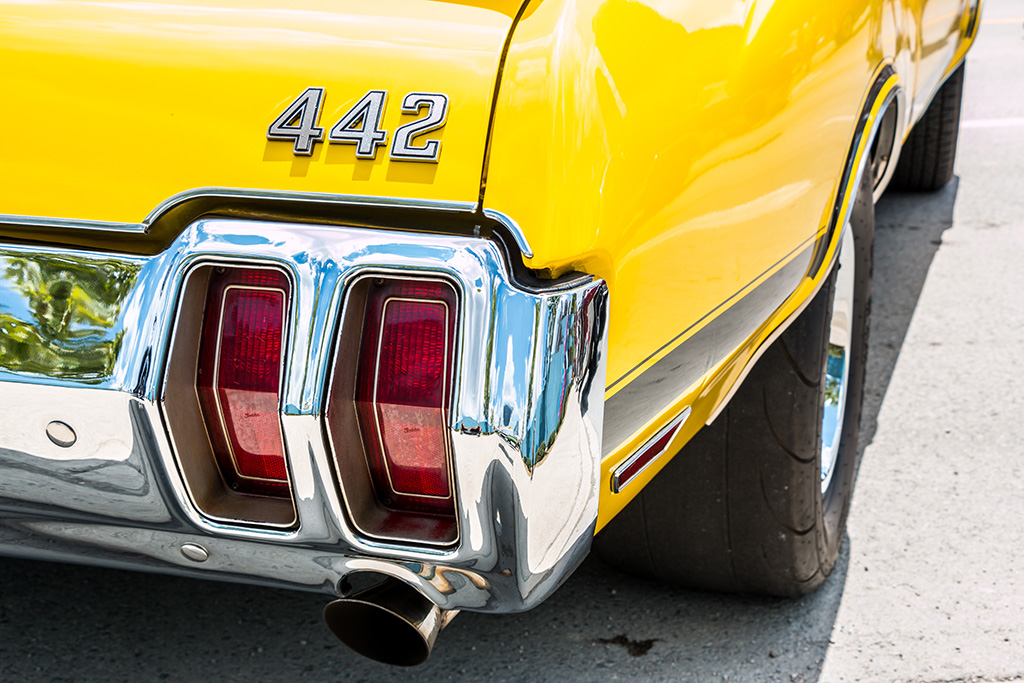

Whenever I see the time on a digital clock of 4:42 I think of my good friend Kim. He was a couple years older than me and in high-school he was the guy we looked up to. Kim had the hottest girlfriends, lived in the best neighbourhood, in the best house, with the best pool. On top of everything else, Kim was cool and he also owned the coolest muscle car; a 442.

Oldsmobile 442
Oldsmobile 442 – began as a 1964 muscle car option package (4-barrel carburetor, 4-speed manual transmission, and 2 exhausts) on the F-85/Cutlass. In 1965, to better compete with the Pontiac GTO, the original 330 CID V8 rated at 310 hp (231 kW) was replaced by a new 400 CID V8 rated at 345 hp (257 kW).
The 442 definition was changed to “4” hundred CID V8 engine, “4”-barrel carburetor, and “2” exhaust pipes, and was named by “Car Craft Nationals” as the “top car of 1965”. In 1968 the 442 became its own model and got a larger, 455 CID (7.5 L), V8 engine in 1970.


The Oldsmobile 4-4-2 (also known as the 442) is a muscle car produced by Oldsmobile between the 1964 and 1987 model years. Introduced as an option package for US-sold F-85 and Cutlass models, it became a model in its own right from 1968 to 1971, spawned the Hurst/Olds in 1968, then reverted to an option through the mid-1970s. The name was revived in the 1980s on the rear-wheel drive Cutlass Supreme and early 1990s as an option package for the new front-wheel drive Cutlass Calais.
The “4-4-2” name (pronounced “Four-four-two”) derives from the original car’s four-barrel carburetor, four-speed manual transmission, and dual exhausts (Some maintain that the ‘2’ indicated a limited-slip differential). It was originally written “4-4-2” (with badging showing hyphens between the numerals), and remained hyphenated throughout Oldsmobile’s use of the designation.
Beginning in 1965, the 4-4-2s standard transmission was a three-speed manual along with an optional two-speed automatic and four-speed manual, but were still badged as “4-4-2″s. Because of this change, from 1965 on, according to Oldsmobile brochures and advertisements, the 4-4-2 designation referred to the 400 cubic inch engine, four-barrel carburetor, and dual exhausts.
By 1968 badging was shortened to simply “442”, but Oldsmobile brochures and internal documents continued to use the “4-4-2” model designation.


You must be logged in to post a comment.